

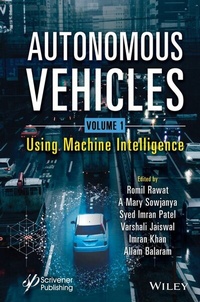
Autonomous Vehicles, Volume 1
Description

Addressing the current challenges, approaches and applications relating to autonomous vehicles, this groundbreaking new volume presents the research and techniques in this growing area, using Internet of Things (IoT), Machine Learning (ML), Deep Learning, and Artificial Intelligence (AI).
This book provides and addresses the current challenges, approaches, and applications relating to autonomous vehicles, using Internet of Things (IoT), machine learning, deep learning, and Artificial Intelligence (AI) techniques. Several self-driving or autonomous ("driverless") cars, trucks, and drones incorporate a variety of IoT devices and sensing technologies such as sensors, gyroscopes, cloud computing, and fog layer, allowing the vehicles to sense, process, and maintain massive amounts of data on traffic, routes, suitable times to travel, potholes, sharp turns, and robots for pipe inspection in the construction and mining industries.
Few books are available on the practical applications of unmanned aerial vehicles (UAVs) and autonomous vehicles from a multidisciplinary approach. Further, the available books only cover a few applications and designs in a very limited scope. This new, groundbreaking volume covers real-life applications, business modeling, issues, and solutions that the engineer or industry professional faces every day that can be transformed using intelligent systems design of autonomous systems. Whether for the student, veteran engineer, or another industry professional, this book, and its companion volume, are must-haves for any library.
More details
Other editions
Additional editions
Persons
Romil Rawat, PhD, is an assistant professor at Shri Vaishnav Vidyapeeth Vishwavidyalaya, Indore. With over 12 years of teaching experience, he has published numerous papers in scholarly journals and conferences. He has also published book chapters and is a board member of two scientific journals. He has received several research grants and has hosted research events, workshops, and training programs. He also has several patents to his credit.
A Mary Sowjanya, PhD, is a faculty member in the Department of Computer Science and Systems Engineering at Andhra University, India. She has three patents to her credit and has more than 70 research publications. She also received the "Young Faculty Research Fellowship Award" under the Viswerayya program from the government of India.
Syed Imran Patel, is a lecturer, education program manager, and lead internal verifier at Bahrain Training Institute, HEC, EDUC-Information System Training Programs, Ministry of Education, Bahrain. With his expertise, he contributes to the Quality Assurance Committee, the Grade and Credit Transfer Committee, and the Curriculum Development Committee.
Varshali Jaiswal, PhD, is an assistant professor at Vellore Institute of Technology, Bhopal, India. She has over 12 years of experience in the field of academics. She has published more than seven papers in international journals and conferences.
Imran Khan, is a faculty member at the Bahrain Training Institute, Higher Education Council, Ministry of Education, Bahrain. Before this, he was a lecturer at Sirt University, Ministry of Education, Libya, and an assistant professor at Osmania University.
Allam Balaram, PhD, is a professor in the Department of Information Technology, MLR Institute of Technology, India. A professional with over 16 years of teaching experience and over eight years of research and development experience, he has published 17 papers.
Content
Preface xiii
1 Anomalous Activity Detection Using Deep Learning Techniques in Autonomous Vehicles 1
Amit Juyal, Sachin Sharma and Priya Matta
1.1 Introduction 2
1.1.1 Organization of Chapter 2
1.2 Literature Review 3
1.3 Artificial Intelligence in Autonomous Vehicles 7
1.4 Technologies Inside Autonomous Vehicle 9
1.5 Major Tasks in Autonomous Vehicle Using AI 11
1.6 Benefits of Autonomous Vehicle 12
1.7 Applications of Autonomous Vehicle 13
1.8 Anomalous Activities and Their Categorization 13
1.9 Deep Learning Methods in Autonomous Vehicle 14
1.10 Working of Yolo 17
1.11 Proposed Methodology 18
1.12 Proposed Algorithms 20
1.13 Comparative Study and Discussion 21
1.14 Conclusion 23
References 23
2 Algorithms and Difficulties for Autonomous Cars Based on Artificial Intelligence 27
Sumit Dhariwal, Avani Sharma and Avinash Raipuria
2.1 Introduction 27
2.1.1 Algorithms for Machine Learning in Autonomous Driving 30
2.1.2 Regression Algorithms 30
2.1.3 Design Identification Systems (Classification) 31
2.1.4 Grouping Concept 31
2.1.5 Decision Matrix Algorithms 31
2.2 In Autonomous Cars, AI Algorithms are Applied 32
2.2.1 Algorithms for Route Planning and Control 32
2.2.2 Method for Detecting Items 32
2.2.3 Algorithmic Decision-Making 33
2.3 AI's Challenges with Self-Driving Vehicles 33
2.3.1 Feedback in Real Time 33
2.3.2 Complexity of Computation 34
2.3.3 Black Box Behavior 34
2.3.4 Precision and Dependability 35
2.3.5 The Safeguarding 35
2.3.6 AI and Security 35
2.3.7 AI and Ethics 36
2.4 Conclusion 36
References 36
3 Trusted Multipath Routing for Internet of Vehicles against DDoS Assault Using Brink Controller in Road Awareness (tmrbc-iov) 39
Piyush Chouhan and Swapnil Jain
3.1 Introduction 40
3.2 Related Work 47
3.3 VANET Grouping Algorithm (VGA) 50
3.4 Extension of Trusted Multipath Distance Vector Routing (TMDR-Ext) 51
3.5 Conclusion 57
References 58
4 Technological Transformation of Middleware and Heuristic Approaches for Intelligent Transport System 61
Rajender Kumar, Ravinder Khanna and Surender Kumar
4.1 Introduction 61
4.2 Evolution of VANET 62
4.3 Middleware Approach 64
4.4 Heuristic Search 65
4.5 Reviews of Middleware Approaches 72
4.6 Reviews of Heuristic Approaches 75
4.7 Conclusion and Future Scope 78
References 79
5 Recent Advancements and Research Challenges in Design and Implementation of Autonomous Vehicles 83
Mohit Kumar and V. M. Manikandan
5.1 Introduction 84
5.1.1 History and Motivation 85
5.1.2 Present Scenario and Need for Autonomous Vehicles 85
5.1.3 Features of Autonomous Vehicles 86
5.1.4 Challenges Faced by Autonomous Vehicles 86
5.2 Modules/Major Components of Autonomous Vehicles 87
5.2.1 Levels of Autonomous Vehicles 87
5.2.2 Functional Components of An Autonomous Vehicle 89
5.2.3 Traffic Control System of Autonomous Vehicles 91
5.2.4 Safety Features Followed by Autonomous Vehicles 91
5.3 Testing and Analysis of An Autonomous Vehicle in a Virtual Prototyping Environment 94
5.4 Application Areas of Autonomous Vehicles 95
5.5 Artificial Intelligence (AI) Approaches for Autonomous Vehicles 97
5.5.1 Pedestrian Detection Algorithm (PDA) 97
5.5.2 Road Signs and Traffic Signal Detection 99
5.5.3 Lane Detection System 102
5.6 Challenges to Design Autonomous Vehicles 104
5.7 Conclusion 110
References 110
6 Review on Security Vulnerabilities and Defense Mechanism in Drone Technology 113
Chaitanya Singh and Deepika Chauhan
6.1 Introduction 113
6.2 Background 114
6.3 Security Threats in Drones 115
6.3.1 Electronics Attacks 115
6.3.1.1 GPS and Communication Jamming Attacks 116
6.3.1.2 GPS and Communication Spoofing Attacks 117
6.3.1.3 Eavesdropping 117
6.3.1.4 Electromagnetic Interference 120
6.3.1.5 Laser Attacks 120
6.3.2 Cyber-Attacks 120
6.3.2.1 Man-in-Middle Attacks 121
6.3.2.2 Black Hole and Grey Hole 121
6.3.2.3 False Node Injection 121
6.3.2.4 False Communication Data Injection 121
6.3.2.5 Firmware's Manipulations 121
6.3.2.6 Sleep Deprivation 122
6.3.2.7 Malware Infection 122
6.3.2.8 Packet Sniffing 122
6.3.2.9 False Database Injection 122
6.3.2.10 Replay Attack 123
6.3.2.11 Network Isolations 123
6.3.2.12 Code Injection 123
6.3.3 Physical Attacks 123
6.3.3.1 Key Logger Attacks 123
6.3.3.2 Camera Spoofing 124
6.4 Defense Mechanism and Countermeasure Against Attacks 124
6.4.1 Defense Techniques for GPS Spoofing 124
6.4.2 Defense Technique for Man-in-Middle Attacks 124
6.4.3 Defense against Keylogger Attacks 127
6.4.4 Defense against Camera Spoofing Attacks 127
6.4.5 Defense against Buffer Overflow Attacks 128
6.4.6 Defense against Jamming Attack 128
6.5 Conclusion 128
References 128
7 Review of IoT-Based Smart City and Smart Homes Security Standards in Smart Cities and Home Automation 133
Dnyaneshwar Vitthal Kudande, Chaitanya Singh and Deepika Chauhan
7.1 Introduction 133
7.2 Overview and Motivation 134
7.3 Existing Research Work 136
7.4 Different Security Threats Identified in IoT-Used Smart Cities and Smart Homes 136
7.4.1 Security Threats at Sensor Layer 136
7.4.1.1 Eavesdropping Attacks 137
7.4.1.2 Node Capturing Attacks 138
7.4.1.3 Sleep Deprivation Attacks 138
7.4.1.4 Malicious Code Injection Attacks 138
7.4.2 Security Threats at Network Layer 138
7.4.2.1 Distributed Denial of Service (DDOS) Attack 139
7.4.2.2 Sniffing Attack 139
7.4.2.3 Routing Attack 139
7.4.2.4 Traffic Examination Attacks 140
7.4.3 Security Threats at Platform Layer 140
7.4.3.1 SQL Injection 140
7.4.3.2 Cloud Malware Injection 141
7.4.3.3 Storage Attacks 141
7.4.3.4 Side Channel Attacks 141
7.4.4 Security Threats at Application Layer 141
7.4.4.1 Sniffing Attack 141
7.4.4.2 Reprogram Attack 142
7.4.4.3 Data Theft 142
7.4.4.4 Malicious Script Attack 142
7.5 Security Solutions For IoT-Based Environment in Smart Cities and Smart Homes 142
7.5.1 Blockchain 142
7.5.2 Lightweight Cryptography 143
7.5.3 Biometrics 143
7.5.4 Machine Learning 143
7.6 Conclusion 144
References 144
8 Traffic Management for Smart City Using Deep Learning 149
Puja Gupta and Upendra Singh
8.1 Introduction 150
8.2 Literature Review 151
8.3 Proposed Method 154
8.4 Experimental Evaluation 155
8.4.1 Hardware and Software Configuration 155
8.4.2 About Dataset 156
8.4.3 Implementation 156
8.4.4 Result 157
8.5 Conclusion 158
References 158
9 Cyber Security and Threat Analysis in Autonomous Vehicles 161
Siddhant Dash and Chandrashekhar Azad
9.1 Introduction 162
9.2 Autonomous Vehicles 162
9.2.1 Autonomous vs. Automated 163
9.2.2 Significance of Autonomous Vehicles 163
9.2.3 Challenges in Autonomous Vehicles 164
9.2.4 Future Aspects 165
9.3 Related Works 165
9.4 Security Problems in Autonomous Vehicles 167
9.4.1 Different Attack Surfaces and Resulting Attacks 168
9.5 Possible Attacks in Autonomous Vehicles 170
9.5.1 Internal Network Attacks 170
9.5.2 External Attacks 173
9.6 Defence Strategies against Autonomous Vehicle Attacks 175
9.6.1 Against Internal Network Attacks 175
9.6.2 Against External Attack 176
9.7 Cyber Threat Analysis 177
9.8 Security and Safety Standards in AVs 178
9.9 Conclusion 179
References 179
10 Big Data Technologies in UAV's Traffic Management System: Importance, Benefits, Challenges and Applications 181
Piyush Agarwal, Sachin Sharma and Priya Matta
10.1 Introduction 182
10.2 Literature Review 183
10.3 Overview of UAV's Traffic Management System 185
10.4 Importance of Big Data Technologies and Algorithm 186
10.5 Benefits of Big Data Techniques in UTM 189
10.6 Challenges of Big Data Techniques in UTM 190
10.7 Applications of Big Data Techniques in UTM 192
10.8 Case Study and Future Aspects 198
10.9 Conclusion 199
References 199
11 Reliable Machine Learning-Based Detection for Cyber Security Attacks on Connected and Autonomous Vehicles 203
Ambika N.
11.1 Introduction 204
11.2 Literature Survey 207
11.3 Proposed Architecture 210
11.4 Experimental Results 211
11.5 Analysis of the Proposal 211
11.6 Conclusion 213
References 214
12 Multitask Learning for Security and Privacy in IoV (Internet of Vehicles) 217
Malik Mustafa, Ahmed Mateen Buttar, Guna Sekhar Sajja, Sanjeev Gour, Mohd Naved and P. William
12.1 Introduction 218
12.2 IoT Architecture 220
12.3 Taxonomy of Various Security Attacks in Internet of Things 221
12.3.1 Perception Layer Attacks 221
12.3.2 Network Layer Attacks 223
12.3.3 Application Layer Attacks 224
12.4 Machine Learning Algorithms for Security and Privacy in IoV 225
12.5 A Machine Learning-Based Learning Analytics Methodology for Security and Privacy in Internet of Vehicles 227
12.5.1 Methodology 227
12.5.2 Result Analysis 229
12.6 Conclusion 230
References 230
13 ML Techniques for Attack and Anomaly Detection in Internet of Things Networks 235
Vinod Mahor, Sadhna Bijrothiya, Rina Mishra and Romil Rawat
13.1 Introduction 236
13.2 Internet of Things 236
13.3 Cyber-Attack in IoT 239
13.4 IoT Attack Detection in ML Technics 244
13.5 Conclusion 249
References 249
14 Applying Nature-Inspired Algorithms for Threat Modeling in Autonomous Vehicles 253
Manas Kumar Yogi, Siva Satya Prasad Pennada, Sreeja Devisetti and Sri Siva Lakshmana Reddy Dwarampudi
14.1 Introduction 254
14.2 Related Work 263
14.3 Proposed Mechanism 265
14.4 Performance Results 268
14.5 Future Directions 270
14.6 Conclusion 273
References 273
15 The Smart City Based on AI and Infrastructure: A New Mobility Concepts and Realities 277
Vinod Mahor, Sadhna Bijrothiya, Rina Mishra, Romil Rawat and Alpesh Soni
15.1 Introduction 278
15.2 Research Method 280
15.3 Vehicles that are Both Networked and Autonomous 282
15.4 Personal Aerial Automobile Vehicles and Unmanned Aerial Automobile Vehicles 287
15.5 Mobile Connectivity as a Service 288
15.6 Major Role for Smart City Development with IoT and Industry 4.0 289
15.7 Conclusion 291
References 292
Index 297
1
Anomalous Activity Detection Using Deep Learning Techniques in Autonomous Vehicles
Amit Juyal1,2, Sachin Sharma1 and Priya Matta1*
1Department of Computer Science and Engineering, Graphic Era (Deemed to be University), Dehradun, Uttarakhand, India
2School of Computing, Graphic Era Hill University, Dehradun, Uttarakhand, India
Abstract
Autonomous driving is self-driving without the intervention of a human driver. A self-driving autonomous vehicle is designed with the help of high-technology sensors that can sense the traffic and traffic signals in the surroundings and move accordingly. It becomes necessary for a self-driving vehicle to take a right decision at the right time in an uncertain traffic environment. Any unusual anomalous activity or unexpected obstacle that could not be detected by an autonomous vehicle can lead to a road accident. For decision making in autonomous vehicles, very precisely designed and optimized programming software are developed and intensively trained to install in vehicle's computer system. But in spite of these trained software some of the anomalous activity could become a hindrance to detect promptly during self-driving. Therefore, automatic detection and recognition of anomalies in autonomous vehicles is critical to a safe drive. In this chapter we discuss and propos deep learning method for anonymous activity detection of other vehicles that can be danger for safe driving in an autonomous vehicle. The present chapter focuses on various conditions and possible anomalies that should be known to handle while developing software for autonomous vehicles using deep learning models. A variety of deep learning models were tested to detect abnormalities, and we discovered that deep learning models can detect anomalies in real time. We have also observed that incremental development in YOLO (You Only Look Once) make it more accurate and agile in object detection. We suggest that anomalies should be detected in real time and YOLO can play a vital role in anomalous activity.
Keywords: Autonomous self-driving, AI, deep learning, YOLO, R-CNN, Fast R-CNN, Faster R-CNN, SSD
1.1 Introduction
A crucial problem for the success of autonomous vehicles is ensuring safe driving. Before being released to the general public, self-driving cars must be thoroughly trained and tested. It should not compromise the safety of passengers or other traffic objects like vehicles, bikers, cyclists, pedestrians, etc. It should be thoroughly tested before the actual launch. Self-driving cars are controlled by software and the software must be trained in such a way that it can perform well under all circumstances or conditions. The following points need to be considered while developing software for autonomous vehicles.
Infrastructure: In the case of self-driving vehicles, infrastructure can be crucial. Almost the majority of the world's roads and transportation infrastructure are now designed for human use. Autonomous vehicles will be required to operate inside existing infrastructure. For a self-driving vehicle, it is a challenging task to use current infrastructure. The software should be trained in such a way that it can easily adapt to the existing road infrastructure.
Traffic conditions: In real time, it is very difficult to predict traffic that what will happen next. It is almost impossible to accommodate all scenarios of traffic conditions while developing software for autonomous vehicles. However, AI-based algorithms should be developed in such a way that it can learn by itself with time and experience.
Weather condition: Weather can affect driving ability in autonomous vehicles. It may be possible that the inputs from various sensors and cameras get damaged due to bad weather, and in heavy rain or in a snowstorm various road streaks and lanes information can be hidden. An autonomous vehicle navigation system should be developed while considering weather conditions and it should be trained and tested in all weather conditions.
Software security: Self-driving cars completely depend on software, and software can be hacked and can be infected by viruses (a malicious computer code). Computer viruses can cause unexpected glitches in self-driving cars. These glitches can be harmful to self-driving cars especially while driving at a high speed. So the software needs to be secure for unauthorized access and viruses for safe driving.
1.1.1 Organization of Chapter
The rest of the chapter is outlined as follows. Section 1.2 gives the literature review. Section 1.3 describes an artificial intelligence approach in autonomous vehicles, section 1.4 outlines technologies inside an autonomous vehicle, section 1.5 shows major tasks in autonomous vehicle using AI, section 1.6 shows the benefits of autonomous vehicle, section 1.7 describes applications of autonomous vehicles. In section 1.8, anomalous activities and their categorization are described, while section 1.9 describes deep learning methods in an autonomous vehicle. Section 1.10 shows the working of YOLO, and section 1.11 shows the proposed method. Section 1.12 shows the proposed algorithm, while section 1.13 is a comparative study and discussion, and section 1.14 presents the conclusion of this chapter.
1.2 Literature Review
A security model has been suggested that can deal with three types of cyber-attacks for Electronic Control Units (ECUs). Over the years, the automobile sector has improved technology and there has been advancement in car production. To make the vehicle more comfortable and automated, companies are doing research on new technology. One of the advancements is that companies are replacing some mechanical parts with electronic components to introduce automation into vehicles. ECU is an electronic control unit that can communicate with other ECUs by messages. ECUs are modern technology that relies upon Control Area Network (CAN) and ensures that all the critical parts of a vehicle, like braking, engine, airbag, steering wheel, fuel indication, and acceleration are working properly. Due to the lack of security on the CAN bus network, it can be hacked and attackers can perform malicious activities in the ECU. The author's security mechanism can solve three types of message attacks like fuzzy, Denial of service (DoS), and impersonation attacks. Deep learning-based network, Deep Denoising Autoencoder was adopted in the proposed security framework. Ecogeography-based optimization (EBO) algorithm was integrated with deep denoising autoencoder. For experimental data, malicious messages injected in CAN traffic were used. The experiment result showed that the proposed deep denoising autoencoder method outperforms the other machine learning models on three different CAN traffic datasets by achieving the highest hit rate and lowest miss rate [1].
A network called mIoUNe for detecting failure cases in semantic segmentation was proposed. To identify identical pixels and then label identical pixels with corresponding class is image segmentation. It may be possible that in the predicted semantic segmentation map, some pixels are labeled with the wrong class. For real-time applications like autonomous vehicles, this type of anomaly can lead to unsafe driving and results in accidents. The authors proposed a method using a neural network. Their network predicts the mean of the intersection of union (mIoU) to ensure that all the pixels were accurately classified. CNN and FCN were used in mIoUNet. Experimental results revealed that the proposed method achieved an accuracy of 93.21% mIoU prediction and 84.8% failure detection. In another experiment with HMG's SVM camera acquisition dataset, the method achieved 90.51% mIoU prediction accuracy and 83.33% failure detection accuracy [2].
Road infrastructure will play a key role in the success of self-driving cars. There are many causes of traffic accidents and one of them is bad conditions. Android application was developed using OpenCV library to detect potholes and cracks in roads in real time. The proposed Automatic Pavement Distress Recognition (APDR) system was developed by combining the Android framework with the Open CV library. The system can detect road anomalies like fatigue cracks, longitudinal, potholes and transversal cracks. The Local Binary Pattern (LBP) feature cascade classifier was employed to train the system for positive samples and negative samples. A custom image dataset of the streets of Rome (Italy) was constructed for the experimental work. Using the LBP feature cascade classifier, the proposed Android system can detect road anomalies directly from live video frames. The system was tested on three android devices. Results showed that the system performed well in an older version android device as well as in a new device. This showed the portability of the proposed system [3].
Connected and automated vehicles (CAVs) capture the surrounding information from various sensors and cameras. Accurate information is very important for self-driving cars because autonomous vehicles are controlled by software. It may be possible that a sensor can provide an anomalous reading due to a faulty sensor or cyber-attacks. A faulty reading in an autonomous vehicle can leads to accidents. Therefore, real-time detection of anomalies is important. The experimental result of an anomaly detection method using CNN and Kalman filtering showed that the proposed approach can detect anomalies and identify their sources with high accuracy, sensitivity, and F1 score [4].
In autonomous vehicles, LiDAR, RADAR, cameras, and various...
