

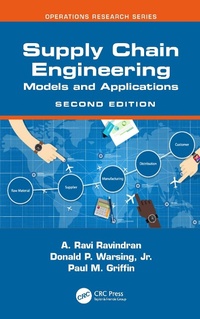
Supply Chain Engineering
Models and Applications
2nd Edition
Published on 30. August 2023
642 pages
978-1-000-92401-5 (ISBN)
Description

This new edition textbook continues down the path that the first edition, winner of the 2013 IISE/Joint Publishers Book-of-the-Year Award, successfully carved out. The textbook targets engineering students and emphasizes the use of operations research models and solution methods important in the design, control, operation, and management of global supply chains.
Completely updated, Supply Chain Engineering: Models and Applications, Second Edition stresses quantitative models and methods, highlights global supplier selection and vendor risk management techniques, and discusses the use of multiple criteria decision-making models in supply chain management. The new edition includes chapters on health and humanitarian supply chains, including disaster management and logistics modeling, and on warehousing and distribution. Disruptions to global supply chains due to the COVID-19 pandemic are discussed throughout the book. Industry and government strategies to make the global supply chains resilient are also presented. Thirty four case studies have been included to illustrate various supply chain models and methods. Exercises are included at the end of each chapter, and a solutions manual and PowerPoint slides are available for qualified textbook adoptions.
The new edition continues to target upper-level undergraduate and graduate students in engineering, as well as MBA students in operations management, logistics, and supply chain management programs that emphasize quantitative analysis. It is also useful as a reference for technical professionals and researchers in industrial engineering, supply chain management, procurement, logistics and health administration.
Completely updated, Supply Chain Engineering: Models and Applications, Second Edition stresses quantitative models and methods, highlights global supplier selection and vendor risk management techniques, and discusses the use of multiple criteria decision-making models in supply chain management. The new edition includes chapters on health and humanitarian supply chains, including disaster management and logistics modeling, and on warehousing and distribution. Disruptions to global supply chains due to the COVID-19 pandemic are discussed throughout the book. Industry and government strategies to make the global supply chains resilient are also presented. Thirty four case studies have been included to illustrate various supply chain models and methods. Exercises are included at the end of each chapter, and a solutions manual and PowerPoint slides are available for qualified textbook adoptions.
The new edition continues to target upper-level undergraduate and graduate students in engineering, as well as MBA students in operations management, logistics, and supply chain management programs that emphasize quantitative analysis. It is also useful as a reference for technical professionals and researchers in industrial engineering, supply chain management, procurement, logistics and health administration.
More details
Series
Edition
2nd edition
Language
English
Place of publication
London
United Kingdom
Publishing group
Taylor & Francis Ltd
Target group
College/higher education
Product notice
Reflowable
Illustrations
246 Tables, black and white; 80 Line drawings, black and white; 28 Halftones, black and white; 108 Illustrations, black and white
ISBN-13
978-1-000-92401-5 (9781000924015)
Copyright in bibliographic data and cover images is held by Nielsen Book Services Limited or by the publishers or by their respective licensors: all rights reserved.
Schweitzer Classification
Other editions
Additional editions
A. Ravi Ravindran | Donald P. Warsing, Jr. | Paul M. Griffin
Supply Chain Engineering
Models and Applications
Book
approx. 07/2026
2nd Edition
CRC Press
€66.00
Not yet published
A. Ravi Ravindran | Donald P. Warsing, Jr. | Paul M. Griffin
Supply Chain Engineering
Models and Applications
Book
08/2023
2nd Edition
CRC Press
€188.90
Shipment within 10-20 days
Persons
A. Ravi Ravindran has been a professor and former department head of industrial and manufacturing engineering at the Pennsylvania State University (1997-2017). He is an Emeritus Professor now. Formerly, he was a faculty member in the school of industrial engineering at Purdue University (1969-1982) and at the University of Oklahoma (1982-1997). At Oklahoma, he served as the Director of the school of industrial engineering for 8 years and as the Associate Provost for the university for 7 years. He received his B.S. in electrical engineering with honors from BITS, Pilani, India, and his M.S. and Ph.D. in industrial engineering and operations research from the University of California, Berkeley. His research interests are in multiple criteria decision-making, financial engineering, healthcare delivery systems, and supply chain optimization. Dr. Ravindran has published 8 books (Operations Research, Engineering Optimization, Operations Research and Management Science Handbook, Operations Research Methodologies, Operations Research Applications, Supply Chain Engineering, Multiple Criteria Decision Making in Supply Chain Management and Big Data Analytics using Multiple Criteria Decision-Making Models) and over 150 journal articles in operations research. His recent book on Supply Chain Engineering received the Institute of Industrial Engineers (IIE) Book-of-the-Year Award in 2013. He is a Fellow of IIE and a Fulbright Fellow. In 2001, he was recognized by IIE with the Albert G. Holzman Distinguished Educator Award for significant contributions to the industrial engineering profession by an educator. In 2013, he received the Outstanding Teaching Award in the college of engineering from the Penn State Engineering Alumni Society. He also received the Excellence in Teaching Award from the Logistics & Supply Chain division of IIE in 2017. He has been a consultant to AT&T, CNH America, General Motors, IBM, Kimberly Clark, General Electric, U.S. Department of Transportation, the Cellular Telecommunications Industry Association and the U.S. Air Force. He currently serves as the Operations Research series editor and the Emerging Operations Research Methodologies and Applications series editor for CRC Press/Taylor & Francis Group.
Don Warsing is an Associate Professor of Operations and Supply Chain Management at the Poole College of Management at North Carolina State University. Prior to joining NC State, he served on the faculty of the Smeal College of Business at Pennsylvania State University and also worked for IBM Corporation in roles spanning from industrial engineering to manufacturing management. Dr. Warsing's research concerns the development of tools and policies for effectively managing inventory, logistics, and business operations, and studying the ways in which various management practices contribute to improved performance outcomes. Throughout his academic career, Dr. Warsing has taught courses that cover a broad array of topics in operations and supply chain management, including process analysis, operations planning, and logistics.
Paul M. Griffin is a professor in the Department of Industrial and Manufacturing Engineering at Penn State University. His research and teaching interests are in health systems engineering, health analytics, and supply chain management. Prior to Penn State, Paul was St. Vincent Health Chair and Director of the Regenstrief Center for Healthcare Engineering at Purdue University. He was also the Joseph C. Mello Chair and professor in the School of Industrial and Systems Engineering at Georgia Tech. While at Georgia Tech, Dr. Griffin was an instructor for the Executive Master's in International Logistics (EMIL) and taught several short courses for the Supply Chain Logistics Institute. Dr. Griffin is a fellow of the American Institute for Medical and Biological Engineering and the Institute for Industrial and Systems Engineers.
Don Warsing is an Associate Professor of Operations and Supply Chain Management at the Poole College of Management at North Carolina State University. Prior to joining NC State, he served on the faculty of the Smeal College of Business at Pennsylvania State University and also worked for IBM Corporation in roles spanning from industrial engineering to manufacturing management. Dr. Warsing's research concerns the development of tools and policies for effectively managing inventory, logistics, and business operations, and studying the ways in which various management practices contribute to improved performance outcomes. Throughout his academic career, Dr. Warsing has taught courses that cover a broad array of topics in operations and supply chain management, including process analysis, operations planning, and logistics.
Paul M. Griffin is a professor in the Department of Industrial and Manufacturing Engineering at Penn State University. His research and teaching interests are in health systems engineering, health analytics, and supply chain management. Prior to Penn State, Paul was St. Vincent Health Chair and Director of the Regenstrief Center for Healthcare Engineering at Purdue University. He was also the Joseph C. Mello Chair and professor in the School of Industrial and Systems Engineering at Georgia Tech. While at Georgia Tech, Dr. Griffin was an instructor for the Executive Master's in International Logistics (EMIL) and taught several short courses for the Supply Chain Logistics Institute. Dr. Griffin is a fellow of the American Institute for Medical and Biological Engineering and the Institute for Industrial and Systems Engineers.
Content
1. Introduction to Supply Chain Engineering. 2. Planning Production in Supply Chains. 3. Inventory Management Methods and Models. 4. Transportation Decisions in Supply Chain Management. 5. Location and Distribution Decisions in Supply Chains. 6. Supplier Selection Models and Methods. 7. Warehousing and Distribution. 8. Managing Risks in Supply Chain. 9. Global Supply Chain Management. 10. Health and Humanitarian Supply Chains. Appendix A. Multiple Criteria Decision Making: An Overview.
