

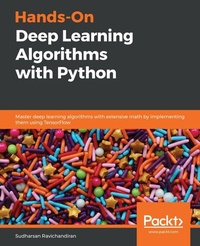
Hands-On Deep Learning Algorithms with Python
Master deep learning algorithms with extensive math by implementing them using TensorFlow
1st Edition
Published on 3. June 2024
512 pages
978-1-78934-451-6 (ISBN)
Description

Understand basic-to-advanced deep learning algorithms, the mathematical principles behind them, and their practical applicationsKey Features - Get up to speed with building your own neural networks from scratch
- Gain insights into the mathematical principles behind deep learning algorithms
- Implement popular deep learning algorithms such as CNNs, RNNs, and more using TensorFlow
Book DescriptionDeep learning is one of the most popular domains in the AI space that allows you to develop multi-layered models of varying complexities. This book introduces you to popular deep learning algorithms-from basic to advanced-and shows you how to implement them from scratch using TensorFlow. Throughout the book, you will gain insights into each algorithm, the mathematical principles involved, and how to implement it in the best possible manner. The book starts by explaining how you can build your own neural networks, followed by introducing you to TensorFlow, the powerful Python-based library for machine learning and deep learning. Moving on, you will get up to speed with gradient descent variants, such as NAG, AMSGrad, AdaDelta, Adam, and Nadam. The book will then provide you with insights into recurrent neural networks (RNNs) and LSTM and how to generate song lyrics with RNN. Next, you will master the math necessary to work with convolutional and capsule networks, widely used for image recognition tasks. You will also learn how machines understand the semantics of words and documents using CBOW, skip-gram, and PV-DM. Finally, you will explore GANs, including InfoGAN and LSGAN, and autoencoders, such as contractive autoencoders and VAE. By the end of this book, you will be equipped with all the skills you need to implement deep learning in your own projects.What you will learn - Implement basic-to-advanced deep learning algorithms
- Master the mathematics behind deep learning algorithms
- Become familiar with gradient descent and its variants, such as AMSGrad, AdaDelta, Adam, and Nadam
- Implement recurrent networks, such as RNN, LSTM, GRU, and seq2seq models
- Understand how machines interpret images using CNN and capsule networks
- Implement different types of generative adversarial network, such as CGAN, CycleGAN, and StackGAN
- Explore various types of autoencoder, such as Sparse autoencoders, DAE, CAE, and VAE
Who this book is forIf you are a machine learning engineer, data scientist, AI developer, or anyone looking to delve into neural networks and deep learning, this book is for you. Those who are completely new to deep learning, but have some experience in machine learning and Python programming will also find the book very helpful.
- Gain insights into the mathematical principles behind deep learning algorithms
- Implement popular deep learning algorithms such as CNNs, RNNs, and more using TensorFlow
Book DescriptionDeep learning is one of the most popular domains in the AI space that allows you to develop multi-layered models of varying complexities. This book introduces you to popular deep learning algorithms-from basic to advanced-and shows you how to implement them from scratch using TensorFlow. Throughout the book, you will gain insights into each algorithm, the mathematical principles involved, and how to implement it in the best possible manner. The book starts by explaining how you can build your own neural networks, followed by introducing you to TensorFlow, the powerful Python-based library for machine learning and deep learning. Moving on, you will get up to speed with gradient descent variants, such as NAG, AMSGrad, AdaDelta, Adam, and Nadam. The book will then provide you with insights into recurrent neural networks (RNNs) and LSTM and how to generate song lyrics with RNN. Next, you will master the math necessary to work with convolutional and capsule networks, widely used for image recognition tasks. You will also learn how machines understand the semantics of words and documents using CBOW, skip-gram, and PV-DM. Finally, you will explore GANs, including InfoGAN and LSGAN, and autoencoders, such as contractive autoencoders and VAE. By the end of this book, you will be equipped with all the skills you need to implement deep learning in your own projects.What you will learn - Implement basic-to-advanced deep learning algorithms
- Master the mathematics behind deep learning algorithms
- Become familiar with gradient descent and its variants, such as AMSGrad, AdaDelta, Adam, and Nadam
- Implement recurrent networks, such as RNN, LSTM, GRU, and seq2seq models
- Understand how machines interpret images using CNN and capsule networks
- Implement different types of generative adversarial network, such as CGAN, CycleGAN, and StackGAN
- Explore various types of autoencoder, such as Sparse autoencoders, DAE, CAE, and VAE
Who this book is forIf you are a machine learning engineer, data scientist, AI developer, or anyone looking to delve into neural networks and deep learning, this book is for you. Those who are completely new to deep learning, but have some experience in machine learning and Python programming will also find the book very helpful.
More details
Other editions
Additional editions
Sudharsan Ravichandiran
Hands-On Deep Learning Algorithms with Python
Master deep learning algorithms with extensive math by implementing them using TensorFlow
Book
07/2019
Packt Publishing
€47.80
Shipment within 3-4 weeks
Person
Ravichandiran Sudharsan :
Sudharsan Ravichandiran is a data scientist and artificial intelligence enthusiast. He holds a Bachelors in Information Technology from Anna University. His area of research focuses on practical implementations of deep learning and reinforcement learning including natural language processing and computer vision. He is an open-source contributor and loves answering questions on Stack Overflow.
Sudharsan Ravichandiran is a data scientist and artificial intelligence enthusiast. He holds a Bachelors in Information Technology from Anna University. His area of research focuses on practical implementations of deep learning and reinforcement learning including natural language processing and computer vision. He is an open-source contributor and loves answering questions on Stack Overflow.
Content
Table of Contents - Introduction to Deep Learning
- Getting to know Tensorflow
- Gradient Descent and its variants
- Generating song lyrics using RNN
- Improvements to the RNN
- Demystifying Convolutional networks
- Representation learning using word embeddings
- Generative adversarial networks
- More About GANs
- Autoencoders
- Few shot learnings
- Getting to know Tensorflow
- Gradient Descent and its variants
- Generating song lyrics using RNN
- Improvements to the RNN
- Demystifying Convolutional networks
- Representation learning using word embeddings
- Generative adversarial networks
- More About GANs
- Autoencoders
- Few shot learnings
