

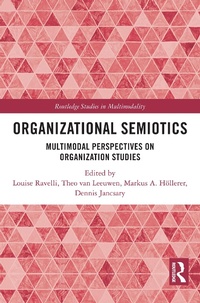
Organizational Semiotics
Multimodal Perspectives on Organization Studies
1st Edition
Published on 17. May 2023
258 pages
978-1-000-86573-8 (ISBN)
Description

This edited volume brings together two largely separate fields - organization studies and multimodal social semiotics - to develop an integrated research agenda for the novel interdisciplinary field of 'organizational semiotics'.
Organizations, whether for profit, non-profit, or governmental, dominate much of everyday life, and multimodal communication is not only an output of organizations, but is also constitutive of them. This volume argues in particular for the importance of organization studies for social semioticians - not just as a site of application, but also as a critical contemporary context that requires novel and expanded methods of analysis and critique, and new practices of partnership. The volume addresses a range of institutions and sectors, from civil to retail to medical, from corporations to universities, and reveals how a deep engagement with their meaning-making practices produces insights not just about communication but also about the broader contemporary cultural context in which organizations play such a significant role. Fundamentally, it reveals that the rich analytical and theoretical resources of multimodal perspectives on organizations studies can - and should - make a fundamental contribution to our understanding of organizations in social life.
This volume is relevant to social semioticians and organizational researchers as well as to practitioners and decision-makers in organizations.
Organizations, whether for profit, non-profit, or governmental, dominate much of everyday life, and multimodal communication is not only an output of organizations, but is also constitutive of them. This volume argues in particular for the importance of organization studies for social semioticians - not just as a site of application, but also as a critical contemporary context that requires novel and expanded methods of analysis and critique, and new practices of partnership. The volume addresses a range of institutions and sectors, from civil to retail to medical, from corporations to universities, and reveals how a deep engagement with their meaning-making practices produces insights not just about communication but also about the broader contemporary cultural context in which organizations play such a significant role. Fundamentally, it reveals that the rich analytical and theoretical resources of multimodal perspectives on organizations studies can - and should - make a fundamental contribution to our understanding of organizations in social life.
This volume is relevant to social semioticians and organizational researchers as well as to practitioners and decision-makers in organizations.
Reviews / Votes
"This new volume is a unique resource for anyone keen to apply their social semiotic expertise to life in organizations and institutions, as it is for those wanting to broaden their analysis and theorization of formal organization to cover the symbolic and interactive dimensions of its practices and communication. The book's hybrid approach is expertly exemplified in each of its individual chapters offering well-researched and supremely evidenced insights."(Professor Rick Iedema, Director of the Centre for Team-Based Practice & Learning in Health Care, King's College London)
"Recently, we have seen a growing interest in organizational communication and processes beyond words. But how, exactly, should we go about studying such multimodal dynamics? This book offers a deep conceptualization of and rich empirical inquiries into organizational semiotics - the multimodal, social, and contextual meaning-making practices that constitute organizing and organizations. By bringing together social semiotics and organization studies, the book offers ways to capture, interpret, and theorize semiotic artifacts and practices in and around organizations."
(Professor Tammar B. Zilber, Hebrew University of Jerusalem Business School; Editor-in-Chief, Organization Studies)
More details
Series
Edition
1. Auflage
Language
English
Place of publication
London
United Kingdom
Publishing group
Taylor & Francis Ltd
Target group
College/higher education
Illustrations
9 Tables, black and white; 1 Line drawings, color; 9 Line drawings, black and white; 48 Halftones, color; 2 Halftones, black and white; 49 Illustrations, color; 11 Illustrations, black and white
ISBN-13
978-1-000-86573-8 (9781000865738)
Copyright in bibliographic data and cover images is held by Nielsen Book Services Limited or by the publishers or by their respective licensors: all rights reserved.
Schweitzer Classification
Other editions
Additional editions
Louise Ravelli | Theo van Leeuwen | Markus A. Hoellerer
Organizational Semiotics
Multimodal Perspectives on Organization Studies
Book
10/2024
1st Edition
Routledge
€82.60
Shipment within 10-20 days
Louise Ravelli | Theo van Leeuwen | Markus A. Hoellerer
Organizational Semiotics
Multimodal Perspectives on Organization Studies
Book
05/2023
1st Edition
Routledge
€215.60
Shipment within 15-20 days
Persons
Louise Ravelli is Professor of Communication in the School of Arts and Media at UNSW Sydney. Her research explores how multimodality works in specific communication contexts, such as museums. She has published widely with monographs, edited volumes and articles, and is joint Chief Editor of the journal Visual Communication.
Theo van Leeuwen is Professor of Language and Communication at the University of Southern Denmark. He has published widely in the areas of visual communication, multimodality, and critical discourse analysis. His latest books are the third revised edition of Reading Images - The Grammar of Visual Design (with Gunther Kress) and Multimodality and Identity.
Markus A. Hoellerer is Professor of Organization and Management at UNSW Sydney. His scholarly work currently focuses on social change, novel forms of organization and governance, and institutions as multimodal accomplishments. He has been widely published in leading academic outlets and is currently Editor-in-Chief of Organization Theory.
Dennis Jancsary is Assistant Professor at the Institute for Organization Studies at WU (Vienna University of Economics and Business). He is particularly interested in the role of language and multimodal communication at the interface of organizations and institutions. His work further includes methodological contributions to visual and multimodal analysis.
Theo van Leeuwen is Professor of Language and Communication at the University of Southern Denmark. He has published widely in the areas of visual communication, multimodality, and critical discourse analysis. His latest books are the third revised edition of Reading Images - The Grammar of Visual Design (with Gunther Kress) and Multimodality and Identity.
Markus A. Hoellerer is Professor of Organization and Management at UNSW Sydney. His scholarly work currently focuses on social change, novel forms of organization and governance, and institutions as multimodal accomplishments. He has been widely published in leading academic outlets and is currently Editor-in-Chief of Organization Theory.
Dennis Jancsary is Assistant Professor at the Institute for Organization Studies at WU (Vienna University of Economics and Business). He is particularly interested in the role of language and multimodal communication at the interface of organizations and institutions. His work further includes methodological contributions to visual and multimodal analysis.
Content
CONTENTS
Chapter 1 'Organizational semiotics': Towards an integrated research agenda
Louise Ravelli, Theo van Leeuwen, Markus A. Hoellerer, Dennis Jancsary
Chapter 2. Social semiotics and organization studies: Building an effective bridge
Dennis Jancsary, Markus A. Hoellerer, Louise Ravelli, Theo van Leeuwen
Chapter 3. The resemiotization of health information in a family planning organization
Theo van Leeuwen, Nikolina Zonjic
Chapter 4. Organizational identity design: The evolution of a university web homepage
Nataliia Laba
Chapter 5. The emotional civil servant: On the multimodal construction of affect in 'platform of values' texts of Swedish public authorities
Anders Bjoerkvall
Chapter 6. Communicating in space: Relating the physical and the social in open-plan offices
Ken Tann, Oluremi B. Ayoko
Chapter 7. Redesigning organizational relations through the built environment:
Changes at a university campus
Louise Ravelli
Chapter 8. How multimodal structures constitute organization: The meaning of structure in offline and online shopping environments
Morten Boeriis
Chapter 9 "It's not just getting a biopsy": Transposing 'take-home' messages from the operating theatre to a proforma
Arpan Tahim, Jeff Bezemer
Chapter 10. Texture and texturization in organizational identity design and legitimacy work
Giorgia Aiello
Afterword
Theo van Leeuwen, Renate E. Meyer
Chapter 1 'Organizational semiotics': Towards an integrated research agenda
Louise Ravelli, Theo van Leeuwen, Markus A. Hoellerer, Dennis Jancsary
Chapter 2. Social semiotics and organization studies: Building an effective bridge
Dennis Jancsary, Markus A. Hoellerer, Louise Ravelli, Theo van Leeuwen
Chapter 3. The resemiotization of health information in a family planning organization
Theo van Leeuwen, Nikolina Zonjic
Chapter 4. Organizational identity design: The evolution of a university web homepage
Nataliia Laba
Chapter 5. The emotional civil servant: On the multimodal construction of affect in 'platform of values' texts of Swedish public authorities
Anders Bjoerkvall
Chapter 6. Communicating in space: Relating the physical and the social in open-plan offices
Ken Tann, Oluremi B. Ayoko
Chapter 7. Redesigning organizational relations through the built environment:
Changes at a university campus
Louise Ravelli
Chapter 8. How multimodal structures constitute organization: The meaning of structure in offline and online shopping environments
Morten Boeriis
Chapter 9 "It's not just getting a biopsy": Transposing 'take-home' messages from the operating theatre to a proforma
Arpan Tahim, Jeff Bezemer
Chapter 10. Texture and texturization in organizational identity design and legitimacy work
Giorgia Aiello
Afterword
Theo van Leeuwen, Renate E. Meyer
