

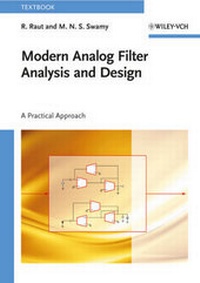
Modern Analog Filter Analysis and Design
Description

More details
Other editions
Additional editions
Persons
M.N.S. Swamy received his Ph.D. degree in electrical engineering from the University of Saskatchewan, Canada, in 1963. He is presently a Research Professor and the Director of the Center for Signal Processing and Communications in the Department of Electrical and Computer Engineering at Concordia University, Montreal, Canada, where he served as the Founding Chair of the Department of Electrical Engineering from 1970 to 1977, and Dean of Engineering and Computer Science from 1977 to 1993. Since 2001, he has been holding the Concordia Research Chair in Signal Processing. Dr. Swamy has also taught in the Electrical Engineering Department of the Technical University of Nova Scotia, Halifax, and the University of Calgary, as well as in the Department of Mathematics at the University of Saskatchewan. He is the author or co-author of many articles and several books, and a Fellow of many societies including the IEEE , the IET (UK) and the EIC (Canada). He is the recipient of many awards including the IEEE-CAS Society education Medal, Golden Jubilee Medal, and the Guillemin-Cauer best paper award. He was the president of the CAS-Society in 2004 and Editor-in Chief of the IEEE transactions on Circuits and Systems during 1999-2001. Recently, he was awarded the title of Honorary Professor by the National Chiao Tung University, Taiwan.
Content
2. A Review of Network Analysis Techniques
3. Network Theorems and Approximation of Filter Functions
4. Basics of Passive Filter Design
5. Second-Order Active-RC Filters
6. Switched-Capacitor Filters
7. Higher-Order Active Filters
8. Current-Mode Filters
9. Implementation of Analog Integrated Circuit Filters
Appendices
Chapter 1
Introduction
Electrical filters permeate modern electronic systems so much that it is imperative for an electronic circuit or system designer to have at least some basic understanding of these filters. The electronic systems that employ filtering process are varied, such as communications, radar, consumer electronics, military, medical instrumentation, and space exploration. An electrical filter is a network that transforms an electrical signal applied to its input such that the signal at the output has specified characteristics, which may be stated in the frequency or the time domain, depending upon the application. Thus, in some cases the filter exhibits a frequency-selective property, such as passing some frequency components in the input signal, while rejecting (stopping) signals at other frequencies.
The developments of filters started around 1915 with the advent of the electric wave filter by Campbell and Wagner, in connection with telephone communication. The early design advanced by Campbell, Zobel, and others made use of passive lumped elements, namely, resistors, inductors, and capacitors, and was based on image parameters (see for example, Ruston and Bordogna, 1971). This is known as the classical filter theory and it yields reasonably good filters without very sophisticated mathematical techniques.
Modern filter theory owes its origin to Cauer, Darlington, and others, and the development of the theory started in the 1930s. Major advancements in filter theory took place in the 1930s and 1940s. However, the filters were still passive structures using R, L, and C elements. One of the most important applications of passive filters has been in the design of channel bank filters in frequency division multiplex telephone systems.
Introduction of silicon integrated circuit (IC) technology together with the development of operational amplifiers (OAs) shifted the focus of filter designers in the 1960s to realize inductorless filters for low-frequency (voice band 300-3400 Hz) applications. Thus ensued the era of active-RC filters, with OA being the active element. With computer-controlled laser trimming, the values of the resistances in thick and thin film technologies could be controlled accurately and this led to widespread use of such low-frequency (up to about 4 kHz) active-RC filters in the pulse code modulation (PCM) system in telephonic communication.
Owing to the difficulty in fabricating large-valued resistors in the same process as the OA, low-frequency filters could not be built as monolithic devices. However, the observation that certain configurations of capacitors and periodically operated switches could function approximately as resistors led to the introduction of completely monolithic low-frequency filters. The advent of complementary metal-oxide semiconductor (CMOS) transistors facilitated this alternative with monolithic capacitors, CMOS OAs, and CMOS transistor switches. The switched-capacitor (SC) filters were soon recognized as being in the class of sampled-data filters, since the switching introduced sampling of the signals. In contrast, the active-RC filters are in the category of continuous-time filters, since the signal processed could theoretically take on any possible value at a given time. In the SC technique, signal voltages sampled and held on capacitors are processed via voltage amplifiers and integrators. Following the SC filters, researchers soon invented the complementary technique where current signals sampled and transferred on to parasitic capacitances at the terminals of metal-oxide semiconductor (MOS) transistors could be processed further via current mirrors and dynamic memory storage (to produce the effect of integration). This led to switched-current (SI) filtering techniques, which have become popular in all-digital CMOS technology, where no capacitors are needed for the filtering process.
In recent times, several microelectronic technologies (such as Bipolar, CMOS, and BiCMOS), filter architectures, and design techniques have emerged leading to high-quality fully integrated active filters. Moreover, sophisticated digital and analog functions (including filtering) can coexist on the same very large-scale integrated (VLSI) circuit chip. An example of the existence of several integrated active filters in a VLSI chip is illustrated in Figure 1.1. This depicts the floor plan of a typical PCM codec chip (Laker and Sansen, 1994).
Figure 1.1 A typical VLSI analog/digital system floor plan.
Together with the progress in semiconductor technology, new types of semiconductor amplifiers, such as the operational transconductance amplifier (OTA), and current conveyor (CC) became realizable in the late 1970s and onwards. This opened up the possibility for implementation of high-frequency filters (50 kHz to ~300 MHz) in monolithic IC technology. An OTA can be conveniently configured to produce the function of a resistor and an inductor, so that usual high-frequency passive LCR filters can be easily replaced by suitable combinations of monolithic OTAs and capacitors leading to operational transconductance amplifier capacitor (OTA-C) (or gm - C) filters. Introduction of CCs in the 1990s encouraged researchers to investigate signal processing in terms of signal currents rather than signal voltages. This initiated activities in the area of current-mode (CM) signal processing and hence CM filtering, even though the idea of realizing current transfer functions goes back to the late 1950s and the 1960s (Thomas, 1959; Hakim, 1965; Bobrow, 1965; Mitra, 1967; Daggett and Vlach, 1969). In fact, a very simple and direct method of obtaining a current transfer function realization from that of a voltage transfer function employing the concept of transposition was advanced as early as 1971 by Bhattacharyya and Swamy (1971). Since for CM signal processing, the impedances at the input and output ports are supposed to be very low, the attendant bandwidth can be very large. Modern CMOS devices can operate at very low voltages (around 1 V direct current (DC)) with small currents (0.1 mA or less). Thus, CM signal processing using CMOS technology entails low-voltage high-frequency operation. The intermediate frequency (IF) (fo±100 MHz) filter in a modern mobile communication (global system mobile, GSM) system has typical specifications as presented in Table 1.1. The required filters can be implemented as monolithic IC filters in the CM, using several CC building blocks and integrated capacitors.
Table 1.1 Magnitude Response Characteristics of an IF Filter.
Considering applications in ultra wideband (~10-30 GHz) communication systems, monolithic inductors (~1-10 nH) can be conveniently realized in modern submicron CMOS technology. Thus, passive LCR filter structures can be utilized for completely monolithic very wideband electronic filters. Advances in IC technology have also led to the introduction of several kinds of digital ICs. These could be used to process an analog signal after sampling and quantization. This has led to digital techniques for implementing an electronic filter (i.e., digital filters), and the area falls under the general category of digital signal processing (DSP).
As the subject of electrical/electronic filter is quite mature, there are a large number of books on this subject contributed by many eminent teachers and researchers. The current book is presented with a practical consideration, namely, that with the advent of computers and the abundance of computer-oriented courses in the electrical engineering curricula, there is insufficient time for a very exhaustive book on analog filters to be used for teaching over the span of one semester or two quarters. The present book is, therefore, relatively concise and is dedicated to current concepts and techniques that are basic and essential to acquire a good initial grasp of the subject of analog filters. Recognizing the popularity of courses that are amenable to the use of computer-aided tools, many circuit analysis (i.e., SPICE) and numerical simulation (i.e., MATLAB) program codes are provided in the body of the book to reinforce computer-aided design and analysis skills. The present book is very close to the practical need of a text book that can be covered over the limited span of time that present-day electrical engineering curricula in different academic institutions in the world can afford to the subject of analog filters. Toward this, the subject matter is presented through several chapters as follows.
Chapter 2 presents a review of several network analysis methods, such as the nodal, loop, and indefinite matrix techniques, as well as a method for analyzing constrained networks. One- and two-port networks are defined and various methods of representing a two-port and the interrelationships between the parameters representing a two-port are also detailed. The analysis methods are illustrated by considering several examples from known filter networks.
Chapter 3 introduces several concepts such as impedance and frequency scaling, impedance transformation, dual (and inverse) two-port networks, reversed two-ports, and transposed networks. Some useful network theorems concerning dual two-ports and transposed two-ports are established, and their applications to singly and doubly terminated networks are considered. Also, the transposes of commonly used active elements are given. Various approximation techniques for both the magnitude and phase of a filter transfer function, as well as frequency transformations to transform a low-pass...
