

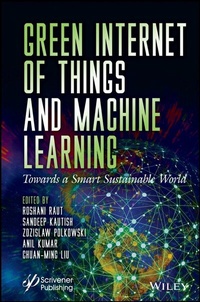
Green Internet of Things and Machine Learning
Description

Encapsulates different case studies where green-IOT and machine learning can be used for making significant progress towards improvising the quality of life and sustainable environment.
The Internet of Things (IoT) is an evolving idea which is responsible for connecting billions of devices that acquire, perceive, and communicate data from their surroundings. Because this transmission of data uses significant energy, improving energy efficiency in IOT devices is a significant topic for research. The green internet of things (G-IoT) makes it possible for IoT devices to use less energy since intelligent processing and analysis are fundamental to constructing smart IOT applications with large data sets. Machine learning (ML) algorithms that can predict sustainable energy consumption can be used to prepare guidelines to make IoT device implementation easier.
Green Internet of Things and Machine Learning lays the foundation of in-depth analysis of principles of Green-Internet of Things (G-IoT) using machine learning. It outlines various green ICT technologies, explores the potential towards diverse real-time areas, as well as highlighting various challenges and obstacles towards the implementation of G-IoT in the real world. Also, this book provides insights on how the machine learning and green IOT will impact various applications: It covers the Green-IOT and ML-based smart computing, ML techniques for reducing energy consumption in IOT devices, case studies of G-IOT and ML in the agricultural field, smart farming, smart transportation, banking industry and healthcare.
Audience
The book will be helpful for research scholars and researchers in the fields of computer science and engineering, information technology, electronics and electrical engineering. Industry experts, particularly in R&D divisions, can use this book as their problem-solving guide.
More details
Other editions
Additional editions
Persons
Roshani Raut, PhD is an associate professor in the Department of Information Technology at Pimpri Chinchwad College of Engineering, Pune University, India. She has presented and published more than 70 research communications in national/international conferences and journals and has published 13 patents.
Sandeep Kautish, PhD is a professor & Dean of Academics with LBEF Campus, Kathmandu Nepal. He has published more than 40 papers in international journals.
Zdzislaw Polkowski, PhD is a professor in the Faculty of Technical Sciences, Jan Wyzykowski University, Polkowice, Poland. He has published more than 75 research articles in peer-reviewed journals.
Anil Kumar, PhD is a professor of CSE and Head of Department of Information Technology, DIT University, India. He has published more than 200 research papers.
Chuan-Ming Liu, PhD is a professor in the Department of Computer Science and Information Engineering (CSIE), National Taipei University of Technology (Taipei Tech), Taiwan. He has published more than 100 research article is international journals.
Content
Preface xvii
1 G-IoT and ML for Smart Computing 1
Karunendra Verma, Vineet Raj Singh Kushwah and Nilesh
1.1 Introduction 2
1.2 Machine Learning 2
1.3 Deep Learning 6
1.4 Correlation Between AI, ML, and dl 7
1.5 Machine Learning-Based Smart Applications 7
1.6 IoT 11
1.7 Green IoT 12
1.8 Green IoT-Based Technologies 13
1.9 Life Cycle of Green IoT 16
1.10 Applications 16
1.11 Challenges and Opportunities for Green IoT 21
1.12 Future of G-IoT 22
1.13 Conclusion 22
References 23
2 Machine Learning-Enabled Techniques for Reducing Energy Consumption of IoT Devices 27
Yogini Dilip Borole, Jaya Dofe and C. G. Dethe
2.1 Introduction 28
2.2 Internet of Things (IoT) 33
2.3 Empowering Tools 35
2.4 IoT in the Energy Sector 48
2.5 Difficulties of Relating IoT 61
2.6 Future Trends 66
2.7 Conclusion 72
References 73
3 Energy-Efficient Routing Infrastructure for Green IoT Network 87
Pradeep Bedi, S. B. Goyal, Jugnesh Kumar and Shailesh Kumar
3.1 Introduction 88
3.2 Overview of IoT 89
3.3 Perspectives of Green Computing: Green IoT 91
3.4 Routing Protocols for Heterogeneous IoT 99
3.5 Machine Learning Application in Green IoT 104
3.6 Conclusion 107
References 107
4 Green IoT Towards Environmentally Friendly, Sustainable and Revolutionized Farming 113
Ravi Manne and Sneha Chowdary Kantheti
4.1 Introduction 114
4.2 How is Machine Learning Used in Agricultural Field? 119
4.3 What is IoT? How Can IoT Be Applied in Agriculture? 127
4.4 What is Green IoT and Use of Green IoT in Agriculture? 130
4.5 Conclusion: Risks of Using G-IoT in Agriculture 135
References 138
5 CIoT: Internet of Green Things for Enhancement of Crop Data Using Analytics and Machine Learning 141
Sahana Shetty and Narayana Swamy Ramaiah
5.1 Introduction 142
5.2 Motivation 146
5.3 Review of Literature 147
5.4 Problem with Traditional Approach 154
5.5 Tool Requirement 155
5.6 Methodology 159
5.7 Conclusion 160
References 161
6 Smart Farming Through Deep Learning 163
Sandeep Mathur, Disha Vaid and Ajay Rana
6.1 Introduction 163
6.2 Literature Review 165
6.3 Deep Learning in Agriculture 169
6.4 Smart Farming 174
6.5 Image Analysis of Agricultural Products 176
6.6 Land-Quality Check 178
6.7 Arduino-Based Soil Moisture Reading Kit 180
6.8 Conclusion 183
6.9 Future Work 184
References 185
7 Green IoT and Machine Learning for Agricultural Applications 189
Keshavi Nalla and Seshu Vardhan Pothabathula
7.1 Introduction 190
7.2 Green IoT 192
7.3 Machine Learning 201
7.4 Conclusion 210
References 210
8 IoT-Enabled AI-Based Model to Assess Land Suitability for Crop Production 215
Aneesha Gudavalli, G. JayaLakshmi and Suneetha Manne
8.1 Introduction 216
8.2 Literature Survey 217
8.3 Conclusion 235
References 235
9 Green Internet of Things (GIoT): Agriculture and Healthcare Application System (GIoT-AHAS) 239
Anil L. Wanare and Sahebrao N. Patil
9.1 Introduction 240
9.2 Relevant Work and Research Motivation for GIoT-AHAS 243
9.3 Conclusion 263
References 264
10 Green IoT for Smart Transportation: Challenges, Issues, and Case Study 269
Pradnya Borkar, Vijaya Balpande, Ujjwala Aher, Roshani Raut and M. Sulas Borkar
10.1 Introduction 270
10.2 Challenges of IoT 270
10.3 Green IoT Communication Components 274
10.4 Applications of IoT and Green IoT 275
10.5 Issues of Concern 279
10.6 Challenges for Green IoT 280
10.7 Green IoT in Smart Transportation: Case Studies
10.8 Conclusion 292
References 292
11 Green Internet of Things (IoT) and Machine Learning (ML): The Combinatory Approach and Synthesis in the Banking Industry 297
Prakashkumar Hasmukhbhai Patel, Chetan K Rathod and Karan Zaveri
11.1 Introduction 298
11.2 Research Objective 299
11.3 Methodology 299
11.4 Result and Discussion 299
11.5 Conclusion 313
References 314
12 Green Internet of Things (G-IoT) Technologies, Application, and Future Challenges 317
Komal Saxena, Abdul Basit and Vinod Kumar Shukla
12.1 Introduction 318
12.2 The Internet of Thing (IoT) 319
12.3 Elements of IoT 322
12.4 The Green IoT: Overview 325
12.5 Green IoT Technologies 326
12.6 Green IoT Applications 329
12.7 IoT in 5G Wireless Technologies 333
12.8 Internet of Things in Smart City 335
12.9 Green IoT Architecture for Smart Cities 337
12.10 Advantages and Disadvantages of Green IoT 342
12.11 Opportunities and Challenges 343
12.12 Future of Green IoT 344
12.13 Conclusion 345
References 345
Index 349
Preface
The Internet of Things (IoT) is an evolving idea which is responsible for connecting billions of devices that acquire, perceive, and communicate data from their surroundings. Because this transmission of data uses significant energy, improving energy efficiency in IOT devices is a significant topic for research. The green internet of things (G-IoT) makes it possible for IoT devices to use less energy since intelligent processing and analysis are fundamental to constructing smart IOT applications with large data sets. Machine learning (ML) algorithms that can predict sustainable energy consumption can be used to prepare guidelines to make IoT device implementation easier.
The G-IoT, an updated version of the IoT, is applied for different applications to improve energy efficiency. Therefore, the material collected in this book has been edited to enhance the reader's knowledge about the current research achievements and challenges in the area of G-IoT and ML applications. The book targets senior and junior engineers, undergraduate and postgraduate students, researchers, and anyone else interested in the trends, developments, and opportunities afforded by the G-IoT and ML concepts.
Although it was impossible to include all current aspects of the research in the targeted area in the twelve chapters of this book, it will be a useful tool in terms of the various possible methodologies that can provide G-IoT applications through the use of ML. A brief description of the various application fields and methodologies covered in each chapter follows:
- - Chapter 1 provides a brief introduction to various artificial intelligence (AI), ML, and IoT-based approaches with their real-life applications. It encompasses the many aspects of the G-IoT based on IoT device use and presents an outline of how each web search engine, such as Bing or Google, is used to search the internet, as they employ strategies such as learning algorithms to rank the websites. For example, every time Facebook is used to identify the photo of friends, online fraud detection, online customer assistance, video surveillance, face recognition, email spam, and malware are based on various learning algorithms.
- - Chapter 2 presents an AI equipment design that focuses on IoT applications. The design is established on the standard of learning automata, characterized by utilizing propositional logic. The reasoning-based support empowers low-vitality impressions just as high learning accuracy throughout is used for preparing and surmising, which are vital criteria for competent AI with a long working life. Methodical encoding of the input information into optimally equal reasoning blocks is essential to this circuit. The distribution of these squares is improved through a plan investigation and robotization stream utilizing field programmable entryway exhibit-based quick models and programming recreations. The plan stream considers an assisted hyperparameter search for matching the clashing demands of economy and high accuracy. Broad approvals of the equipment execution of the new engineering employing single- and multiclass AI datasets reveal potential for fundamentally reduced vitality compared to the current AI equipment structures.
- - Chapter 3 focuses on the IoT as a technology that connects everything to the smart world. To develop a practical smart scenario, this chapter explores numerous technologies along with the difficulties involved in fulfilling the goal of a G-IoT. Since energy-efficient communication in large-scale IoT devices has become a key concern in recent years, there is a fundamental need in such networks to minimize overall battery-powered device power consumption to reduce data transmission costs and lengthen network life. This study requires a scalable and energy-efficient approach for G-IoT heterogeneous nodes. These nodes need to create energyefficient power conservation mechanisms to provide a longlived network.
- - Chapter 4 discusses the role of ML and the G-IoT in agriculture. Machine learning and its various application domains are explained and extensively covered in the first part of the chapter. In agricultural and farming applications, there are pros and cons to using the IoT to preserve biodiversity and reduce greenhouse gas emissions. To minimize the drawbacks, the smart food and agricultural enterprises built using G-IoT and green nanotechnology are discussed. Furthermore, how the IoT and G-IoT empower agriculture with accurate and sustainable farming approaches is also discussed.
- - Chapter 5 demonstrates the use of analytics and machine learning to improve crop data. For optimal crop growth, pH, water content, and humidity are key. Inadequate inputs might lead to a growth imbalance in crops. Machine learning approaches can profit from prediction and classification challenges. To monitor the health of crops in the field, CIoT (Crop Internet of Things) was mostly required to assist in humidity, soil pH, soil wetness, soil type, and crop quality monitoring. Various sensors, like humidity sensors, pH sensors, soil quality sensors, and temperature sensors, can be utilized to detect crop yield and ML algorithms to calculate yields alongside descriptive analytics. Decisions on types of pesticides to use and the nutritional requirements of individual crops can be made with ML algorithms. Farmers would benefit from the early use of ML for soil mapping to produce a better environment for future crops.
- - Chapter 6 explores smart farming using deep learning (DL) techniques. In the modern world, trending automation techniques are mixed with traditional farming approaches. A variety of crops are cultivated in various seasons from farmland. Farmers face several obstacles such as climatic calamities, pests, seed quality, soil quality, etc. Therefore, DL technologies are being used to turn traditional farming into smart farming.
- - Chapter 7 presents the use of G-IoT and ML for agriculture applications. The IoT is a network of diverse sensors, software, and other technologies embedded in a system that retains flexibility. This design combines many sensors and software to perform multiple functions simultaneously. Artificial neural networks, C-means, K-means, Bayesian model and so on are used to make cost-effective, low-power IoT devices. Approaches like green computing, green wireless sensor networks, etc., create a difference in criteria for energy consumption.
- - Chapter 8 presents an IoT-enabled AI-based model to assess land suitability for crop production. It briefly covers the IoT sensors used in horticulture and presents a summary of ML, AI, and DL techniques for farmers. Current challenges in the field of agribusiness are shown with the evaluation of the study. The review reveals that explicit model assessment is supported by a wholly automated approach.
- - Chapter 9 introduces green cloud computing (GCC) and G-IoT applications for agriculture and healthcare systems. In this chapter, the technology and issues relating to GCC and G-IoT, as well as the ability to minimize energy usage through the combination of these two approaches, are discussed. The green information and communication technologies (GICTs) that facilitate the G-IoT are extensively discussed. Additionally, the possibilities of a healthcare and G-IoT application system using a digital wireless sensor cloud with discrete integration or digital summation modeling are presented.
- - Chapter 10 discusses how the G-IoT can be used for smart transportation. This is a global technical necessity since building an energy-efficient IoT ecosystem reduces CO2 emissions from sensors, devices, and services that are implemented in IoT applications. The IoT is used in smart transportation (cars, trains, buses, etc.) to provide an effective way to avoid more energy use. This chapter looks at the G-IoT, along with its various challenges and issues, and the various technologies utilized in it.
- - Chapter 11 discusses the use of the G-IoT and ML in the banking industry. It provides an overview as to how banking institutions are making use of the G-IoT and its life cycle. Also, it focuses on the use of AI and ML in the banking industry, along with scrutinizing their important role in the banking sector, and identifies the latest technologies which can be adopted for reducing carbon footprints with the IoT.
- - Chapter 12 presents the G-IoT technologies and the future challenges they face. The IoT appends everything in the smart world. Consequently, the utilization of IoT advancements in applications has become an energized area of research. Enlivened by achieving low power consumption using the IoT, a green IoT is proposed. This chapter fundamentally discusses the existing procedure of the G-IoT, which contains green development, green reprocessing, green execution, and green improvement. A study is presented that analyzes the principles of the G-IoT, and plots the pivotal energy of the G-IoT and its structure.
Machine learning and deep learning, along with the developments in the IoT, are accelerating the value of different applications, thereby increasing the prospects for boosting operational effectiveness and productivity. However, security and scalability still need to be achieved for many processes, goods, and services since many of the devices remain susceptible to malicious acts due to a lack of end-to-end security solutions. Nonetheless, ML-enabled IoT devices have faster, flexible, high-performance networks that connect a wide variety of devices that provide numerous functions and...
