

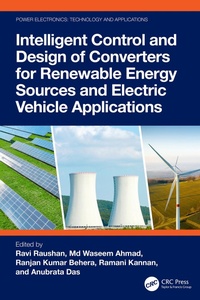
Intelligent Control and Design of Converters for Renewable Energy Sources and Electric Vehicle Applications
1st Edition
Published on 20. May 2026
272 pages
978-1-040-52373-5 (ISBN)
Description

The book discusses aspects such as converter design, control techniques, and other functionality augmented in the controllers mandated by the grid. It further explains how the power from renewable energy is converted to electrical energy and integrated into the grid smoothly. It showcases how an electrical motor powered by a battery is controlled in electric vehicles.
Features:
Incorporates the latest advancements in intelligent control and converter design for renewable energy and electric vehicles.
Focuses on power electronics and control for a wide range of topics like integration of renewable energy sources, converter topologies and their design, and energy management.
Discusses the efficient control applied to power electronic converters for improved performance.
Presents practical implementation guidelines for intelligent control algorithms and converter design.
Includes case studies, simulation examples, and real-world applications to facilitate the application of intelligent control techniques in renewable energy and electric vehicle systems.
It is primarily written for senior undergraduates, graduate students, and academic researchers in the fields of electrical engineering, electronics and communication engineering, computer science and engineering, and automotive engineering.
Features:
Incorporates the latest advancements in intelligent control and converter design for renewable energy and electric vehicles.
Focuses on power electronics and control for a wide range of topics like integration of renewable energy sources, converter topologies and their design, and energy management.
Discusses the efficient control applied to power electronic converters for improved performance.
Presents practical implementation guidelines for intelligent control algorithms and converter design.
Includes case studies, simulation examples, and real-world applications to facilitate the application of intelligent control techniques in renewable energy and electric vehicle systems.
It is primarily written for senior undergraduates, graduate students, and academic researchers in the fields of electrical engineering, electronics and communication engineering, computer science and engineering, and automotive engineering.
More details
Series
Edition
1. Auflage
Language
English
Place of publication
London
United Kingdom
Publishing group
Taylor & Francis Ltd
Target group
College/higher education
Professional and scholarly
Illustrations
38 Tables, black and white; 193 Line drawings, black and white; 1 Halftones, black and white; 194 Illustrations, black and white
File size
24,71 MB
ISBN-13
978-1-040-52373-5 (9781040523735)
Copyright in bibliographic data and cover images is held by Nielsen Book Services Limited or by the publishers or by their respective licensors: all rights reserved.
Schweitzer Classification
Other editions
Additional editions
Ravi Raushan | Md Waseem Ahmad | Ranjan Kumar Behera
Intelligent Control and Design of Converters for Renewable Energy Sources and Electric Vehicle Applications
Book
05/2026
1st Edition
CRC Press
€160.50
Shipment within 10-20 days
Persons
Ravi Raushan is currently working as an assistant professor in the Department of Electrical and Electronics Engineering at the National Institute of Technology Surathkal, Karnataka, India. His areas of research interest include multilevel inverters, power electronics, photovoltaic systems, and electrical drives. He has taught courses such as digital electronics, digital systems design, power electronics, and control systems. He has published research papers in journals and conferences of national and international repute.
Md Waseem Ahmad is working as an assistant professor in the Department of Electrical and Electronics Engineering at the National Institute of Technology Surathkal, Karnataka, India. His areas of expertise include efficient power electronic converters, fault diagnostics, and condition monitoring of power electronic converters. He has published research papers in journals and conferences of national and international repute.
Ranjan Kumar Behera is presently working as an associate professor in the Department of Electrical Engineering at the Indian Institute of Technology Patna, Bihar, India. He has published research papers in journals and conferences of national and international repute. His areas of research include power electronics converters, electrical machines and high-performance drives, microgrids and smart grids, solar and wind energy integration, and solar tree design for rural electrification. He has taught courses such as FACTS controllers in power systems, control of electric drives, distributed energy resources, and power electronics.
Ramani Kannan is working as a senior lecturer in the Department of Electrical and Electronics Engineering at the Universiti Teknologi PETRONAS (UTP), Malaysia. His areas of expertise include power electronics and drives, renewable energy, intelligent control techniques, and smart grid applications. He has published more than 200 research papers in journals and conferences of national and international repute. He is a senior member of the IEEE Power Electronics and Power Energy and a life member of the Indian Society for Technical Education.
Anubrata Das is presently working as an assistant professor in the Department of Electrical Engineering at the Indian Institute of Technology, Banaras Hindu University, India. He previously worked as a postdoctoral researcher at the University of Tennessee, Knoxville, TN, USA. His areas of research include power electronics, inverters, voltage regulation, transformers, electrical machines, and power electronic applications. He has published research papers in journals and conferences of national and international repute.
Md Waseem Ahmad is working as an assistant professor in the Department of Electrical and Electronics Engineering at the National Institute of Technology Surathkal, Karnataka, India. His areas of expertise include efficient power electronic converters, fault diagnostics, and condition monitoring of power electronic converters. He has published research papers in journals and conferences of national and international repute.
Ranjan Kumar Behera is presently working as an associate professor in the Department of Electrical Engineering at the Indian Institute of Technology Patna, Bihar, India. He has published research papers in journals and conferences of national and international repute. His areas of research include power electronics converters, electrical machines and high-performance drives, microgrids and smart grids, solar and wind energy integration, and solar tree design for rural electrification. He has taught courses such as FACTS controllers in power systems, control of electric drives, distributed energy resources, and power electronics.
Ramani Kannan is working as a senior lecturer in the Department of Electrical and Electronics Engineering at the Universiti Teknologi PETRONAS (UTP), Malaysia. His areas of expertise include power electronics and drives, renewable energy, intelligent control techniques, and smart grid applications. He has published more than 200 research papers in journals and conferences of national and international repute. He is a senior member of the IEEE Power Electronics and Power Energy and a life member of the Indian Society for Technical Education.
Anubrata Das is presently working as an assistant professor in the Department of Electrical Engineering at the Indian Institute of Technology, Banaras Hindu University, India. He previously worked as a postdoctoral researcher at the University of Tennessee, Knoxville, TN, USA. His areas of research include power electronics, inverters, voltage regulation, transformers, electrical machines, and power electronic applications. He has published research papers in journals and conferences of national and international repute.
Content
Chapter 1. Power Converter topologies for single-phase grid-tied PV Microinverters. Chapter 2. Adaptive Voltage Regulation in Inverter-Based Power Systems. Chapter 3. The Neutral Point Less (NPL-H) H-Type 3-Level Dual Inverter Topology for Renewable Energy Integration. Chapter 4. Machine Learning Control Techniques for DC-DC Converters. Chapter 5. Disturbance Rejection Controller of High Performance PMBLDC Motor Drives for Electric Vehicle Applications. Chapter 6. Mitigating Power Quality Challenges: MqSZS Grid-Tied Level-3 battery charger control with SVPWM for EV Charging Infrastructure. Chapter 7. Design and Implementation of Efficient EV Charger for CC and CV Mode of Operation while Maintaining Grid Code and Quality. Chapter 8. Mitigating Circulating Currents in Electric Vehicle Charging Stations with Multiple Parallel-Connected Non-Identical Three-Phase Vienna Rectifiers. Chapter 9. Analysis of Vehicle-to-Grid as an Auxiliary Support for Grid Faults. Chapter 10. Open Charge Point Protocol (OCPP): A Survey of Enabling Interoperability and Innovation in Electric Vehicle Charging Infrastructure
