

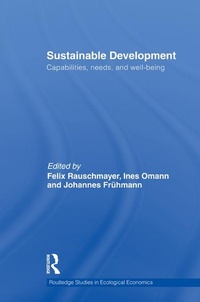
Sustainable Development
Capabilities, Needs, and Well-being
1st Edition
Published on 26. July 2012
192 pages
978-1-136-88677-5 (ISBN)
Description

This groundbreaking new work establishes links between sustainable development, needs, well-being, and the capabilities approach that is central to human development and the United Nations Development Programme. By challenging the role of people in sustainability policy, this collection's argument refocuses sustainable development on needs and makes it easier for people to relate positively to its core values. This exciting new book incites a whole new way of looking at sustainable development.
Even though the word 'needs' is central to the most popular definition of sustainable development, the concepts of needs and capabilities remain within the debate on human development, without going further into intergenerational justice or environmental protection. The discussion of needs reaches non-academics in a more direct way than talking about abstract thresholds, substitutability and other issues dear to academic debate on sustainability. This collection links the questions of intra- and intergenerational justice with issues of quality of life, life courses, and well-being. Dealing with needs entails dealing with deeper layers of consciousness, revealing emotions and questioning habits and values. In this way, the collection presents an opportunity for substantial social change as well as a challenge for research and policy-making.
This thought-provoking collection asks its readers to reconsider the role of needs based on the philosophical arguments presented, to understand how sustainability can become a part of the capability approach, to better consider the dependency of life chances on birth contingencies, and to see the relationship between capabilities, needs, and well-being in a different light. The editors finish by clarifying the possibilities and challenges of a needs-based sustainability policy for policy makers, and explain the role of deeply held values. This book should be of interest to postgraduates and researchers in Environmental and Ecological Economics, as well as many other disciplines including Political Economics, Social Ecology, Human Ecology, Sustainability Science and Developmental Politics.
Even though the word 'needs' is central to the most popular definition of sustainable development, the concepts of needs and capabilities remain within the debate on human development, without going further into intergenerational justice or environmental protection. The discussion of needs reaches non-academics in a more direct way than talking about abstract thresholds, substitutability and other issues dear to academic debate on sustainability. This collection links the questions of intra- and intergenerational justice with issues of quality of life, life courses, and well-being. Dealing with needs entails dealing with deeper layers of consciousness, revealing emotions and questioning habits and values. In this way, the collection presents an opportunity for substantial social change as well as a challenge for research and policy-making.
This thought-provoking collection asks its readers to reconsider the role of needs based on the philosophical arguments presented, to understand how sustainability can become a part of the capability approach, to better consider the dependency of life chances on birth contingencies, and to see the relationship between capabilities, needs, and well-being in a different light. The editors finish by clarifying the possibilities and challenges of a needs-based sustainability policy for policy makers, and explain the role of deeply held values. This book should be of interest to postgraduates and researchers in Environmental and Ecological Economics, as well as many other disciplines including Political Economics, Social Ecology, Human Ecology, Sustainability Science and Developmental Politics.
Reviews / Votes
'The collection of essays in this volume represents a significant and admirable effort to explore these links between capabilities, needs, and well-being and sustainable development. There is a fundamental connection between the two, but for too long the discussions of these have generally been kept separate.' - Dale S. Rothman (Denver University)'The audacity, personal involvement and academic rigor of the editors of this volume make it a reference work for researchers and policy advisors interested in sustainable development and human flourishing.' - Monica Guillen-Royo (University of Bath)
'This book provides an informative first step to a hopefully very lively debate of relevance for sustainability science, developmental politics, ecological economics and (environmental) ethics alike." - Lieske Voget-Kleschin (University of Greifswald)
More details
Series
Language
English
Place of publication
London
United Kingdom
Publishing group
Taylor & Francis Ltd
Target group
College/higher education
Illustrations
13 s/w Zeichnungen, 13 s/w Abbildungen, 12 s/w Tabellen
12 Tables, black and white; 13 Line drawings, black and white; 13 Illustrations, black and white
File size
2,99 MB
ISBN-13
978-1-136-88677-5 (9781136886775)
Copyright in bibliographic data and cover images is held by Nielsen Book Services Limited or by the publishers or by their respective licensors: all rights reserved.
Schweitzer Classification
Other editions
New editions
Additional editions
Felix Rauschmayer | Ines Omann | Johannes Fruehmann
Sustainable Development
Capabilities, Needs, and Well-being
Book
11/2011
1st Edition
Routledge
€71.00
Shipment within 15-20 days
Felix Rauschmayer | Ines Omann | Johannes Fruehmann
Sustainable Development
Capabilities, Needs, and Well-being
Book
10/2010
1st Edition
Routledge
€241.50
Shipment within 15-20 days
Persons
Felix Rauschmayer is a senior research fellow at the Helmholtz-Centre for Environmental Research, Leipzig, Germany.
Ines Omann is a senior researcher at the Sustainable Europe Research Institute, Austria. She is also a lecturer in ecological economics and sustainability at the University of Graz and the University of Natural Resources and Applied Life Sciences, Austria.
Johannes Fruehmann is a researcher at the Sustainable Europe Research Institute, Austria.
Ines Omann is a senior researcher at the Sustainable Europe Research Institute, Austria. She is also a lecturer in ecological economics and sustainability at the University of Graz and the University of Natural Resources and Applied Life Sciences, Austria.
Johannes Fruehmann is a researcher at the Sustainable Europe Research Institute, Austria.
Content
Preface: The Death and Rebirth of Economics 1. Needs, Capabilities, and Quality of Life: Refocusing Sustainable Development 2. The Overshadowing of Needs 3. Sustainability as a Challenge to the Capability Approach 4. From Individual Well-Being to Sustainable Development: A Path Where Psychologists and Economist Meet 5. The Life-Chances Concept: A Sociological Perspective on Equity and Sustainable Development 6. Human Needs Frameworks and Their Contribution as Analytical Instruments in Sustainable Development Policy-Making 7. A Plea for the Self-Aware Sustainability Researcher: Learning from Business Transformation Processes for Transitions to Sustainable Development 8. Transition Towards Sustainable Development: Which Tensions Emerge? How To Deal With Them?
