

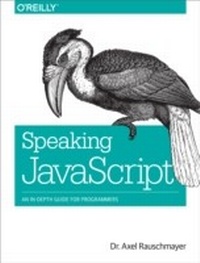
Speaking JavaScript
An In-Depth Guide for Programmers
1st Edition
Published on 25. February 2014
460 pages
978-1-4493-6501-1 (ISBN)
Description

Like it or not, JavaScript is everywhere these daysfrom browser to server to mobileand now you, too, need to learn the language or dive deeper than you have. This concise book guides you into and through JavaScript, written by a veteran programmer who once found himself in the same position.Speaking JavaScript helps you approach the language with four standalone sections. First, a quick-start guide teaches you just enough of the language to help you be productive right away. More experienced JavaScript programmers will find a complete and easy-to-read reference that covers each language feature in depth. Complete contents include:JavaScript quick start: Familiar with object-oriented programming? This part helps you learn JavaScript quickly and properly.JavaScript in depth: Learn details of ECMAScript 5, from syntax, variables, functions, and object-oriented programming to regular expressions and JSON with lots of examples. Pick a topic and jump in.Background: Understand JavaScripts history and its relationship with other programming languages.Tips, tools, and libraries: Survey existing style guides, best practices, advanced techniques, module systems, package managers, build tools, and learning resources.
More details
Other editions
Additional editions
Book
04/2014
1st Edition
O'Reilly
€47.00
Shipment within 10-20 days
Content
- Intro
- Copyright
- Table of Contents
- Preface
- What You Need to Know About This Book
- Tips for Reading This Book
- The Four Parts of This Book
- JavaScript Command Lines
- Notational Conventions
- Quickly Finding Documentation
- Safari® Books Online
- How to Contact Us
- Acknowledgments
- Preparing for JavaScript
- Help with JavaScript
- Reviewers
- Part I. JavaScript Quick Start
- Chapter 1. Basic JavaScript
- Background
- JavaScript Versus ECMAScript
- Influences and Nature of the Language
- Syntax
- An Overview of the Syntax
- Statements Versus Expressions
- Semicolons
- Comments
- Variables and Assignment
- Assignment
- Compound Assignment Operators
- Identifiers and Variable Names
- Values
- Primitive Values Versus Objects
- Primitive Values
- Objects
- undefined and null
- Categorizing Values Using typeof and instanceof
- Booleans
- Truthy and Falsy
- Binary Logical Operators
- Equality Operators
- Numbers
- Operators
- Strings
- String Operators
- String Methods
- Statements
- Conditionals
- Loops
- Functions
- Function Declarations Are Hoisted
- The Special Variable arguments
- Too Many or Too Few Arguments
- Optional Parameters
- Enforcing an Arity
- Converting arguments to an Array
- Exception Handling
- Strict Mode
- Variable Scoping and Closures
- Variables Are Function-Scoped
- Variables Are Hoisted
- Closures
- The IIFE Pattern: Introducing a New Scope
- Objects and Constructors
- Single Objects
- Arbitrary Property Keys
- Extracting Methods
- Functions Inside a Method
- Constructors: Factories for Objects
- Arrays
- Array Literals
- Array Methods
- Iterating over Arrays
- Regular Expressions
- Method test(): Is There a Match?
- Method exec(): Match and Capture Groups
- Method replace(): Search and Replace
- Math
- Other Functionality of the Standard Library
- Part II. Background
- Chapter 2. Why JavaScript?
- Is JavaScript Freely Available?
- Is JavaScript Elegant?
- Is JavaScript Useful?
- Graphical User Interfaces
- Other Technologies Complementing JavaScript
- Does JavaScript Have Good Tools?
- Is JavaScript Fast Enough?
- Is JavaScript Widely Used?
- Does JavaScript Have a Future?
- Conclusion
- Chapter 3. The Nature of JavaScript
- Quirks and Unorthodox Features
- Elegant Parts
- Influences
- Chapter 4. How JavaScript Was Created
- Chapter 5. Standardization: ECMAScript
- Chapter 6. Historical JavaScript Milestones
- Part III. JavaScript in Depth
- Chapter 7. JavaScript's Syntax
- An Overview of the Syntax
- Comments
- Expressions Versus Statements
- Expressions
- Statements
- Control Flow Statements and Blocks
- Rules for Using Semicolons
- No Semicolon After a Statement Ending with a Block
- The Empty Statement
- Automatic Semicolon Insertion
- Legal Identifiers
- Invoking Methods on Number Literals
- Strict Mode
- Switching on Strict Mode
- Strict Mode: Recommended, with Caveats
- Variables Must Be Declared in Strict Mode
- Functions in Strict Mode
- Setting and Deleting Immutable Properties Fails with an Exception in Strict Mode
- Unqualified Identifiers Can't Be Deleted in Strict Mode
- eval() Is Cleaner in Strict Mode
- Features That Are Forbidden in Strict Mode
- Chapter 8. Values
- JavaScript's Type System
- JavaScript's Types
- Static Versus Dynamic
- Static Typing Versus Dynamic Typing
- Static Type Checking Versus Dynamic Type Checking
- Coercion
- Primitive Values Versus Objects
- Primitive Values
- Objects
- undefined and null
- Occurrences of undefined and null
- Checking for undefined or null
- The History of undefined and null
- Changing undefined
- Wrapper Objects for Primitives
- Wrapper Objects Are Different from Primitives
- Wrapping and Unwrapping Primitives
- Primitives Borrow Their Methods from Wrappers
- Type Coercion
- Type Coercion Can Hide Bugs
- Functions for Converting to Boolean, Number, String, and Object
- Algorithm: ToPrimitive()-Converting a Value to a Primitive
- Chapter 9. Operators
- Operators and Objects
- Assignment Operators
- Compound Assignment Operators
- Equality Operators: === Versus ==
- Strict Equality (===, !==)
- Normal (Lenient) Equality (==, !=)
- There Are No Valid Use Cases for ==
- Ordering Operators
- The Algorithm
- The Plus Operator (+)
- The Algorithm
- Operators for Booleans and Numbers
- Special Operators
- The Conditional Operator ( ? : )
- The Comma Operator
- The void Operator
- Categorizing Values via typeof and instanceof
- typeof: Categorizing Primitives
- instanceof: Checking Whether an Object Is an Instance of a Given Constructor
- Object Operators
- Chapter 10. Booleans
- Converting to Boolean
- Manually Converting to Boolean
- Truthy and Falsy Values
- Logical Operators
- Binary Logical Operators: And (&&) and Or (||)
- Logical And (&&)
- Logical Or (||)
- Logical Not (!)
- Equality Operators, Ordering Operators
- The Function Boolean
- Chapter 11. Numbers
- Number Literals
- Exponent
- Invoking Methods on Literals
- Converting to Number
- Manually Converting to Number
- parseFloat()
- Special Number Values
- NaN
- Infinity
- Two Zeros
- The Internal Representation of Numbers
- Special Exponents
- Handling Rounding Errors
- Integers in JavaScript
- Ranges of Integers
- Representing Integers as Floating-Point Numbers
- Safe Integers
- Converting to Integer
- Integers via Math.floor(), Math.ceil(), and Math.round()
- Integers via the Custom Function ToInteger()
- 32-bit Integers via Bitwise Operators
- Integers via parseInt()
- Arithmetic Operators
- Bitwise Operators
- Background Knowledge
- Bitwise Not Operator
- Binary Bitwise Operators
- Bitwise Shift Operators
- The Function Number
- Number Constructor Properties
- Number Prototype Methods
- Number.prototype.toFixed(fractionDigits?)
- Number.prototype.toPrecision(precision?)
- Number.prototype.toString(radix?)
- Number.prototype.toExponential(fractionDigits?)
- Functions for Numbers
- Sources for This Chapter
- Chapter 12. Strings
- String Literals
- Escaping in String Literals
- Character Access
- Converting to String
- Manually Converting to String
- Comparing Strings
- Concatenating Strings
- Concatenation: The Plus (+) Operator
- Concatenation: Joining an Array of String Fragments
- The Function String
- String Constructor Method
- String Instance Property length
- String Prototype Methods
- Extract Substrings
- Transform
- Search and Compare
- Test, Match, and Replace with Regular Expressions
- Chapter 13. Statements
- Declaring and Assigning Variables
- The Bodies of Loops and Conditionals
- Loops
- Mechanisms to Be Used with Loops
- while
- do-while
- for
- for-in
- for each-in
- Conditionals
- if-then-else
- switch
- The with Statement
- Syntax and Semantics
- The with Statement Is Deprecated
- The Rationale for the Deprecation
- The debugger Statement
- Chapter 14. Exception Handling
- What Is Exception Handling?
- Exception Handling in JavaScript
- throw
- try-catch-finally
- Examples
- Error Constructors
- Stack Traces
- Implementing Your Own Error Constructor
- Chapter 15. Functions
- The Three Roles of Functions in JavaScript
- Terminology: "Parameter" Versus "Argument"
- Defining Functions
- Function Expressions
- Function Declarations
- The Function Constructor
- Hoisting
- The Name of a Function
- Which Is Better: A Function Declaration or a Function Expression?
- More Control over Function Calls: call(), apply(), and bind()
- func.apply(thisValue, argArray)
- func.bind(thisValue, arg1, ..., argN)
- Handling Missing or Extra Parameters
- All Parameters by Index: The Special Variable arguments
- Mandatory Parameters, Enforcing a Minimum Arity
- Optional Parameters
- Simulating Pass-by-Reference Parameters
- Pitfall: Unexpected Optional Parameters
- Named Parameters
- Named Parameters as Descriptions
- Optional Named Parameters
- Simulating Named Parameters in JavaScript
- Chapter 16. Variables: Scopes, Environments, and Closures
- Declaring a Variable
- Background: Static Versus Dynamic
- Background: The Scope of a Variable
- Variables Are Function-Scoped
- Variable Declarations Are Hoisted
- Introducing a New Scope via an IIFE
- IIFE Variation: Prefix Operators
- IIFE Variation: Already Inside Expression Context
- IIFE Variation: An IIFE with Parameters
- IIFE Applications
- Global Variables
- Best Practice: Avoid Creating Global Variables
- Module Systems Lead to Fewer Globals
- The Global Object
- Cross-Platform Considerations
- Use Cases for window
- Environments: Managing Variables
- Closures: Functions Stay Connected to Their Birth Scopes
- Handling Closures via Environments
- Pitfall: Inadvertently Sharing an Environment
- Chapter 17. Objects and Inheritance
- Layer 1: Single Objects
- Kinds of Properties
- Object Literals
- Dot Operator (.): Accessing Properties via Fixed Keys
- Unusual Property Keys
- Bracket Operator ([]): Accessing Properties via Computed Keys
- Converting Any Value to an Object
- this as an Implicit Parameter of Functions and Methods
- Calling Functions While Setting this: call(), apply(), and bind()
- apply() for Constructors
- Pitfall: Losing this When Extracting a Method
- Pitfall: Functions Inside Methods Shadow this
- Layer 2: The Prototype Relationship Between Objects
- Inheritance
- Overriding
- Sharing Data Between Objects via a Prototype
- Getting and Setting the Prototype
- The Special Property __proto__
- Setting and Deleting Affects Only Own Properties
- Iteration and Detection of Properties
- Listing Own Property Keys
- Listing All Property Keys
- Checking Whether a Property Exists
- Examples
- Best Practices: Iterating over Own Properties
- Accessors (Getters and Setters)
- Defining Accessors via an Object Literal
- Defining Accessors via Property Descriptors
- Accessors and Inheritance
- Property Attributes and Property Descriptors
- Property Attributes
- Property Descriptors
- Getting and Defining Properties via Descriptors
- Copying an Object
- Properties: Definition Versus Assignment
- Inherited Read-Only Properties Can't Be Assigned To
- Enumerability: Best Practices
- Protecting Objects
- Preventing Extensions
- Sealing
- Freezing
- Pitfall: Protection Is Shallow
- Layer 3: Constructors-Factories for Instances
- The new Operator Implemented in JavaScript
- Terminology: The Two Prototypes
- The constructor Property of Instances
- The instanceof Operator
- Tips for Implementing Constructors
- Data in Prototype Properties
- Avoid Prototype Properties with Initial Values for Instance Properties
- Avoid Nonpolymorphic Prototype Properties
- Polymorphic Prototype Properties
- Keeping Data Private
- Private Data in the Environment of a Constructor (Crockford Privacy Pattern)
- Private Data in Properties with Marked Keys
- Private Data in Properties with Reified Keys
- Keeping Global Data Private via IIFEs
- Layer 4: Inheritance Between Constructors
- Inheriting Instance Properties
- Inheriting Prototype Properties
- Ensuring That instanceof Works
- Overriding a Method
- Making a Supercall
- Avoiding Hardcoding the Name of the Superconstructor
- Example: Constructor Inheritance in Use
- Example: The Inheritance Hierarchy of Built-in Constructors
- Antipattern: The Prototype Is an Instance of the Superconstructor
- Methods of All Objects
- Conversion to Primitive
- Object.prototype.toLocaleString()
- Prototypal Inheritance and Properties
- Generic Methods: Borrowing Methods from Prototypes
- Accessing Object.prototype and Array.prototype via Literals
- Examples of Calling Methods Generically
- Array-Like Objects and Generic Methods
- A List of All Generic Methods
- Pitfalls: Using an Object as a Map
- Pitfall 1: Inheritance Affects Reading Properties
- Pitfall 2: Overriding Affects Invoking Methods
- Pitfall 3: The Special Property __proto__
- The dict Pattern: Objects Without Prototypes Are Better Maps
- Best Practices
- Cheat Sheet: Working with Objects
- Chapter 18. Arrays
- Overview
- Arrays Are Maps, Not Tuples
- Arrays Can Also Have Properties
- Creating Arrays
- The Array Constructor
- Multidimensional Arrays
- Array Indices
- The in Operator and Indices
- Deleting Array Elements
- Array Indices in Detail
- length
- Manually Increasing the Length of an Array
- Decreasing the Length of an Array
- The Maximum Length
- Holes in Arrays
- Creating Holes
- Sparse Arrays Versus Dense Arrays
- Which Operations Ignore Holes, and Which Consider Them?
- Removing Holes from Arrays
- Array Constructor Method
- Array Prototype Methods
- Adding and Removing Elements (Destructive)
- Sorting and Reversing Elements (Destructive)
- Comparing Numbers
- Comparing Strings
- Comparing Objects
- Concatenating, Slicing, Joining (Nondestructive)
- Searching for Values (Nondestructive)
- Iteration (Nondestructive)
- Examination Methods
- Transformation Methods
- Reduction Methods
- Pitfall: Array-Like Objects
- Best Practices: Iterating over Arrays
- Chapter 19. Regular Expressions
- Regular Expression Syntax
- Atoms: General
- Atoms: Character Classes
- Atoms: Groups
- Quantifiers
- Assertions
- Disjunction
- Unicode and Regular Expressions
- Creating a Regular Expression
- Literal Versus Constructor
- Flags
- Instance Properties of Regular Expressions
- Examples of Creating Regular Expressions
- RegExp.prototype.test: Is There a Match?
- String.prototype.search: At What Index Is There a Match?
- RegExp.prototype.exec: Capture Groups
- First Match (Flag /g Not Set)
- All Matches (Flag /g Set)
- String.prototype.match: Capture Groups or Return All Matching Substrings
- String.prototype.replace: Search and Replace
- Replacement Is a String
- Replacement Is a Function
- Problems with the Flag /g
- Tips and Tricks
- Quoting Text
- Pitfall: Without an Assertion (e.g., ^, $), a Regular Expression Is Found Anywhere
- Matching Everything or Nothing
- Manually Implementing Lookbehind
- Regular Expression Cheat Sheet
- Chapter 20. Dates
- The Date Constructor
- Date Constructor Methods
- Date Prototype Methods
- Time Unit Getters and Setters
- Various Getters and Setters
- Convert a Date to a String
- Date Time Formats
- Date Formats (No Time)
- Time Formats (No Date)
- Date Time Formats
- Time Values: Dates as Milliseconds Since 1970-01-01
- Converting a Date to a Number
- Chapter 21. Math
- Math Properties
- Numerical Functions
- Trigonometric Functions
- Other Functions
- Chapter 22. JSON
- Background
- Data Format
- History
- Grammar
- JSON.stringify(value, replacer?, space?)
- Data Ignored by JSON.stringify()
- The toJSON() Method
- JSON.parse(text, reviver?)
- Transforming Data via Node Visitors
- JSON.stringify()
- JSON.parse()
- Chapter 23. Standard Global Variables
- Constructors
- Error Constructors
- Nonconstructor Functions
- Encoding and Decoding Text
- Categorizing and Parsing Numbers
- Dynamically Evaluating JavaScript Code via eval() and new Function()
- Evaluating Code Using eval()
- Evaluating Code Using new Function()
- eval() Versus new Function()
- Best Practices
- Conclusion
- The Console API
- How Standardized Is the Console API Across Engines?
- Simple Logging
- Checking and Counting
- Formatted Logging
- Profiling and Timing
- Namespaces and Special Values
- Chapter 24. Unicode and JavaScript
- Unicode History
- Important Unicode Concepts
- Code Points
- Unicode Encodings
- JavaScript Source Code and Unicode
- Source Code Internally
- Source Code Externally
- JavaScript Strings and Unicode
- Escape Sequences
- Refering to Astral Plane Characters via Escapes
- Counting Characters
- Unicode Normalization
- JavaScript Regular Expressions and Unicode
- Matching Any Code Unit and Any Code Point
- Libraries
- Recommended Reading and Chapter Sources
- Chapter 25. New in ECMAScript 5
- New Features
- Syntactic Changes
- New Functionality in the Standard Library
- Metaprogramming
- New Methods
- JSON
- Tips for Working with Legacy Browsers
- Part IV. Tips, Tools, and Libraries
- Chapter 26. A Meta Code Style Guide
- Existing Style Guides
- General Tips
- Code Should Be Consistent
- Code Should Be Easy to Understand
- Commonly Accepted Best Practices
- Brace Styles
- Prefer Literals to Constructors
- Don't Be Clever
- Acceptable Cleverness
- Controversial Rules
- Syntax
- Variables
- Object Orientation
- Miscellaneous
- Conclusion
- Chapter 27. Language Mechanisms for Debugging
- Chapter 28. Subclassing Built-ins
- Terminology
- Obstacle 1: Instances with Internal Properties
- Workaround for Obstacle 1
- Caveats
- Obstacle 2: A Constructor That Can't Be Called as a Function
- Workaround for Obstacle 2
- Another Solution: Delegation
- Chapter 29. JSDoc: Generating API Documentation
- The Basics of JSDoc
- Syntax
- Naming Types
- Basic Tags
- Documenting Functions and Methods
- Inline Type Information ("Inline Doc Comments")
- Documenting Variables, Parameters, and Instance Properties
- Documenting Classes
- Defining a Class via a Constructor Function
- Defining a Class via an Object Literal
- Defining a Class via an Object Literal with an @constructs Method
- Subclassing
- Other Useful Tags
- Chapter 30. Libraries
- Shims Versus Polyfills
- Four Language Libraries
- The ECMAScript Internationalization API
- The ECMAScript Internationalization API, Edition 1
- What Kind of Standard Is It?
- When Can I Use It?
- Further Reading
- Directories for JavaScript Resources
- Chapter 31. Module Systems and Package Managers
- Module Systems
- Package Managers
- Quick and Dirty Modules
- Chapter 32. More Tools
- Chapter 33. What to Do Next
- Index
- About the Author
