

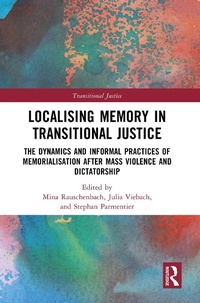
Localising Memory in Transitional Justice
The Dynamics and Informal Practices of Memorialisation after Mass Violence and Dictatorship
1st Edition
Published on 30. May 2022
288 pages
978-1-000-57568-2 (ISBN)
Description

This collection adds to the critical transitional justice scholarship that calls for "transitional justice from below" and that makes visible the complex and oftentimes troubled entanglements between justice endeavours, locality, and memory-making. Broadening this perspective, it explores informal memory practices across various contexts with a focus on their individual and collective dynamics and their intersections, reaching also beyond a conceptualisation of memory as mere symbolic reparation and politics of memory.
It seeks to highlight the hidden, unwritten, and multifaceted in today's memory boom by focusing on the memorialisation practices of communities, activists, families, and survivors. Organising its analytical focal point around the localisation of memory, it offers valuable and new insights on how and under what conditions localised memory practices may contribute to recognition and social transformation, as well as how they may at best be inclusive, or exclusive, of dynamic and diverse memories.
Drawing on inter- and multi-disciplinary approaches, this book brings an in-depth and nuanced understanding of local memory practices and the dynamics attached to these in transitional justice contexts. It will be of much interest to students and scholars of memory and genocide studies, peace and conflict studies, transitional justice, sociology, and anthropology.
It seeks to highlight the hidden, unwritten, and multifaceted in today's memory boom by focusing on the memorialisation practices of communities, activists, families, and survivors. Organising its analytical focal point around the localisation of memory, it offers valuable and new insights on how and under what conditions localised memory practices may contribute to recognition and social transformation, as well as how they may at best be inclusive, or exclusive, of dynamic and diverse memories.
Drawing on inter- and multi-disciplinary approaches, this book brings an in-depth and nuanced understanding of local memory practices and the dynamics attached to these in transitional justice contexts. It will be of much interest to students and scholars of memory and genocide studies, peace and conflict studies, transitional justice, sociology, and anthropology.
More details
Series
Edition
1. Auflage
Language
English
Place of publication
London
United Kingdom
Publishing group
Taylor & Francis Ltd
Target group
College/higher education
ISBN-13
978-1-000-57568-2 (9781000575682)
Copyright in bibliographic data and cover images is held by Nielsen Book Services Limited or by the publishers or by their respective licensors: all rights reserved.
Schweitzer Classification
Other editions
Additional editions
Mina Rauschenbach | Julia Viebach | Stephan Parmentier
Localising Memory in Transitional Justice
The Dynamics and Informal Practices of Memorialisation after Mass Violence and Dictatorship
Book
01/2024
1st Edition
Routledge
€65.60
Shipment within 10-20 days
Mina Rauschenbach | Julia Viebach | Stephan Parmentier
Localising Memory in Transitional Justice
The Dynamics and Informal Practices of Memorialisation after Mass Violence and Dictatorship
Book
05/2022
1st Edition
Routledge
€206.70
Shipment within 15-20 days
Persons
Mina Rauschenbach is based at the University of Lausanne; Julia Viebach is at the University of Oxford; and Stephan Parmentier is based at KU Leuven.
Content
General introduction
Mina Rauschenbach, Julia Viebach and Stephan Parmentier
PART I Memory and transitional justice
International memory entrepreneurs' prescriptions for the remembrance of the Srebrenica genocide: What implications for local understandings of collective victimhood?
Mina Rauschenbach
Transitional justice principles versus survivors' experience: Conflicting interpretations in Kosovo case study involving missing persons and their memorialisation
Melanie Klinkner and Stephanie Schwandner-Sievers
PART II Memory dynamics in transitional justice
The micro-politics of remembering "the 1994 genocide against the Tutsi" in Rwanda: On the anonymous dead in Karongi district, western Rwanda
Erin Jessee
Bottom-up and thought-provoking sites of memory
Anita Ferrara
Informal commemoration in post-war Burundi: Exploring the usefulness and the limits of the concept
Andrea Purdekova
The struggle to remember: Rhodes Must Fall in South Africa
Ingrid Samset
PART III Localised memory in transitional justice
Place-bound proximity at Rwanda's genocide memorials: On coming home to the dead and the affective force of their remains
Julia Viebach
Missing people and missing stories in the aftermath of genocide: Reclaiming local memories at the places of suffering
Hariz Halilovich
Music, testimony, and emotional engagement in alternative memorial ceremonies in Palestine-Israel
Luisa Gandolfo
Epilogue: Localising memory and reinventing the present
Brandon Hamber
Mina Rauschenbach, Julia Viebach and Stephan Parmentier
PART I Memory and transitional justice
International memory entrepreneurs' prescriptions for the remembrance of the Srebrenica genocide: What implications for local understandings of collective victimhood?
Mina Rauschenbach
Transitional justice principles versus survivors' experience: Conflicting interpretations in Kosovo case study involving missing persons and their memorialisation
Melanie Klinkner and Stephanie Schwandner-Sievers
PART II Memory dynamics in transitional justice
The micro-politics of remembering "the 1994 genocide against the Tutsi" in Rwanda: On the anonymous dead in Karongi district, western Rwanda
Erin Jessee
Bottom-up and thought-provoking sites of memory
Anita Ferrara
Informal commemoration in post-war Burundi: Exploring the usefulness and the limits of the concept
Andrea Purdekova
The struggle to remember: Rhodes Must Fall in South Africa
Ingrid Samset
PART III Localised memory in transitional justice
Place-bound proximity at Rwanda's genocide memorials: On coming home to the dead and the affective force of their remains
Julia Viebach
Missing people and missing stories in the aftermath of genocide: Reclaiming local memories at the places of suffering
Hariz Halilovich
Music, testimony, and emotional engagement in alternative memorial ceremonies in Palestine-Israel
Luisa Gandolfo
Epilogue: Localising memory and reinventing the present
Brandon Hamber
