

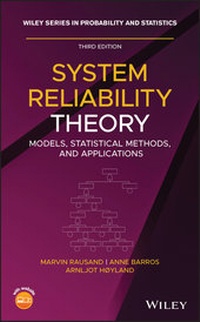
System Reliability Theory
Description

System Reliability Theory: Models, Statistical Methods, and Applications, Third Edition presents an updated and revised look at system reliability theory, modeling, and analytical methods. The new edition is based on feedback to the second edition from numerous students, professors, researchers, and industries around the world. New sections and chapters are added together with new real-world industry examples, and standards and problems are revised and updated.
System Reliability Theory covers a broad and deep array of system reliability topics, including:
· In depth discussion of failures and failure modes
· The main system reliability assessment methods
· Common-cause failure modeling
· Deterioration modeling
· Maintenance modeling and assessment using Python code
· Bayesian probability and methods
· Life data analysis using R
Perfect for undergraduate and graduate students taking courses in reliability engineering, this book also serves as a reference and resource for practicing statisticians and engineers.
Throughout, the book has a practical focus, incorporating industry feedback and real-world industry problems and examples.
More details
Other editions
Additional editions
Persons
MARVIN RAUSAND is Professor Emeritus in the department of Mechanical and Industrial Engineering at the Norwegian University of Science and Technology (NTNU), Norway, and author of Risk Assessment: Theory, Methods, and Applications and Reliability of Safety-Critical Systems: Theory and Applications, both published by Wiley.
ANNE BARROS, PHD, is Professor in reliability and maintenance engineering at Ecole CentraleSupélec, University of Paris-Saclay, France. Her research focus is on degradation modeling, prognostics, condition based and predictive maintenance. She got a PHD then a professorship position at University of Technology of Troyes, France (2003 2014) and spent five years as a full-time professor at NTNU, Norway (2014 2019). She is currently heading a research group and holds an industrial chair at CentraleSupélec with the ambition to provide reliability assessment and maintenance modeling methods for systems of systems.
The late ARNLJOT HØYLAND, PHD, was a Professor in the Department of Mathematical Sciences at the Norwegian University of Science and Technology.
Content
Preface xxiii
About the Companion Website xxix
1 Introduction 1
1.1 What is Reliability? 1
1.1.1 Service Reliability 2
1.1.2 Past and Future Reliability 3
1.2 The Importance of Reliability 3
1.2.1 Related Applications 4
1.3 Basic Reliability Concepts 6
1.3.1 Reliability 6
1.3.2 Maintainability and Maintenance 8
1.3.3 Availability 8
1.3.4 Quality 9
1.3.5 Dependability 9
1.3.6 Safety and Security 10
1.3.7 RAM and RAMS 10
1.4 Reliability Metrics 11
1.4.1 Reliability Metrics for a Technical Item 11
1.4.2 Reliability Metrics for a Service 12
1.5 Approaches to Reliability Analysis 12
1.5.1 The Physical Approach to Reliability 13
1.5.2 Systems Approach to Reliability 13
1.6 Reliability Engineering 15
1.6.1 Roles of the Reliability Engineer 16
1.6.2 Timing of Reliability Studies 17
1.7 Objectives, Scope, and Delimitations of the Book 17
1.8 Trends and Challenges 19
1.9 Standards and Guidelines 20
1.10 History of System Reliability 20
1.11 Problems 26
References 27
2 The Study Object and its Functions 31
2.1 Introduction 31
2.2 System and System Elements 31
2.2.1 Item 32
2.2.2 Embedded Item 33
2.3 Boundary Conditions 33
2.3.1 Closed and Open Systems 34
2.4 Operating Context 35
2.5 Functions and Performance Requirements 35
2.5.1 Functions 35
2.5.2 Performance Requirements 36
2.5.3 Classification of Functions 37
2.5.4 Functional Modeling and Analysis 38
2.5.5 Function Trees 38
2.5.6 SADT and IDEF 0 39
2.6 System Analysis 41
2.6.1 Synthesis 41
2.7 Simple, Complicated, and Complex Systems 42
2.8 System Structure Modeling 44
2.8.1 Reliability Block Diagram 44
2.8.2 Series Structure 46
2.8.3 Parallel Structure 46
2.8.4 Redundancy 47
2.8.5 Voted Structure 47
2.8.6 Standby Structure 48
2.8.7 More Complicated Structures 48
2.8.8 Two Different System Functions 49
2.8.9 Practical Construction of RBDs 50
2.9 Problems 51
References 52
3 Failures and Faults 55
3.1 Introduction 55
3.1.1 States and Transitions 56
3.1.2 Operational Modes 56
3.2 Failures 57
3.2.1 Failures in a State 58
3.2.2 Failures During Transition 59
3.3 Faults 60
3.4 Failure Modes 60
3.5 Failure Causes and Effects 62
3.5.1 Failure Causes 62
3.5.2 Proximate Causes and Root Causes 63
3.5.3 Hierarchy of Causes 64
3.6 Classification of Failures and Failure Modes 64
3.6.1 Classification According to Local Consequence 65
3.6.2 Classification According to Cause 65
3.6.3 Failure Mechanisms 70
3.6.4 Software Faults 71
3.6.5 Failure Effects 71
3.7 Failure/Fault Analysis 72
3.7.1 Cause and Effect Analysis 73
3.7.2 Root Cause Analysis 74
3.8 Problems 76
References 77
4 Qualitative System Reliability Analysis 79
4.1 Introduction 79
4.1.1 Deductive Versus Inductive Analysis 80
4.2 FMEA/FMECA 80
4.2.1 Types of FMECA 81
4.2.2 Objectives of FMECA 82
4.2.3 FMECA Procedure 83
4.2.4 Applications 87
4.3 Fault Tree Analysis 88
4.3.1 Fault Tree Symbols and Elements 88
4.3.2 Definition of the Problem and the Boundary Conditions 91
4.3.3 Constructing the Fault Tree 92
4.3.4 Identification of Minimal Cut and Path Sets 95
4.3.5 MOCUS 96
4.3.6 Qualitative Evaluation of the Fault Tree 98
4.3.7 Dynamic Fault Trees 101
4.4 Event Tree Analysis 103
4.4.1 Initiating Event 104
4.4.2 Safety Functions 105
4.4.3 Event Tree Construction 106
4.4.4 Description of Resulting Event Sequences 106
4.5 Fault Trees versus Reliability Block Diagrams 109
4.5.1 Recommendation 111
4.6 Structure Function 111
4.6.1 Series Structure 112
4.6.2 Parallel Structure 112
4.6.3 koon:G Structure 113
4.6.4 Truth Tables 114
4.7 System Structure Analysis 114
4.7.1 Single Points of Failure 115
4.7.2 Coherent Structures 115
4.7.3 General Properties of Coherent Structures 117
4.7.4 Structures Represented by Paths and Cuts 119
4.7.5 Pivotal Decomposition 123
4.7.6 Modules of Coherent Structures 124
4.8 Bayesian Networks 127
4.8.1 Illustrative Examples 128
4.9 Problems 131
References 138
5 Probability Distributions in Reliability Analysis 141
5.1 Introduction 141
5.1.1 State Variable 142
5.1.2 Time-to-Failure 142
5.2 A Dataset 143
5.2.1 Relative Frequency Distribution 143
5.2.2 Empirical Distribution and Survivor Function 144
5.3 General Characteristics of Time-to-Failure Distributions 145
5.3.1 Survivor Function 147
5.3.2 Failure Rate Function 148
5.3.3 Conditional Survivor Function 153
5.3.4 Mean Time-to-Failure 154
5.3.5 Additional Probability Metrics 155
5.3.6 Mean Residual Lifetime 157
5.3.7 Mixture of Time-to-Failure Distributions 160
5.4 Some Time-to-Failure Distributions 161
5.4.1 The Exponential Distribution 161
5.4.2 The Gamma Distribution 168
5.4.3 TheWeibull Distribution 173
5.4.4 The Normal Distribution 180
5.4.5 The Lognormal Distribution 183
5.4.6 Additional Time-to-Failure Distributions 188
5.5 Extreme Value Distributions 188
5.5.1 The Gumbel Distribution of the Smallest Extreme 190
5.5.2 The Gumbel Distribution of the Largest Extreme 191
5.5.3 TheWeibull Distribution of the Smallest Extreme 191
5.6 Time-to-Failure Models With Covariates 193
5.6.1 Accelerated Failure Time Models 194
5.6.2 The Arrhenius Model 195
5.6.3 Proportional Hazards Models 198
5.7 Additional Continuous Distributions 198
5.7.1 The Uniform Distribution 198
5.7.2 The Beta Distribution 199
5.8 Discrete Distributions 200
5.8.1 Binomial Situation 200
5.8.2 The Binomial Distribution 201
5.8.3 The Geometric Distribution 201
5.8.4 The Negative Binomial Distribution 202
5.8.5 The Homogeneous Poisson Process 203
5.9 Classes of Time-to-Failure Distributions 205
5.9.1 IFR and DFR Distributions 206
5.9.2 IFRA and DFRA Distributions 208
5.9.3 NBU and NWU Distributions 208
5.9.4 NBUE and NWUE Distributions 209
5.9.5 Some Implications 209
5.10 Summary of Time-to-Failure Distributions 210
5.11 Problems 210
References 218
6 System Reliability Analysis 221
6.1 Introduction 221
6.1.1 Assumptions 222
6.2 System Reliability 222
6.2.1 Reliability of Series Structures 223
6.2.2 Reliability of Parallel Structures 224
6.2.3 Reliability of koon Structures 225
6.2.4 Pivotal Decomposition 226
6.2.5 Critical Component 227
6.3 Nonrepairable Systems 228
6.3.1 Nonrepairable Series Structures 228
6.3.2 Nonrepairable Parallel Structures 230
6.3.3 Nonrepairable 2oo3 Structures 234
6.3.4 A Brief Comparison 235
6.3.5 Nonrepairable koon Structures 236
6.4 Standby Redundancy 237
6.4.1 Passive Redundancy, Perfect Switching, No Repairs 238
6.4.2 Cold Standby, Imperfect Switch, No Repairs 240
6.4.3 Partly Loaded Redundancy, Imperfect Switch, No Repairs 241
6.5 Single Repairable Items 242
6.5.1 Availability 243
6.5.2 Average Availability with Perfect Repair 244
6.5.3 Availability of a Single Item with Constant Failure and Repair Rates 246
6.5.4 Operational Availability 247
6.5.5 Production Availability 248
6.5.6 Punctuality 249
6.5.7 Failure Rate of Repairable Items 249
6.6 Availability of Repairable Systems 252
6.6.1 The MUT and MDT of Repairable Systems 253
6.6.2 Computation Based on Minimal Cut Sets 258
6.6.3 Uptimes and Downtimes for Reparable Systems 260
6.7 Quantitative Fault Tree Analysis 262
6.7.1 Terminology and Symbols 263
6.7.2 Delimitations and Assumptions 263
6.7.3 Fault Trees with a Single AND-Gate 264
6.7.4 Fault Tree with a Single OR-Gate 265
6.7.5 The Upper Bound Approximation Formula for Q0(t) 265
6.7.6 The Inclusion-Exclusion Principle 267
6.7.7 ROCOF of a Minimal Cut Parallel Structure 271
6.7.8 Frequency of the TOP Event 271
6.7.9 Binary Decision Diagrams 273
6.8 Event Tree Analysis 275
6.9 Bayesian Networks 277
6.9.1 Influence and Cause 278
6.9.2 Independence Assumptions 278
6.9.3 Conditional Probability Table 279
6.9.4 Conditional Independence 280
6.9.5 Inference and Learning 282
6.9.6 BN and Fault Tree Analysis 282
6.10 Monte Carlo Simulation 284
6.10.1 Random Number Generation 285
6.10.2 Monte Carlo Next Event Simulation 287
6.10.3 Simulation of Multicomponent Systems 289
6.11 Problems 291
References 296
7 Reliability Importance Metrics 299
7.1 Introduction 299
7.1.1 Objectives of Reliability Importance Metrics 300
7.1.2 Reliability Importance Metrics Considered 300
7.1.3 Assumptions and Notation 301
7.2 Critical Components 302
7.3 Birnbaum's Metric for Structural Importance 304
7.4 Birnbaum's Metric of Reliability Importance 305
7.4.1 Birnbaum's Metric in Fault Tree Analysis 307
7.4.2 A Second Definition of Birnbaum's Metric 308
7.4.3 A Third Definition of Birnbaum's Metric 310
7.4.4 Computation of Birnbaum's Metric for Structural Importance 312
7.4.5 Variants of Birnbaum's Metric 312
7.5 Improvement Potential 313
7.5.1 Relation to Birnbaum's Metric 314
7.5.2 A Variant of the Improvement Potential 314
7.6 Criticality Importance 315
7.7 Fussell-Vesely's Metric 317
7.7.1 Derivation of Formulas for Fussell-Vesely's Metric 317
7.7.2 Relationship to Other Metrics for Importance 320
7.8 Differential Importance Metric 323
7.8.1 Option 1 323
7.8.2 Option 2 324
7.9 Importance Metrics for Safety Features 326
7.9.1 Risk AchievementWorth 327
7.9.2 Risk ReductionWorth 329
7.9.3 Relationship with the Improvement Potential 330
7.10 Barlow-Proschan's Metric 331
7.11 Problems 333
References 335
8 Dependent Failures 337
8.1 Introduction 337
8.1.1 Dependent Events and Variables 337
8.1.2 Correlated Variables 338
8.2 Types of Dependence 340
8.3 Cascading Failures 340
8.3.1 Tight Coupling 342
8.4 Common-Cause Failures 342
8.4.1 Multiple Failures that Are Not a CCF 344
8.4.2 Causes of CCF 344
8.4.3 Defenses Against CCF 345
8.5 CCF Models and Analysis 346
8.5.1 Explicit Modeling 347
8.5.2 Implicit Modeling 348
8.5.3 Modeling Approach 348
8.5.4 Model Assumptions 349
8.6 Basic Parameter Model 349
8.6.1 Probability of a Specific Multiplicity 350
8.6.2 Conditional Probability of a Specific Multiplicity 351
8.7 Beta-Factor Model 352
8.7.1 Relation to the BPM 354
8.7.2 Beta-Factor Model in System Analysis 354
8.7.3 Beta-Factor Model for Nonidentical Components 358
8.7.4 C-Factor Model 360
8.8 Multi-parameter Models 360
8.8.1 Binomial Failure Rate Model 360
8.8.2 Multiple Greek Letter Model 362
8.8.3 Alpha-Factor Model 364
8.8.4 Multiple Beta-Factor Model 365
8.9 Problems 366
References 368
9 Maintenance and Maintenance Strategies 371
9.1 Introduction 371
9.1.1 What is Maintenance? 372
9.2 Maintainability 372
9.3 Maintenance Categories 374
9.3.1 Completeness of a Repair Task 377
9.3.2 Condition Monitoring 377
9.4 Maintenance Downtime 378
9.4.1 Downtime Caused by Failures 379
9.4.2 Downtime of a Series Structure 381
9.4.3 Downtime of a Parallel Structure 381
9.4.4 Downtime of a General Structure 382
9.5 Reliability Centered Maintenance 382
9.5.1 What is RCM? 383
9.5.2 Main Steps of an RCM Analysis 384
9.6 Total Productive Maintenance 396
9.7 Problems 398
References 399
10 Counting Processes 401
10.1 Introduction 401
10.1.1 Counting Processes 401
10.1.2 Basic Concepts 406
10.1.3 Martingale Theory 408
10.1.4 Four Types of Counting Processes 409
10.2 Homogeneous Poisson Processes 410
10.2.1 Main Features of the HPP 411
10.2.2 Asymptotic Properties 412
10.2.3 Estimate and Confidence Interval 412
10.2.4 Sum and Decomposition of HPPs 413
10.2.5 Conditional Distribution of Failure Time 414
10.2.6 Compound HPPs 415
10.3 Renewal Processes 417
10.3.1 Basic Concepts 417
10.3.2 The Distribution of Sn 418
10.3.3 The Distribution of N(t) 420
10.3.4 The Renewal Function 421
10.3.5 The Renewal Density 423
10.3.6 Age and Remaining Lifetime 427
10.3.7 Bounds for the Renewal Function 431
10.3.8 Superimposed Renewal Processes 433
10.3.9 Renewal Reward Processes 434
10.3.10 Delayed Renewal Processes 436
10.3.11 Alternating Renewal Processes 438
10.4 Nonhomogeneous Poisson Processes 447
10.4.1 Introduction and Definitions 447
10.4.2 Some Results 449
10.4.3 Parametric NHPP Models 452
10.4.4 Statistical Tests of Trend 454
10.5 Imperfect Repair Processes 455
10.5.1 Brown and Proschan's model 456
10.5.2 Failure Rate Reduction Models 458
10.5.3 Age Reduction Models 461
10.5.4 Trend Renewal Process 462
10.6 Model Selection 464
10.7 Problems 466
References 470
11 Markov Analysis 473
11.1 Introduction 473
11.1.1 Markov Property 475
11.2 Markov Processes 476
11.2.1 Procedure to Establish the Transition Rate Matrix 479
11.2.2 Chapman-Kolmogorov Equations 482
11.2.3 Kolmogorov Differential Equations 483
11.2.4 State Equations 484
11.3 Asymptotic Solution 487
11.3.1 System Performance Metrics 492
11.4 Parallel and Series Structures 495
11.4.1 Parallel Structures of Independent Components 495
11.4.2 Series Structures of Independent Components 497
11.4.3 Series Structure of Components Where Failure of One Component Prevents Failure of the Other 499
11.5 Mean Time to First System Failure 501
11.5.1 Absorbing States 501
11.5.2 Survivor Function 504
11.5.3 Mean Time to the First System Failure 505
11.6 Systems with Dependent Components 507
11.6.1 Common Cause Failures 508
11.6.2 Load-Sharing Systems 510
11.7 Standby Systems 512
11.7.1 Parallel System with Cold Standby and Perfect Switching 513
11.7.2 Parallel System with Cold Standby and Perfect Switching (Item A is the Main Operating Item) 515
11.7.3 Parallel System with Cold Standby and Imperfect Switching (Item A is the Main Operating Item) 517
11.7.4 Parallel System with Partly Loaded Standby and Perfect Switching (Item A is the Main Operating Item) 518
11.8 Markov Analysis in Fault Tree Analysis 519
11.8.1 Cut Set Information 520
11.8.2 System Information 521
11.9 Time-Dependent Solution 521
11.9.1 Laplace Transforms 522
11.10 Semi-Markov Processes 524
11.11 Multiphase Markov Processes 526
11.11.1 Changing the Transition Rates 526
11.11.2 Changing the Initial State 527
11.12 Piecewise Deterministic Markov Processes 528
11.12.1 Definition of PDMP 529
11.12.2 State Probabilities 529
11.12.3 A Specific Case 530
11.13 Simulation of a Markov Process 532
11.14 Problems 536
References 543
12 Preventive Maintenance 545
12.1 Introduction 545
12.2 Terminology and Cost Function 546
12.3 Time-Based Preventive Maintenance 548
12.3.1 Age Replacement 549
12.3.2 Block Replacement 553
12.3.3 P-F Intervals 557
12.4 Degradation Models 564
12.4.1 Remaining Useful Lifetime 565
12.4.2 Trend Models; Regression-Based Models 567
12.4.3 Models with Increments 569
12.4.4 Shock Models 571
12.4.5 Stochastic Processes with Discrete States 573
12.4.6 Failure Rate Models 574
12.5 Condition-Based Maintenance 574
12.5.1 CBM Strategy 575
12.5.2 Continuous Monitoring and Finite Discrete State Space 576
12.5.3 Continuous Monitoring and Continuous State Space 581
12.5.4 Inspection-Based Monitoring and Finite Discrete State Space 583
12.5.5 Inspection-Based Monitoring and Continuous State Space 586
12.6 Maintenance of Multi-Item Systems 587
12.6.1 System Model 587
12.6.2 Maintenance Models 589
12.6.3 An Illustrative Example 591
12.7 Problems 595
References 601
13 Reliability of Safety Systems 605
13.1 Introduction 605
13.2 Safety-Instrumented Systems 606
13.2.1 Main SIS Functions 607
13.2.2 Testing of SIS Functions 608
13.2.3 Failure Classification 609
13.3 Probability of Failure on Demand 611
13.3.1 Probability of Failure on Demand 612
13.3.2 Approximation Formulas 617
13.3.3 Mean Downtime in a Test Interval 618
13.3.4 Mean Number of Test Intervals Until First Failure 619
13.3.5 Staggered Testing 620
13.3.6 Nonnegligible Repair Time 621
13.4 Safety Unavailability 622
13.4.1 Probability of Critical Situation 623
13.4.2 Spurious Trips 623
13.4.3 Failures Detected by Diagnostic Self-Testing 625
13.5 Common Cause Failures 627
13.5.1 Diagnostic Self-Testing and CCFs 629
13.6 CCFs Between Groups and Subsystems 631
13.6.1 CCFs Between Voted Groups 632
13.6.2 CCFs Between Subsystems 632
13.7 IEC 61508 632
13.7.1 Safety Lifecycle 633
13.7.2 Safety Integrity Level 634
13.7.3 Compliance with IEC 61508 635
13.8 The PDS Method 638
13.9 Markov Approach 639
13.9.1 All Failures are Repaired After Each Test 643
13.9.2 All Critical Failures Are Repaired after Each Test 644
13.9.3 Imperfect Repair after Each Test 644
13.10 Problems 644
References 652
14 Reliability Data Analysis 655
14.1 Introduction 655
14.1.1 Purpose of the Chapter 656
14.2 Some Basic Concepts 656
14.2.1 Datasets 657
14.2.2 Survival Times 658
14.2.3 Categories of Censored Datasets 660
14.2.4 Field Data Collection Exercises 662
14.2.5 At-Risk-Set 663
14.3 Exploratory Data Analysis 663
14.3.1 A Complete Dataset 664
14.3.2 Sample Metrics 665
14.3.3 Histogram 669
14.3.4 Density Plot 670
14.3.5 Empirical Survivor Function 671
14.3.6 Q-Q Plot 673
14.4 Parameter Estimation 674
14.4.1 Estimators and Estimates 675
14.4.2 Properties of Estimators 675
14.4.3 Method of Moments Estimation 677
14.4.4 Maximum Likelihood Estimation 680
14.4.5 Exponentially Distributed Lifetimes 686
14.4.6 Weibull Distributed Lifetimes 692
14.5 The Kaplan-Meier Estimate 696
14.5.1 Motivation for the Kaplan-Meier Estimate Based a Complete Dataset 696
14.5.2 The Kaplan-Meier Estimator for a Censored Dataset 697
14.6 Cumulative Failure Rate Plots 701
14.6.1 The Nelson-Aalen Estimate of the Cumulative Failure Rate 703
14.7 Total-Time-on-Test Plotting 708
14.7.1 Total-Time-on-Test Plot for Complete Datasets 708
14.7.2 Total-Time-on-Test Plot for Censored Datasets 721
14.7.3 A Brief Comparison 722
14.8 Survival Analysis with Covariates 723
14.8.1 Proportional Hazards Model 723
14.8.2 Cox Models 726
14.8.3 Estimating the Parameters of the Cox Model 727
14.9 Problems 730
References 736
15 Bayesian Reliability Analysis 739
15.1 Introduction 739
15.1.1 Three Interpretations of Probability 739
15.1.2 Bayes' Formula 741
15.2 Bayesian Data Analysis 742
15.2.1 Frequentist Data Analysis 743
15.2.2 Bayesian Data Analysis 743
15.2.3 Model for Observed Data 745
15.2.4 Prior Distribution 745
15.2.5 Observed Data 746
15.2.6 Likelihood Function 746
15.2.7 Posterior Distribution 747
15.3 Selection of Prior Distribution 749
15.3.1 Binomial Model 749
15.3.2 Exponential Model - Single Observation 752
15.3.3 Exponential Model - Multiple Observations 753
15.3.4 Homogeneous Poisson Process 755
15.3.5 Noninformative Prior Distributions 757
15.4 Bayesian Estimation 758
15.4.1 Bayesian Point Estimation 758
15.4.2 Credible Intervals 760
15.5 Predictive Distribution 761
15.6 Models with Multiple Parameters 762
15.7 Bayesian Analysis with R 762
15.8 Problems 764
References 766
16 Reliability Data: Sources and Quality 767
16.1 Introduction 767
16.1.1 Categories of Input Data 767
16.1.2 Parameters Estimates 768
16.2 Generic Reliability Databases 769
16.2.1 OREDA 770
16.2.2 PDS Data Handbook 772
16.2.3 PERD 773
16.2.4 SERH 773
16.2.5 NPRD, EPRD, and FMD 773
16.2.6 GADS 774
16.2.7 GIDEP 774
16.2.8 FMEDA Approach 775
16.2.9 Failure Event Databases 775
16.3 Reliability Prediction 775
16.3.1 MIL-HDBK-217 Approach 776
16.3.2 Similar Methods 778
16.4 Common Cause Failure Data 778
16.4.1 ICDE 779
16.4.2 IEC 61508 Method 779
16.5 Data Analysis and Data Quality 780
16.5.1 Outdated Technology 780
16.5.2 Inventory Data 781
16.5.3 Constant Failure Rates 781
16.5.4 Multiple Samples 783
16.5.5 Data From Manufacturers 785
16.5.6 Questioning the Data Quality 785
16.6 Data Dossier 785
16.6.1 Final Remarks 785
References 787
Appendix A Acronyms 789
Appendix B Laplace Transforms 793
B.1 Important Properties of Laplace Transforms 794
B.2 Laplace Transforms of Some Selected Functions 794
Author Index 797
Subject Index 803
Preface
This book provides a basic, but rather comprehensive introduction to system reliability theory and the main methods used in reliability analyses. System reliability theory is used in many application areas. Some of these are illustrated in the book as examples and problems.
Main Changes from the Second Edition
Readers who are familiar with the second edition (Rausand and Høyland 2004) will find that the third edition is a major update and that most chapters have been rewritten. The most significant changes include:
- A new Chapter 2 defining the study object and its functions and operating context is included. System modeling by reliability block diagrams is introduced and the concept of complexity is discussed.
- A new Chapter 3 defining and discussing the concepts of failure and fault, together with several associated concepts is added. Two failure analysis techniques are presented.
- New component importance metrics are included.
- The treatment of dependent failures is significantly extended.
- Section 8.8 on complex systems in the second edition is removed from the chapter on Markov analysis where several new models are added.
- A new Chapter 2 on preventive maintenance is added. This chapter merges aspects from the previous edition with new models and methods. The presentation is supplemented by Python scripts that are found on the
book companion site. - Chapters 11 and 13 in the second edition on life data analysis and Bayesian reliability analysis are totally rewritten. The statistical program system R is extensively used in the presentation.
- Chapter 12 in the second edition on accelerated testing has been removed, but parts of the chapter are moved to the chapter on reliability data analysis.
- The end of chapter problems have been revised and new problems are added.
- Most of the appendices are removed. The content is partly integrated in the text and partly obsolete because of the use of R.
- An author index is provided.
Supplementary Information on the Internet
An immense amount of relevant information is today available on the Internet, and many of the topics in this book may be found as books, reports, lecture notes, or slides written by lecturers from many different universities. The quality of this information is varying and ranging from very high to rather low, the terminology is often not consistent, and it may sometimes be a challenge to read some of these Internet resources. The reader is encouraged to search the Internet for alternative presentations and compare with the book. This way, new ideas and increased insight may spring up.
With the abundance of free information on the Internet, it is pertinent to ask whether a traditional book is really needed. We strongly believe that a book may provide a more coherent knowledge and we have tried to write the book with this in mind.
Intended Audience
The book is written primarily for engineers and engineering students, and the examples and applications are related to technical systems. There are three groups that constitute our primary audience:
- The book was originally written as a textbook for university courses in system reliability at the Norwegian University of Science and Technology (NTNU) in Trondheim. This third edition is based on experience gained from use of the first two editions, at NTNU and many other universities, and also from using the book in a wide range of short courses for industry.
- The second is to be a guide for engineers and consultants who carry out practical system reliability analyses of technical systems.
- The third is to be a guide for engineers and consultants in areas where reliability is an important aspect. Such areas include risk assessment, systems engineering, maintenance planning and optimization, logistics, warranty engineering and management, life cycle costing, quality engineering, and several more. It may be noted that several of the methods used in artificial intelligence and machine learning are treated in this book.
Readers should have a basic course in probability theory. If not, you should get hold of an introductory textbook in probability and statistics to study in parallel with reading this book. A multitude of relevant lecture notes, slides, and reports are also available on the Internet. Brief guidance to relevant sources is provided on the book companion site.
Aims and Delimitation
The book is intended to give a thorough introduction to system reliability. Detailed objectives and associated delimitations are found in Section 1.8. The study object may range from a single component up to a rather complicated technical system. The study object is delimited to items that are mainly based on mechanical, electrical, or electronic technology. An increasing number of modern items have a lot of embedded software. Functions that earlier were carried out by mechanical and electromechanical technology are today software-based functions. A family car that was built when the second edition was published is, for example, very different from a modern car, which is sometimes characterized as a "computer on wheels." Software reliability is different from hardware reliability in many ways and we, therefore, consider pure software reliability to be outside the scope of the book. Many software-based functions may, however, be treated with the methods presented.
Many modern systems are getting more and more complex. Chapter 2 introduces three categories of systems: simple, complicated, and complex systems. Complex systems are here defined to be systems that do not meet all the requirements of the Newtonian-Cartesian paradigm and therefore cannot be adequately analyzed with traditional methods. The complexity theory and the approaches to study complex systems is considered to be outside the scope of the book.
The objective of this book is to help the reader to understand the basic theory of system reliability and to become familiar with the most commonly used analytical methods. We have focused on producing reliability results by hand-calculation, sometimes assisted by simple R and Python programs. When you carry out practical reliability analyses of large systems, you usually need some special computer programs, such as fault tree analysis programs and simulation programs. A high number of programs are available on the market. We do not present any of these special programs in the book, but supply a list of the main vendors of such programs on the book companion site. To use a specific program, you need to study the user manual. This book should help you understand the content of such manuals and the sources of uncertainty of the results produced.
A wide range of theories and methods have been developed for system reliability analysis. All these cannot be covered in an introductory text. When selecting material to cover, we have focused on methods that:
- Are commonly used in industry or in other relevant application areas
- Give the analyst insights that increase her understanding of the system (such that system weaknesses can be identified at an early stage of the analysis)
- Provide the analyst with genuine insight into system behavior
- Can be used for hand-calculation (at least for small systems)
- Can be explained rather easily to, and be understood by nonreliability engineers and managers.
The authors have mainly been engaged in applications related to the offshore oil and gas industry and many examples therefore come from this industry. The methods described and many of the examples are equally suitable for other industries and application areas.
Authors
The first edition of the book (Høyland and Rausand 1994) was written with joint efforts from Arnljot Høyland and Marvin Rausand. Arnljot sorrily passed away in 2002. The second edition (Rausand and Høyland 2004), was therefore prepared by Marvin alone and represented a major update of the first edition. Marvin retired from his professorship at NTNU in 2015 and when Wiley wanted an updated version, he asked Anne Barros to help preparing this third edition. Due to unforeseen practical constraints, Anne could not devote as much time to this project as she wanted. Anne's contribution to this edition is mainly related to Chapters 11 and 12, the end of chapter problems, in addition to reviewing and proposing improvements to other chapters.
Acknowledgments
First of all, we express our deepest thanks to Professor Arnljot Høyland. Professor Høyland passed away in December 2002, 78 years old, and could not participate in writing any further editions of the book. We hope that he would have approved and appreciated the changes and additions we have made.
The authors sincerely thank a high number of students at NTNU, and lecturers and students at many other universities around the world for comments to the previous edition and for suggesting improvements. We have done our best to implement these suggestions. Special thanks go to Professor Bruno Castanier, Université d'Angers, for making significant contributions to Section 12.3, and to Per Hokstad, SINTEF, for many inputs to Chapter 8.
Many definitions used in the book are from, or are inspired by, the...
