

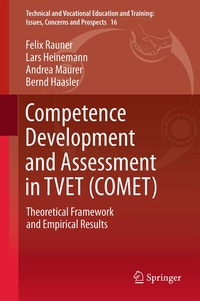
Competence Development and Assessment in TVET (COMET)
Description

The transferability of vocational education and training qualifications across international borders is a live issue in this heterogeneous field. Key to this goal is defining a common methodology for measuring vocational competences. This publication sets out a proposal for just that, based on the results of a pilot project known as 'COMET' on competence diagnostics in the field of electrical engineering. The study deploys longitudinal analysis to explore issues of competence development, the development of vocational identity, and occupational commitment. It focuses on two discrete occupational profiles in electrical engineering in an ambitious test of a model currently applied to other professions as well.
The model's success in its first phase is detailed in the second part of the volume, where the authors show that the transfer of the competence framework into an empirical model was successful. They also demonstrate that the methodology can be applied to designing and evaluating vocational education and training processes, making the material relevant to VET teachers and trainers as well as academics. With its first section comprising a full description of the theoretical framework, this book is a significant step forward in an urgent task facing administrations, labor forces and employers around the world. The achievement is in proportion to the notorious complexities of a field whose diversity makes tough demands on large-scale methods of assessment.
Reviews / Votes
A pioneering collection of essays which is central to understanding the historical and contemporary meanings of socialism in the context of neoliberal globalization. It is a most timely contribution to a growing intellectual project that challenges the hegemony of capitalism, while re-thinking and theorizing alternatives.
Iveta Silova, Associate Professor of Comparative Education, Lehigh University, Bethlehem, PA, USA
In this significant contribution to recent scholarship the authors use the lens of socialist education to offer an original critique of hegemonic capitalism, and present an intellectually rigorous search for alternatives by reconsidering historical socialism and advancing promising educational experiments that challenge the 'global architecture of education'.
Anders Breidlid, Professor of International Education and Development, Oslo University College, Norway
More details
Other editions
Additional editions
Content
Preface.- Introduction: Competence Diagnostics in Vocational Education - what for?.- Foundations of a competence model.- The COMET competence model: foundations for the study of professional competence and identity.- Test development and design of the study.- Test instruments and implementation of the COMET study.- Results 2008 - the survey population.- Results 2008 - Apprentices competence.- Results of the main phase.- The COMET rating procedure in practice: some conclusions.- References.
