

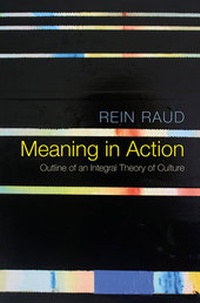
Meaning in Action
Description

In developing this innovative theory, Raud draws on a wide range of disciplines, from anthropology, sociology and cultural studies to semiotics and philosophy. The theory is illustrated throughout with examples drawn from both high and popular culture, and from Western and Asian traditions, dealing with both contemporary and historical topics. The book concludes with two case studies from very different contexts one dealing with Italian poetry in the 13th century, the other dealing with the art scene in Eastern Europe in the 1990s.
This timely and original work makes a major new contribution to the theory of culture and will be welcomed by students and scholars throughout the social sciences and humanities.
More details
Other editions
Additional editions
Person
Content
Introduction
An outline of the theory and the book
1 Looking for culture, looking at things
Social/cultural
Cultural communities
The cultural subject
Summary
2 Meaning and signification
The problem of reference
Two kinds of concepts
The internalisation of meaning
Claims and bids
Summary
3 Culture as textuality
Base-texts and result-texts
The operational memory
Organisation of knowledge
Standards and codes
Summary
4 Culture as a network of practices
The cultural role: functions and goals of a practice
The social position: the carrier and status of a practice
Materials and rules
Cultural institutions
Summary
5 Case Study I: The metaphysics of love and the beginnings of Italian vernacular poetry
Italian political landscape in the 13th century: the bidding space
The poetic context
The carriers of the practice
The science of love as privileged knowledge
Vulgare, the medium
Institutions and textuality
Summary
6 Case Study II: Art and politics in Eastern Europe in the 1990s
The institutions
The carriers
Textuality, codes and languages
Summary
7 Concluding remarks
A few final words
References
Index
AN OUTLINE OF THE THEORY AND THE BOOK
Any theory of culture has to start with the definition of its object. In chapter 1, I argue for an approach to culture that is able to account for all phenomena related to the production, dissemination, transmission and interpretation of meaning. If culture constitutes the sum total of our efforts to make sense of our world, from the most individual and personal level to the most universal, then meaning should indeed be the common denominator for all phenomena we consider cultural. But meaning is not something abstract; it is itself produced in and by individual minds when they confront their reality.
Throughout the book, I stress the binary nature of cultural phenomena. On the one hand, there are more or less stable and shareable fixtures of meaning from images and narratives to laws, dress codes and domesticated spaces such as cities. A cultural subject comes into being in dialogue with such entities - texts - and inevitably participates in their production as well. On the other hand, culture manifests itself in all kinds of activities, from real rituals to ritualistic behaviour, from displaying curiosities to auditions for reality shows, from witch-trials to defences of dissertations. All activities grounded in meaning, or cultural practices, also construct their participants while being constructed by them in the process: you become a 'player' by 'playing'. I will proceed from the description of the signifying act - the elementary cultural event - to the nature of the mechanisms that combine and organize singular moments of signification into larger meaningful wholes, 'texts' and 'textualities', and from there to the cultural practices that relate the signifying wholes to the behaviour of people towards each other as well as all levels of their environment.
Chapter 2 will outline the theory of meaning used in this book. Just as cultural activity iterates between textuality and practice, the human subject also conceptualizes the world in two different ways that result in two different kinds of concepts - through direct experience, when the empirical flux is structured into a manageable reality, and with the help of acquired tools: by learning, for instance, that an unknown city is situated in a certain country of which the person has no experience. Concepts learned this way are, in Saussurean terms, more closely related to the signifier while the ones deduced from lived experience are inherent in the signified. It can be said that the moment of becoming meaningful, or the act of signification, takes place when these two concepts converge. This does not happen solely through an internal realization, but rather as a response to a claim. When an adult is speaking with a child and points to a furry barking animal, saying 'This is a dog!', she makes the claim that the signifier [dog], which the child may already know from a bedtime story, is associated with the animal they are observing. Of course, it is possible to use signs - for example, for abstract concepts - that hark back only to other signs that form their definitions, the only reality to which they refer. But all these derive, in the last resort, from similarly accepted claims, just as physically non-existent fictional characters are imagined through an analogy with real people. It is also possible not to accept claims others are making by saying, for example, 'this is what being a real man is all about', when the experiential concept does not fit the one acquired through learning. Moments like this highlight the difference between the two kinds of concepts, unnoticed in uncritical situations. And, from within, it is also possible to construct private-language signifiers with which one can refer to personally relevant reality slices. Nonetheless, reality on the whole becomes culturally meaningful to the perceiver through acts of signification that claim the identity of intralinguistic, learned concepts and experiential concepts, and it is these claims, not actually existing relations of meaning, that become reified in signs. And this is precisely what constitutes their irreducible arbitrariness. In a claim, the relation between the intralinguistic concept, definable through linguistically expressed characteristics, and the experiential concept, derived from our observation of reality, is necessarily arbitrary.
But stand-alone signs or their random combinations do not constitute cultural phenomena. Various sets of rules that govern cultural expression make it possible for us to express ourselves - to engage in practices and produce texts - and for others to interpret our utterances. These 'grammars' are modulated by the mentalities, the structures of knowledge, the worldviews of their historical context, which, deep down, have a similarly cultural origin. Although most of our cultural environment is handed down to us in a ready-made form, the elements that constitute it have all been produced by the same dynamic processes that are taking place in our minds when they encounter something unknown.
It should also be noted that cultural phenomena do not automatically enter circulation. At this next level, there is a mechanism at work similar to that within the elementary act of signification. Any new cultural expression (text or pattern of practice) that seeks to be acknowledged by the community makes a bid, a promise to be meaningful to its recipients in certain ways. Thousands of clothes designers produce new models each year and each of them makes a bid to be the expression of the new trends in fashion. Thousands of new poets make their debut and each of them makes the bid to be the voice of the new generation. Especially in the present times, when the equipment for producing a sample CD, a portfolio of photographs or a video is accessible to a much larger proportion of aspiring creative personalities than ever before, the number of bids greatly outweighs the number of those texts that are accepted by cultural institutions. At the same time, more democratic as well as more cheaply available new channels of communication, such as the internet, have also made alternative dissemination possible. Nevertheless, even after a text has initially entered circulation, it remains only a bid until it is endorsed by a critical mass of its intended recipients - tens of thousands of dedicated fans if the bid is to be a pop idol, or perhaps a dozen academics if it is a bid for the reinterpretation of the seventeenth-century Ethiopian philosopher Zera Yacob. If a bid is accepted, it will gain access to proper channels of circulation, which, in turn, determine the rules for its reception. Each cultural text comes with an implicit operation manual. A romantic comedy shown at an arthouse cinema may be poorly welcomed, even if the majority of the audience likes to see a romantic comedy now and then, but in another setting.
At this point it will be useful to start describing the mechanisms of the cultural system with the help of not one, but two separate models, a text-centred and a practice-centred one, sketched here in the barest outline. It is possible to look at a culture as primarily the sum total of all products of meaning production, or texts in the widest sense of the word - written and oral, verbal and visual, aural, corporal, spatial. But it is also possible to describe the cultural system as a totality of different, sometimes mingling, mostly collective but occasionally private, practices in which its carriers engage, producing and consuming texts in the process, sometimes simply as negligible by-products. For a holistic view, it is important not to privilege one of these perspectives over the other, though (or actually because) they operate with incompatible sets of concepts.
Chapter 3 will be dedicated to the text-centred model of culture. I will first distinguish between two categories of texts that differ in status and function. First, there are the texts that every carrier of the culture could be expected to know - at least to some extent or by hearsay - and the extent of her knowledge is a measure of her level of education. The Gospel, Hamlet, elementary table manners, Mona Lisa, the beginning of Beethoven's Fifth Symphony, basic traffic rules and the Eiffel Tower are examples of such texts in contemporary Western culture. I will call these nodes of meanings base-texts. No cultural system is totally homogeneous, and one way to identify its different layers is by the differences in their sets of base-texts. The heavy metal cultural community counts 'War Pigs' and Smoke on the Water among them, while Giselle and The Nutcracker belong to the base-texts of ballet enthusiasts, but the Eiffel Tower, traffic rules and Mona Lisa are shared by both. Obviously, the borders of these communities are not closed and a person with somewhat more catholic tastes can actually appreciate ballet and heavy metal alike. This also demonstrates that the category of base-texts has no fixed boundaries - immediately next to those actually shared by the overwhelming majority of the carriers of a culture are texts that are still only making the bid to be accepted on this level, emerging from a subculture and claiming their spot on the central stage. Similarly, there are texts, such as the catechism or novels by Mikhail Sholokhov, the Nobelist classic author of socialist realism, that have previously been base-texts in their respective cultures, but are no longer.
At the opposite end of the status scale are...
