

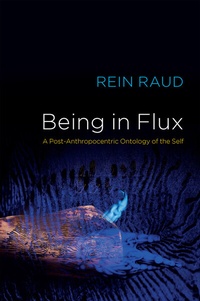
Being in Flux
A Post-Anthropocentric Ontology of the Self
1st Edition
Published on 19. August 2021
256 pages
978-1-5095-4974-0 (ISBN)
Description

Reality exists independently of human observers, but does the same apply to its structure? Realist ontologies usually assume so: according to them, the world consists of objects, these have properties and enter into relations with each other, more or less as we are accustomed to think of them.
Against this view, Rein Raud develops a radical process ontology that does not credit any vantage point, any scale or speed of being, any range of cognitive faculties with the privilege to judge how the world 'really' is. In his view, what we think of as objects are recast as fields of constitutive tensions, cross-sections of processes, never in complete balance but always striving for it and always reconfiguring themselves accordingly. The human self is also understood as a fluctuating field, not limited to the mind but distributed all over the body and reaching out into its environment, with different constituents of the process constantly vying for control.
The need for such a process philosophy has often been voiced, but rarely has there been an effort to develop it in a systematic and rigourous manner that leads to original accounts of identity, continuity, time, change, causality, agency and other topics. Throughout his new book, Raud engages with an unusually broad range of philosophical schools and debates, from New Materialism and Object-Oriented Ontology to both phenomenological and analytical philosophy of mind, from feminist philosophy of science to neurophilosophy and social ontology.
Being in Flux will be of interest to students and scholars in philosophy and the humanities generally and to anyone interested in current debates about realism, materialism and ontology.
Against this view, Rein Raud develops a radical process ontology that does not credit any vantage point, any scale or speed of being, any range of cognitive faculties with the privilege to judge how the world 'really' is. In his view, what we think of as objects are recast as fields of constitutive tensions, cross-sections of processes, never in complete balance but always striving for it and always reconfiguring themselves accordingly. The human self is also understood as a fluctuating field, not limited to the mind but distributed all over the body and reaching out into its environment, with different constituents of the process constantly vying for control.
The need for such a process philosophy has often been voiced, but rarely has there been an effort to develop it in a systematic and rigourous manner that leads to original accounts of identity, continuity, time, change, causality, agency and other topics. Throughout his new book, Raud engages with an unusually broad range of philosophical schools and debates, from New Materialism and Object-Oriented Ontology to both phenomenological and analytical philosophy of mind, from feminist philosophy of science to neurophilosophy and social ontology.
Being in Flux will be of interest to students and scholars in philosophy and the humanities generally and to anyone interested in current debates about realism, materialism and ontology.
More details
Other editions
Additional editions
Rein Raud
Being in Flux: A Post-Anthropocentric Ontology of the Self
A Post-Anthropocentric Ontology of the Self
Book
09/2021
1st Edition
Polity Press
€71.00
Shipment within 15-20 days
Book
09/2021
1st Edition
Polity Press
€24.00
Shipment within 15-20 days
Person
Rein Raud is a research professor at the School of Humanities, Tallinn University, and a Visiting Professor at the Freie Universität Berlin.
Content
Acknowledgements
Introduction
Chapter 1 Ontology: some of the story so far
Chapter 2 An ontology of processes and fields
Chapter 3 Me, myself and my brain
Chapter 4 The self as an extended decision-making network
Concluding remarks
Notes
References
Introduction
Chapter 1 Ontology: some of the story so far
Chapter 2 An ontology of processes and fields
Chapter 3 Me, myself and my brain
Chapter 4 The self as an extended decision-making network
Concluding remarks
Notes
References
