

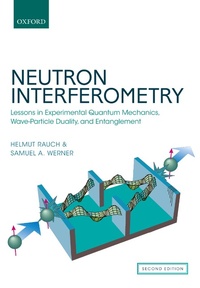
Neutron Interferometry
Lessons in Experimental Quantum Mechanics, Wave-Particle Duality, and Entanglement
2nd Edition
Published on 15. January 2015
456 pages
978-0-19-102125-1 (ISBN)
Description

This is an open access title. It is available to read and download as a free PDF version on Oxford Academic and is made available under a Creative Commons Attribution-Non Commercial-No Derivatives 4.0 International licence.
The quantum interference of de Broglie matter waves is probably one of the most startling and fundamental aspects of quantum mechanics. It continues to tax our imaginations and leads us to new experimental windows on nature. Quantum interference phenomena are vividly displayed in the wide assembly of neutron interferometry experiments, which have been carried out since the first demonstration of a perfect silicon crystal interferometer in 1974. Since the neutron experiences all four fundamental forces of nature (strong, weak, electromagnetic, and gravitational), interferometry with neutrons provides a fertile testing ground for theory and precision measurements. Many Gedanken experiments of quantum mechanics have become real due to neutron interferometry.
Quantum mechanics is a part of physics where experiment and theory are inseparably intertwined. This general theme permeates the second edition of this book. It discusses more than 40 neutron interferometry experiments along with their theoretical motivations and explanations. The basic ideas and results of interference experiments related to coherence and decoherence of matter waves and certain post-selection variations, gravitationally induced quantum phase shifts, Berry`s geometrical phases, spinor symmetry and spin superposition, and Bell's inequalities are all discussed and explained in this book. Both the scalar and vector Aharonov-Bohm topological interference effects and the neutron version of the Sagnac effect are presented in a self-contained and pedagogical way. Interferometry with perfect crystals, artificial lattices, and spin-echo systems are also topics of this book. It includes the theoretical underpinning as well as connections to other areas of experimental physics, such as quantum optics, nuclear physics, gravitation, and atom interferometry. The observed phase shifts due to the Earth's gravity and rotation indicate a close connection to relativity theory. Neutron interferometry can be considered as a central technique of quantum optics with massive particles. It has stimulated the development of interferometry with atoms, molecules and clusters.
The book is written in a style that will be suitable at the senior undergraduate and beginning of graduate level. It will interest and excite many students and researchers in neutron, nuclear, quantum, gravitational, optical, and atomic physics. Lecturers teaching courses in modern physics and quantum mechanics will find a number of interesting and historic experiments they may want to include in their lectures.
More details
Other editions
Additional editions
Helmut Rauch | Samuel A. Werner
Neutron Interferometry
Lessons in Experimental Quantum Mechanics, Wave-Particle Duality, and Entanglement
Book
01/2015
2nd Edition
Oxford University Press
€164.04
Shipment within 15-20 days
Persons
Helmut Rauch completed his PhD in 1965 and become full Professor in 1972. He spent one sabbatical year at KFA Juelich/Germany and worked regularly at the Institute Laue-Langevin in Grenoble/France. His scientific interests are: neutron physics, quantum optics, foundations of quantum mechanics, and reactor physics. He invented together with U. Bonse and W. Treimer the perfect crystal neutron interferometer, and has published more than 350 papers in refereed journals. He was Director of the Atomic Institute in Vienna, President of the Austrian Science Foundation and twice President of the Austrian Physical Society. He is member of the Austrian and German Physical Society, the Austrian Academy of Sciences, and the German Academy of Sciences "Leopoldina" in Halle. Honours include the Erwin Schrödinger Award of the Austrian Academy of Sciences, and the Ludwig Wittgenstein Award of the Austrian Research Association.
Samuel Werner received his AB degree at Dartmouth College in 1959 and his PhD degree at the University of Michigan in 1965. He was a staff scientist in the Physics Department of the Scientific Laboratory of the Ford Motor Company for 10 years. He became Professor of Physics at the University of Missouri in 1975. Upon his retirement from Missouri in 2000 he moved to Gaithersburg, MD to become a guest researcher at NIST. His scientific interests are: neutron scattering, neutron physics, spin density waves (CDW) and charge density waves (SDW) in solids. He received the President's Award for Outstanding Research at the University of Missouri in 1980, the Outstanding Alumnus Award of the Nuclear Engineering Department at the University of Michigan in 1980, and an Exceptional Service Award of the Neutron Scattering Society of America in 2012. He was the first President of the NSSA. He is a Fellow of the NSSA, the American Physical Society, and the American Association for the Advancement of Science.
Content
- Cover
- Contents
- 1 Introduction
- 1.1 Neutron Optics and the Analogy with Light Optics
- 1.2 The Quantum Phase Shift of Matter Waves
- 1.3 Basic Neutron Diffraction Phenomena
- 2 Neutron Interferometers and Apparatus
- 2.1 The Perfect Si-Crystal Interferometer
- 2.2 Perfect Crystal Interferometer Setups
- 2.2.1 The ILL Setup
- 2.2.2 The MURR Setup
- 2.2.3 The NIST Setup
- 2.3 Interferometers Based upon Cold and Ultra-Cold Neutrons
- 2.4 Larmor and Ramsey Interferometers
- 3 Neutron Interactions and the Coherent Scattering Lengths
- 3.1 Nuclear Interaction
- 3.1.1 General Relations
- 3.1.2 Experimental Results
- 3.2 Electromagnetic Interaction
- 3.2.1 Magnetic Terms
- 3.2.2 Electrostatic Interactions
- 3.2.3 Electrostatic Terms
- 3.2.4 Electrical Polarizability Term
- 3.3 Parity Violating Interactions
- 3.4 External Influences
- 3.4.1 Atmospheric Effects
- 3.4.2 Temperature Effect
- 3.4.3 Magnetic Field Effects of Paramagnetic Substances
- 3.4.4 Local Field and Holography Effects
- 4 Coherence and Decoherence
- 4.1 Basic Relations
- 4.1.1 Mach-Zehnder Interferometer in Second Quantization
- 4.1.2 Coherence Function
- 4.2 Coherence Measurements
- 4.2.1 Longitudinal Coherence, x-Direction
- 4.2.2 Transverse Coherence, y-Direction
- 4.2.3 Vertical Coherence, z-Direction
- 4.2.4 Phase-Echo and Spin-Echo Experiments
- 4.2.5 Non-dispersive and Non-defocusing Phase Shifters
- 4.2.6 Neutronic Coherence Features
- 4.3 Partial Beam Path Detection
- 4.3.1 Stochastic and Deterministic Beam Attenuation
- 4.3.2 Quantum Limit of Stochastic and Deterministic Absorption
- 4.3.3 Unsharp Wave-Particle Behavior
- 4.4 Counting Statistics
- 4.4.1 General Relations
- 4.4.2 Analysis of the Neutron Counting Statistics in Interferometry
- 4.4.3 Particle Number-Phase Uncertainty Relation
- 4.4.4 Intensity Correlation Experiments
- 4.5 Post-selection Measurements
- 4.5.1 Post-selection in Ordinary Space
- 4.5.2 Post-selection in Momentum Space
- 4.5.3 The Wigner Function
- 4.5.4 Post-selection in the Time Domain
- 4.5.5 Time-of-Flight Post-selection
- 4.5.6 Interferometric Post-selection-Multiplate Interferometers
- 4.6 Decoherence and Dephasing
- 4.6.1 Basic Relations
- 4.6.2 Dephasing and Decoherence Experiments
- 5 Spinor Symmetry and Spin Superposition
- 5.1 Spinor Symmetry
- 5.2 Spin Superposition
- 5.3 Time-Dependent Spinor Superposition
- 5.4 Double-Coil Experiments and the Magnetic Josephson Effect
- 5.5 Multiphoton Exchange Experiments
- 6 Topological and Geometric Phases
- 6.1 Aharonov-Casher Topological Phase
- 6.2 Scalar Aharonov-Bohm Effects
- 6.3 Geometric Phases: Theoretical Background
- 6.4 Interferometric Measurement of the Berry Phase
- 6.5 Non-cyclic Berry Phases
- 6.6 Polarization Rotation Experiments
- 6.7 Spin-Echo Version of the Geometric Phase
- 6.8 Absorption Analog
- 6.9 Confinement-Induced Topological Quantum Phase
- 7 Contextuality and Kochen-Specker Phenomena
- 7.1 Quantum Contextuality
- 7.2 Quantum Cheshire Cat
- 8 Gravitational, Inertial, and Motional Effects
- 8.1 Gravitationally Induced Quantum Interference
- 8.1.1 Geometry of the COW Experiment
- 8.1.2 Formal Derivations of the COW and Sagnac Phase Shifts
- 8.1.3 The Total Phase Shift Including Bending
- 8.1.4 Neutron-X-Ray Difference Experiments
- 8.1.5 Neutron Two-Wavelength Difference Experiment
- 8.2 Sagnac Effect
- 8.2.1 Earth's Rotation
- 8.2.2 Turnable Rotation
- 8.2.3 Effective Mass and the Coriolis Force
- 8.3 Acceleration-Induced Interference
- 8.4 Connections with Photons
- 8.5 Neutron Fizeau Effects
- 8.5.1 Rotating Quartz Rod Experiment
- 8.5.2 Theoretical Origin of the Neutron Fizeau Phase Shift
- 8.5.3 Null Fizeau Effect Experiment
- 8.5.4 Rotating Aluminum Propeller Experiment
- 8.5.5 Rotating Samarium Disk Experiment
- 8.5.6 Proper Time and General Relativity Considerations
- 9 Solid State Physics Applications
- 9.1 Contrast Reduction due to Inhomogeneities
- 9.2 Phase Imaging Topography and Phase Tomography
- 9.2.1 Double-Crystal Method
- 9.2.2 Pinhole Method
- 9.2.3 Grating Method
- 9.2.4 Interferometer Method
- 9.3 Observation of the Goos-Hänchen Effect
- 10 Forthcoming, Proposed, and More Speculative Experiments
- 10.1 Non-linearity of the Schrödinger Equation
- 10.2 Aharonov-Bohm Analog
- 10.3 Quaternions in Quantum Mechanics
- 10.4 Non-ergodic Effects
- 10.5 Wheeler Delayed-Choice Experiments
- 10.6 Neutron-Antineutron Oscillations
- 10.7 Non-Newtonian Gravity Effects
- 10.8 Spin-Rotation Coupling
- 10.9 Hanbury-Brown and Twiss Analog
- 10.10 Search for Nuclear Entanglement
- 10.11 Confinement-Gravity Coupled Quantum Phase
- 10.12 The Anandan Acceleration
- 10.13 Search for Basic Dissipative Terms
- 10.14 Proper Time Effects in Gravity Experiments
- 10.15 Neutron Fourier Spectroscopy
- 10.16 Time-Dependent Fizeau Phase Shift
- 10.17 Search for Chameleon Fields
- 10.18 Quantum Zeno Tomography
- 10.19 Complementarity and Equivalence Tests with Unstable Particles
- 11 Perfect Crystal Neutron Optics
- 11.1 Transition from the Kinematical to Dynamical Diffraction
- 11.2 Dynamical Diffraction for the Symmetric Laue Case
- 11.3 Anomalous transmission, Angle Amplification, and High Collimation Effects
- 11.4 Pendellösung Interference Effects
- 11.5 Primary Extinction and the Width of a Bragg Reflection
- 11.6 The Takagi-Taupin Equations
- 11.7 Theory of the Perfect Silicon Crystal Neutron Interferometer
- 11.7.1 Plane Wave Theory of the LLL Interferometer
- 11.7.2 Beam Profiles and Ray Tracing through the Interferometer
- 11.7.3 The Defocused Interferometer
- 12 Interpretational Questions and Conclusions
- 12.1 Interpretations and Approaches
- 12.1.1 Copenhagen-Göttingen interpretation
- 12.1.2 The Ensemble or Statistical Interpretation
- 12.1.3 The Spontaneous Localization Approach
- 12.1.4 The Decoherence Approach
- 12.1.5 The Consistent History Approach
- 12.1.6 The Transactional Interpretation
- 12.1.7 The Guide or Pilot Wave Interpretation
- 12.1.8 The Information Interpretation
- 12.1.9 Many-World Interpretation
- 12.1.10 Bohm's Quantum Potential
- 12.1.11 Event-Based Models
- 12.1.12 No-Problem Approach
- 12.2 Conclusions
- References
- Index
