

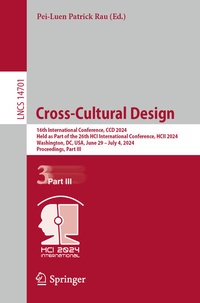
Cross-Cultural Design
Description

This four-volume set LNCS 14699-14702 constitutes the refereed proceedings of the 16th International Conference on Cross-Cultural Design, CCD 2024, held as part of the 26th International Conference, HCI International 2024, in Washington, DC, USA, during June 29 - July 4, 2024.
The total of 1271 papers and 309 posters included in the HCII 2024 proceedings was carefully reviewed and selected from 5108 submissions.
The CCD 2024 proceedings focus a broad range of theoretical and applied issues related to Cross-Cultural Design and its applications, and much more.
More details
Other editions
Additional editions
Content
- Intro
- Foreword
- HCI International 2024 Thematic Areas and Affiliated Conferences
- List of Conference Proceedings Volumes Appearing Before the Conference
- Preface
- 16th International Conference on Cross-Cultural Design (CCD2024)
- HCI International 2025 Conference
- Contents - Part III
- Cross-Cultural Tangible and Intangible Heritage
- Nature's Canvas: Exploring Landscape Through Cyanotype Assemblage Art
- 1 Introduction
- 2 Related Works
- 3 Methods
- 3.1 Exploratory Field Research
- 3.2 Cyanotype Photography and Assemblage
- 4 Results and Discussion
- 5 Conclusion
- References
- Research on the Design of Art Derivatives from the Perspective of Digital Culture and Tourism: A Case Study of Works with Jiangsu Regional Themes
- 1 Introduction
- 2 Design Theory of Jiangsu Regional Theme Art Derivatives
- 2.1 Cultural Connotation and Artistic Characteristics
- 2.2 Design Strategy for Regional Themed Art Derivatives
- 3 Application of Digital Innovation Technologies in Art Derivative Design
- 3.1 Virtual Reality (VR) and Augmented Reality (AR) Technologies
- 3.2 Artificial Intelligence (AI) and Generative Art
- 3.3 Digital Platforms and E-Commerce
- 4 Case Study on the Design of Regional-Themed Art Derivatives in Jiangsu Province
- 4.1 Case Study of Jinling Diagram Digital Art Exhibition
- 4.2 Digital Intelligence Technologies Empower Regional-Themed Art Derivatives
- 5 Conclusion
- References
- Exploring Innovative Models of Guizhou Miao Embroidery from a Digital Perspective
- 1 Introduction
- 2 Establish the Gene Pool of Miao Embroidery Culture
- 2.1 The Function of Recording Patterns
- 2.2 Designers Connect to the Miao Embroidery Database
- 3 The Collection and Analysis of Miao Embroidery Craftsmen's Data
- 3.1 Handicraft Level
- 3.2 Working Age
- 3.3 Good at Embroidery
- 4 Construction of Miao Embroidery Pattern Database in Colleges and Universities
- 4.1 Needlework
- 4.2 Patterns
- 4.3 Color
- 5 Establishment of Chinese Patterns Online Museum Database--Wen Zang Website
- 6 Digital Enabling to Open up "Online Market" for Miao Embroidery
- 6.1 Standardization of Production
- 6.2 Product Scale
- 7 Conclusions
- References
- Exploring the Recognition of Illustration Styles in Marine Culture - "The Case of Fishermen's Painting in East Zhejiang Province as an Example"
- 1 Introduction
- 1.1 Research Motivation
- 1.2 Research Purpose
- 2 Literature Review
- 2.1 Literature Review on Fishermen's Paintings
- 2.2 Exploration of Painting Styles
- 3 Research Methodology
- 4 Results and Discussion
- 4.1 MDS (Multidimensional Scaling) Analysis
- 4.2 Gender and Professional Background Layer Cognitive Analysis
- 5 Conclusion and Recommendations
- References
- Unveiling User Cognitive Ergonomics Excellence: Digitally Redesigning Traditional Chinese Textile Patterns
- 1 Introduction
- 2 Research Content
- 2.1 Aesthetic Innovation and User Cognitive Ergonomics
- 2.2 The Interplay of Body and Pattern
- 2.3 Designing in the Metaverse
- 2.4 Data as a Medium for Creativity
- 3 Methods
- 3.1 User Experience Ecosystem Perspective
- 3.2 IPII Design Approach
- 3.3 Cognition in Traditional Versus Digital Media
- 3.4 Interactive Exhibition Design
- 4 Conclusion
- References
- A Study on the Audience's Perception Differences of the "New Culture" Animated Movie "A Journey of Thirty Thousand Kilometers in Chang'an"
- 1 Introduction
- 2 Literature Review
- 2.1 The Significance of "New Culture"
- 2.2 Emotional Perception of Film Viewers
- 2.3 Audience Cognitive Differences in Animated Films with Traditional Cultural Themes
- 3 Research Objects and Methods
- 3.1 Research Methods
- 3.2 Sample Collection of Questionnaires
- 4 Results
- 4.1 Reliability and Validity Analysis
- 4.2 Analysis of Gender Differences in Various Variables
- 4.3 Analysis of Age Differences in Various Variables
- 4.4 Analysis of Professional Differences in Various Variables
- 4.5 Analysis of Educational Attainment Differences in Various Variables
- 4.6 Analysis of Viewing Methods Differences in Various Variables
- 5 Conclusion and Suggestions
- References
- Cross-Media Digital Form Design and Comparative Measurement of Intangible Cultural Heritage in Zhuhai: Promoting Cultural Exchange and Global Communication
- 1 Research Background
- 2 Literature Review
- 2.1 Communication of Intangible Cultural Heritage (ICH) and Digital Media Forms
- 2.2 The Discrepancy in Communication Effectiveness of Media Forms
- 3 Research Methodology
- 3.1 Focus Groups
- 3.2 Experimental Methods
- 3.3 In-Depth Interviews
- 4 Analysis of Results
- 4.1 Experimental Data Analysis
- 4.2 Interview Data Analysis
- 5 Discussion
- 5.1 Effectiveness Evaluation of Digital Media Form Designs
- 5.2 The Relationship Between Audience Cultural Background and Choice of Digital Media Forms
- 5.3 The Key Role of Cross-Media Form Design in Cultural Communication and Preservation
- 6 Conclusions
- References
- Information Visualization Expression of Cultural Heritage and Innovation of Communication Paradigm Paths - The Overseas Communication of "The Compendium of Materia Medica" as an Example
- 1 Historical Value of the Materia Medica and the Current Status of Its Dissemination
- 2 Research Perspectives
- 2.1 Cross-disciplinary Based Research Perspectives
- 2.2 Perspectives Based on User Research
- 2.3 Research Perspectives Based on the Integration of Science and Art
- 2.4 Research Perspective Based on Theory to Practice
- 3 Object and Main Content of the Study
- 4 The Specific Path of Informatization Expression of the Materia Medica
- 4.1 Visualization Design of Cultural Gene Mapping of Materia Medica
- 4.2 Role-Playing Game Design of "Compendium of Materia Medica"
- 5 Conclusion
- References
- Digital Interactive Experience Design Based on Guangxi Yao Ethnic Embroidery Patterns
- 1 Introduction
- 2 Regional Culture of the Yao Ethnic Group
- 3 Significance of Yao Ethnic Embroidery in Guangxi
- 3.1 Characteristics of Yao Ethnic Embroidery Patterns
- 3.2 Extraction of Stylistic Features of Embroidery Patterns in Various Yao Subgroups in Guangxi
- 4 The Significance of Yao Ethnic Embroidery Patterns in Yao Culture in Guangxi
- 4.1 The Relationship Between Yao Ethnic Embroidery Patterns and Traditional Yao Culture
- 4.2 Symbolic Significance and Social Functions of Yao Ethnic Embroidery Patterns in Guangxi
- 4.3 Social Interaction and Ritual Activities of Yao Ethnic Embroidery Patterns in Guangxi
- 4.4 Economic Income and Ethnic Industry of Yao Ethnic Embroidery in Guangxi
- 5 Designing Digital Interactive Experiences for Yao Ethnic Embroidery Patterns in Guangxi
- 5.1 Digital Creation of Yao Ethnic Embroidery Patterns in Guangxi
- 5.2 Digital Exhibition of Yao Ethnic Embroidery Patterns in Guangxi
- 5.3 Community Interaction and Interactive Learning Module
- 5.4 Customization Services for Yao Ethnic Embroidery Patterns in Guangxi
- 5.5 Virtual Reality Interactive Experience of Yao Ethnic Embroidery Patterns in Guangxi
- 6 Conclusion
- References
- Engaging Children in Cultural Heritage Through Book Craft: An Interaction Design Approach
- 1 Introduction
- 2 Related Work
- 3 Methods
- 3.1 Stage 1: Understanding Users and Their Needs
- 3.2 Stage 2: Framing the Information Architecture
- 3.3 Stage 3: Designing Interactive Elements
- 3.4 Stage 4: Testing and Refinement
- 3.5 Stage 5: Implementing the Final Design
- 4 Results and Discussion
- 5 Conclusion
- References
- Application of Motion Capture Technology in Ethnic Costume Cultural and Creative Products: Taking Guangxi Zhuang Ethnic Culture as an Example
- 1 Instruction
- 2 Development Opportunities for Ethnic Costume Cultural and Creative Products in the Digital Era
- 2.1 Enhancing the Dissemination Speed of Ethnic Culture Through the Digital Transformation of Creative Products
- 2.2 Enriched Digital Creative Presentations Promote the Diversified Development of Ethnic Culture
- 3 The Application Value of Motion Capture Technology in Fashion Cultural Creative Products
- 3.1 Promoting the Digitization of Ethnic Fashion Products
- 3.2 Classification and Characteristics of Motion Capture Technology
- 3.3 Enhancing the Cross-Platform and In-Depth Dissemination of Ethnic Costume Culture
- 4 Application of Motion Capture Technology in Cultural and Creative Products Featuring Ethnic Costumes
- 4.1 Design Planning for Digital Creative Products Featuring Ethnic Costumes
- 4.2 Application of Motion Capture Technology in Cultural and Creative Product Design for Ethnic Costumes
- 5 Conclusion
- References
- The Digital Integration Path of Aesthetic Education and Ideological Education: Based on the Design Application of China's Yao Ethnic Group's Ecological Textile Process
- 1 Introduction
- 2 Basic Functions of Ecological Textile Process of the Yao Ethnic Group in Guangxi
- 2.1 Protective and Health Preservation Function
- 2.2 Identity Recognition Function
- 2.3 Historical Documentation Function
- 2.4 Decorative and Beautification Function
- 3 Value Analysis of Yao Ethnic Group's Ecological Textile Processes
- 3.1 Analysis of Historical Value
- 3.2 Analysis of Aesthetic Education Value
- 3.3 Analysis of Intellectual Value
- 4 Digital Integration Path: Innovative Strategies Based on Yao Ethnic Group's Ecological Textile Craftsmanship
- 4.1 Branding or Brand Building
- 4.2 Building a Digital Marketing Model
- 4.3 Design-Oriented Souvenirs
- 4.4 Conducting Promotion Through Digital Cartoon Characters
- 5 Conclusion
- References
- Research on Digital Identification for Cultural Protection of Yao People Clothing Patterns in Northern Guangdong
- 1 Introduction
- 1.1 Research Motivation
- 1.2 Research Purposes
- 2 Literature Review
- 2.1 Research on Yao Costume Patterns
- 2.2 Research on Pattern Digitization
- 3 Research Methods
- 4 Data Analysis
- 4.1 Analysis of Embroidery Patterns of the Yao People in Northern Guangdong
- 4.2 Digital Identification of Pattern Units
- 4.3 Composition and Color Matching
- 4.4 Examples of Digital Recognition and Application of Yao Costume Patterns
- 5 Conclusion
- References
- Cross-Cultural Digital Transformation
- Strategic Pathways to Net Zero by 2050: Vietnam's Adoption of South Korea's Policies
- 1 Introduction
- 2 Literature Review
- 2.1 Net Zero 2050 Explained - Understanding Its Global Significance and Role
- 2.2 Comparative Commitments: Climate Strategies of Vietnam and South Korea
- 2.3 Strategic Frameworks: Evaluating and Propelling National Net Zero Initiatives
- 3 Method
- 3.1 Conceptual Model and Research Questions
- 3.2 Questionnaire Construction and Survey Procedure
- 3.3 Data Analysis
- 4 Result
- 4.1 Insights on Vietnam's Net Zero Policy Framework and Korean's Lessons
- 4.2 Insights into Study Findings and Recommended Action Plans
- 5 Conclusion
- References
- Educational Methods and Practices for Futures-Thinking-Based Interaction Design Curricula
- 1 Introduction
- 2 Methodology
- 3 Conceptual Framework
- 3.1 Personal Level
- 3.2 The Program Level 6Fs
- 3.3 The Practice Level
- 4 Implications of the 3P-6Fs Systems Thinking Framework for Curricular Designs
- 5 Discussion
- 6 Conclusion
- References
- What is Priming You in APP? The Study of Cultural Difference in Consumers' Self-construction and Perception by Exploring the Splash Screen Design for Mobile Banking Apps
- 1 Introduction
- 2 Literature Review
- 2.1 The User Experience of the Splash Screen
- 2.2 Intentions and Attitudes
- 2.3 Cross-cultural Perspective and User Interface Experience
- 3 Study 1
- 3.1 Method
- 3.2 Result
- 4 Study 2
- 4.1 Method
- 4.2 Result
- 5 Conclusion and Discussion
- 5.1 Contribution
- 5.2 Limitations and Future Research
- Appendices
- Appendix 1. Visual Stimulus Samples
- Appendix 2. Questionnaire
- References
- The Application of Digital Media in Macao's Cultural Communication - A Case Study of Macao Light Festival
- 1 Introduction
- 2 Literature Review
- 2.1 Digital Media
- 2.2 Urban Light Festival
- 3 Methodology
- 4 The Case Study of Macao Light Festival
- 4.1 Macao Light Festival
- 4.2 The Application of Digital Media
- 4.3 The Realization of Cultural Communication
- 5 Discussion and Conclusions
- References
- Design-Driven Local Rural Transformation: Taking Anji County as an Example
- 1 Introduction
- 2 The Past and Current Situation of Rural Areas in Anji County
- 3 Yucun: A Case Study of Transformation in Rural Areas of Anji County
- 4 The Dimensions of Design-Driven Local Rural Transformation
- 5 Collaboration and Co-creation: A Mode of Design-Driven Local Rural Transformation
- E-commerce Platform Mobile Interface Experience Design from a Cross-Cultural Perspective
- 1 Introduction
- 2 Cross-Cultural Interface Design Model for E-commerce Platform Mobile
- 2.1 Cultural Dimensions in the Context of Cross-Cultural E-commerce
- 2.2 User Behavioral Habits in Cross-Cultural E-commerce Contexts
- 2.3 User Behavioral Habits in Cross-Cultural E-commerce Contexts
- 2.4 User Behavioral Habits in Cross-Cultural E-commerce Contexts
- 3 Case Validation: The United States and China
- 3.1 Cultural Differences and Design Strategies for E-commerce Mobile in China and the US
- 3.2 Design Practices: Optimizing the American Version of Chinese Pinduoduo
- 4 Conclusion
- 5 Prospects
- References
- The Role of Scientific Research Foundation in the United States, Germany, and China in Developing the Industrial Internet
- 1 Introduction
- 2 Background
- 3 Analysis of Industrial Internet Projects
- 3.1 Data Collection
- 3.2 Number of Projects
- 3.3 Project Funding
- 3.4 Research Focus
- 3.5 Project Disciplines
- 4 Conclusion
- References
- Dilemmas and Path Exploration in the Development of Educational Digital Transformation
- 1 Introduction
- 2 The Inevitability of Digital Transformation in Education
- 2.1 The Policy System for the Development of Digital Education is Becoming Increasingly Comprehensive and Effective
- 2.2 The Application of Digital Technology in Educational Scenarios is Gradually Accelerating
- 3 Dilemmas Faced by the Digital Transformation and Development of Education
- 3.1 Insufficient Theoretical Research on Digital Education Disciplines
- 3.2 The Impact of Digital Technology on Future Education Development is Uncontrollable
- 3.3 The Risk of Increased Reliance on Digital Tools Fostering Laziness in Education has Become Increasingly Prominent
- 3.4 The Alienation Phenomenon Appears in the Development of Educational Digitalization
- 4 Exploring the Development Path of Digital Transformation of Education
- 4.1 Deepen Theoretical Research on Digital Education Disciplines
- 4.2 Improve the Construction of Digital Education Research Institutions and Academic Organizations
- 4.3 Strengthen the Training of Talents for the Digital Development of Education
- 4.4 Always Remain Firm in Our Original Aspiration and Stand Unwaveringly in Education
- 5 Conclusion
- References
- Exploring Ecological Value and Innovative Transformation of Traditional Packaging
- 1 Introduction
- 2 Literature Review
- 2.1 Traditional Ecological Packaging
- 2.2 Traditional Packaging Ecological Values
- 2.3 Innovative Transformation and Sustainable Development Trend of Traditional Ecological Packaging
- 3 Methods
- 3.1 Theories of Ecological Packaging
- 3.2 Theories of Ecological Packaging
- 3.3 Triple Bottom Lines Analysis
- 4 Discussion
- 4.1 Understanding the Ecological Value of Traditional Natural Packaging
- 4.2 Exploring Innovative Transformations of Traditional Ecological Packaging
- 5 Conclusion
- References
- Bringing Lose Sheep into the Fold: Redesigning Women-In-Tech (WIT) App for Women of Three Age Groups
- 1 Introduction
- 2 Research Methodology
- 2.1 Sample
- 2.2 Measures and Data Analysis
- 3 Results
- 4 Discussions
- 4.1 Proposed Design for Women-In-Tech App
- 4.2 Limitations and Future Study
- 5 Conclusions
- References
- Regulating Cross-Cultural Moral Sensitivity: An Image Ethic Analysis of Appearance Design of Intelligent Machine
- 1 Introduction
- 2 Methods and Materials
- 2.1 Methods
- 2.2 Materials
- 3 Results and Analysis
- 3.1 Subject Overview
- 3.2 Sensitivity: Ratio of Objective to Subjective Descriptions
- 3.3 Sensitive Points: Unique Sensitive Points in Different Cultures
- 4 Discussion
- 4.1 Triggering Sensitization with Ethical Attitudes
- 4.2 Shaping the Image Elements of the Moral Agent
- 4.3 Designing Clear Storylines
- 5 Conclusion and Limitations
- References
- Author Index
