

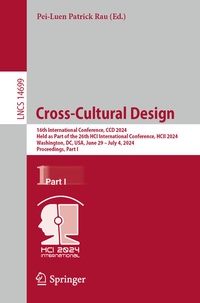
Cross-Cultural Design
Description

This four-volume set LNCS 14699-14702 constitutes the refereed proceedings of the 16th International Conference on Cross-Cultural Design, CCD 2024, held as part of the 26th International Conference, HCI International 2024, in Washington, DC, USA, during June 29 - July 4, 2024.
The total of 1271 papers and 309 posters included in the HCII 2024 proceedings was carefully reviewed and selected from 5108 submissions.
The CCD 2024 proceedings focus a broad range of theoretical and applied issues related to Cross-Cultural Design and its applications, and much more.
More details
Other editions
Additional editions

Content
- Intro
- Foreword
- HCI International 2024 Thematic Areas and Affiliated Conferences
- List of Conference Proceedings Volumes Appearing Before the Conference
- Preface
- 16th International Conference on Cross-Cultural Design (CCD2024)
- HCI International 2025 Conference
- Contents - Part I
- Cross-Cultural Design and User Experience
- Persuasive Determinants of Physical Activity in Adults: Cultural Differences and the Moderating Effect of Gender and Age
- 1 Introduction
- 2 Background and Related Work
- 2.1 Culture and Human Behaviour
- 2.2 Culturally Relevant Persuasive Technology
- 2.3 HBM and Theory-Driven Behaviour Change Systems
- 3 Method
- 3.1 Measurement Instrument
- 3.2 Participants Recruitment
- 4 Data Analysis
- 4.1 Model Validity and Reliability
- 5 Result
- 5.1 General Model - Saudi Arabians vs. Canadians
- 5.2 Moderating Effect of Gender and Age
- 6 Discussion
- 6.1 Using Our Results to One-Size-Fits-All and Personalized Physical Activity App Design
- 6.2 Mapping the Determinants to Persuasive Strategies
- 6.3 Limitations and Future Work
- 7 Conclusion
- References
- Design Innovation Based on the Material Experience and Tactile Prompting
- 1 Introduction
- 2 Literature Review
- 2.1 Material Experience
- 2.2 Haptic Cognition Model
- 2.3 Tactile Prompting and AI-co-Creation
- 3 Method and Material
- 3.1 Research Method: HDD
- 3.2 Stimuli and Empirical Design Project
- 3.3 Participants and Procedures
- 3.4 Research Instrument
- 4 Results and Discussions
- 4.1 The Creation of HDD Project
- 4.2 Varying Capabilities of HDD Application
- 4.3 The Innovation via Tactile Prompting with AI-co-Creation
- 5 Conclusions
- References
- Behavioral Lock Screen Application Practice Based on Gamification Design Method
- 1 Introduction
- 2 Gamification Theories and Methods
- 3 Introduction of Behavioral Lock Screen Application
- 4 Practical Implementation Process
- 4.1 Discovery
- 4.2 Problem Definition
- 4.3 Determine Gamification Theme
- 4.4 Develop
- 4.5 Delivery and Implementation
- 4.6 Data Feedback
- 4.7 Iterative Design Based on Data Feedback
- 5 Conclusion
- References
- Shaping a Longevity Service Through Visual, Tangible, Cultural, and Social Artifacts
- 1 Introduction
- 1.1 Longevity Economics and Experience-Driven Service Industries
- 1.2 Research Hypothesis and Questions
- 2 Literature Review
- 2.1 Longevity Planning Blocks (LPBs) and Tangible Artifacts
- 2.2 Cultural and Social Artifacts
- 2.3 Experience Prototype
- 2.4 Think-Aloud Approach
- 3 Research Methods, Process, and Results
- 3.1 Recruitment
- 3.2 Visual and Tangible Prototypes of Longevity Services
- 3.3 Semi-structured Interview
- 3.4 D4L Service Considerations Through Various Lenses
- 4 Discussion and Next Steps
- 4.1 Translated Three Different Formats: Verbal, Visual, and Tangible
- 4.2 Create and Explore the Value of Make-to-Think Spirit
- 4.3 Consider Design Solutions Through Individual, Communal, and Social Lenses
- 5 Conclusion
- References
- Room Acoustic Design for Open Plan Interior in Dwelling House
- 1 Introductions
- 1.1 Research Background
- 1.2 Research Purposes
- 2 Project Practices
- 2.1 The Design Implement
- 2.2 Indoor Sound Environment
- 2.3 Sound Absorption Usage
- 3 Objective Evaluation
- 3.1 Computer Simulation
- 3.2 Field Verification
- 3.3 Sound Proof Exterior
- 4 Results
- 4.1 Computer Simulation
- 4.2 Field Verification
- 5 Discussion
- References
- Designing Virtual Spaces for Cross-Cultural Engagement: A Focus on Young Adults and Regional Cultural Elements
- 1 Introduction
- 1.1 Background
- 1.2 Research Objectives and Significance
- 2 Literature Review and Related Work
- 2.1 Exploration and Challenges in the Design of Cross-Cultural Virtual Spaces
- 2.2 The Application of Virtual Reality in Cross-Cultural Communication and Education
- 2.3 Cultural Acceptance and Interactive Behavior of Young Adults
- 2.4 Cultural Symbols and High-Low Context Virtual Spaces
- 3 Methodology
- 3.1 Data Collection
- 3.2 Quantitative Data Analysis
- 3.3 Ethical Considerations
- 3.4 Virtual Space Design Samples
- 4 Data Collection and Analysis
- 4.1 Data Preparation and Preprocessing
- 4.2 Descriptive Statistical Analysis
- 4.3 Inferential Statistical Analysis
- 4.4 Discussion and Limitations
- 5 Conclusion
- 5.1 Key Findings
- 5.2 Conclusions and Recommendations
- 5.3 Limitations and Future Directions
- References
- Interactive Experience Design of Indoor Lamps Based on the Concept of Emotionalization
- 1 Introduction
- 2 Indoor Lamps and Lanterns Development Status and Inter-issues (Problems)
- 2.1 Analysis of Market Conditions
- 2.2 Problems with Indoor Lighting
- 2.3 Trends in Interior Lighting Design Under Emotional Demands
- 3 Related Theories
- 3.1 Emotional Design Concepts
- 4 Emotional Expression of Interior Lighting Design
- 4.1 Emotional Design at the Instinctive Level
- 4.2 Emotional Design at the Behavioral Level
- 4.3 Emotional Design at the Reflective Level
- 5 Indignant Interior Luminaire Design Practices
- 5.1 Design Orientation
- 5.2 Product Design Innovation Points
- 6 Conclusion
- References
- Developing a Co-eating Agent for Food Education
- 1 Introduction
- 2 Method
- 2.1 Participants
- 2.2 Co-eating Agent
- 2.3 Food Education Workshop
- 2.4 Environment
- 2.5 Data Collection and Analysis
- 2.6 Experimental Procedures
- 3 Results
- 3.1 Co-eating Experience
- 3.2 Impression of the Co-Eating Agent
- 3.3 Learning Satisfaction and Learning Outcome
- 3.4 Relationship Between the Impression and Learning Outcome.
- 4 Discussion
- 4.1 Learning Satisfaction and Learning Outcome in Food Education Provide by Co-eating Agent
- 4.2 The Role of Co-eating Agent in Food Educational Workshop
- 5 Conclusion
- References
- The Impact of Short-Video Application Affordances on Cross-Cultural User Engagement Behavior Intention: Based on SOR Model
- 1 Introduction
- 2 Theoretical Background and Hypothesis Building
- 2.1 SOR Model
- 2.2 Technology Affordance as Stimulus
- 2.3 Perceived Self-efficacy as Organism
- 2.4 Behavioral Engagement Intention as Response
- 3 Methodology
- 3.1 Data Collection and Analysis
- 3.2 Measurements
- 3.3 Reliability and Validity
- 3.4 Structural Equation Model
- 4 Discussion
- References
- A Gamified Approach on Inducing Energy Conservation Behavior
- 1 Introduction
- 2 Literature Review
- 2.1 Gamification and Behavior Change
- 2.2 Energy-Saving Behaviors and Motivation
- 2.3 Gamification in the Domain of Energy
- 3 Research Framework and Hypotheses
- 3.1 Theoretical Framework
- 3.2 Hypotheses
- 4 Methodology
- 4.1 Experiment Design
- 4.2 Experiment Tasks
- 4.3 Measurements
- 5 Results
- 5.1 Participants' Profile
- 5.2 Model Evaluation
- 5.3 Energy-Reducing Behavioral Results
- 5.4 Correlation Test
- 6 Discussion and Conclusion
- 6.1 Discussion
- 6.2 Limitations and Future Recommendations
- 6.3 Conclusion
- References
- The Impact of Color-Touch Cross-Modal Correspondence on the Temporal Integration of Multimodal Information
- 1 Introduction
- 1.1 Significance
- 1.2 Theoretical Background
- 1.3 Related Temporal Concepts
- 2 Research Framework
- 3 Methods
- 3.1 Participants
- 3.2 Apparatus and Stimuli
- 3.3 Experimental Design
- 3.4 Tasks and Procedures
- 3.5 Data Analysis
- 4 Results
- 4.1 Cross-Modal Correspondences
- 4.2 One-Way ANOVA to Accuracy and Reaction Time
- 4.3 SOA, ABS and Occurrence Sequence
- 4.4 Types and Stimuli Intensity
- 4.5 Other Conclusions Regarding Specific Levels of SOA
- 4.6 Discussion
- 5 Conclusion
- References
- Exploring Cross-Disciplinary Design Dialogues: A Case-Study Workshop on Designing Medical Interfaces and the Integration of the 'Check' Methodological Canvas
- 1 Introduction
- 1.1 Challenges and Opportunities of a Collaboration Between Designers and Medical Companies
- 1.2 The Culture of Designing Interfaces
- 2 Methods
- 2.1 General Principles of Designing Interfaces
- 2.2 Case-Study: Designing User Interface for an Inhalation Anesthesia Device
- 2.3 Pedagogical Methodology
- 3 Results and Discussion
- 3.1 Redesigning the Interface of the Inhalation Anesthesia Device
- 3.2 Pedagogy and Necessary Design Skills
- 3.3 Collaboration Between Designers and Companies, Conclusions
- References
- Cross-Cultural Product Design
- Discussion on Common Audience's Cognitive Differences of Cultural Commodities - Taking Contemporary Lighting Design as an Example
- 1 Introduction
- 2 Theoretical Background and Literature Review
- 2.1 The Development and Value of Paper Lantern Culture
- 2.2 Cultural Commodities and Cultural Codes
- 2.3 Audience Cognition Model of Cultural Commodities
- 3 Materials and Methods
- 3.1 The Cultural Codes of Paper Lanterns
- 3.2 Case Introduction
- 3.3 Questionnaire Design
- 4 Results and Discussion
- 5 Conclusion
- References
- Angular vs. Rounded Perception? The Eye-Tracking Study of Cross-Cultural Differences in Visual Perception of the Relationship Between Product Outline and Its Surface Texture
- 1 Introduction
- 2 Literature Review
- 2.1 The Self-construction of "Individualism" and "Collectivism"
- 2.2 Aesthetic Preference of "Shape"
- 2.3 Overview and Practical Application of "Parametric Design"
- 2.4 Overview of "Eye-Tracker"
- 3 Method
- 3.1 Participants
- 3.2 Procedure
- 3.3 Measurement
- 4 Result
- 4.1 Physiological Response (Eye-Tracking)
- 4.2 Psychological Response (Questionnaire)
- 5 Conclusion and Discussion
- References
- The Relationship Between Ming-Style Chair Form Attributes and GenY Emotion by Kansei Engineering in China
- 1 Introduction
- 2 Literature Review
- 2.1 The Concept of Kansei Engineering
- 2.2 Generation Y Consumers in China
- 2.3 Consumer Emotion
- 2.4 The Form Attributes of Ming-Style Chair
- 2.5 Conceptual Framework
- 3 Methodology
- 3.1 Study Design
- 3.2 Semantic Difference
- 3.3 Quantification I Theory
- 4 Procedures Design of Ming-Style Chair Based on Kansei Engineering Type I Method
- 4.1 Choosing the Product Domain
- 4.2 Spanning the Semantic Space
- 4.3 Collection of Ming-Style Chair Samples
- 4.4 Semantic Difference Experiment About the Form Attributes of Ming-Style Chair
- 4.5 Test of Validity and Iterations
- 4.6 Model Building
- 5 Conclusion
- References
- Investigation Into the Elderly's Appraisal of Visual-Tactile Association Imagery Perception Design in Smart Product
- 1 Introduction
- 2 Literature Review
- 2.1 The Intersection of Smart Product Design and the Elderly
- 2.2 The Role of Visual and Tactile Imagery Perception in Product Design
- 2.3 The Concept of Design Imagery and Its Implementation in Smart Products
- 2.4 Utilizing the Evaluation Grid Method (EGM) in Design Research
- 3 Method
- 3.1 Study Subjects and Sample Collection for Assessment of Visual-Tactile Associations
- 3.2 Gathering and Structuring Data via EGM
- 3.3 Analysis of Favorable Factors
- 4 Results
- 4.1 Compilation and Construction of Individual EGMs
- 4.2 Overall Visual-Tactile-Associative-Imagery Perception EGM
- 4.3 Analysis of Favorable Factors
- 5 Conclusions and Suggestions
- References
- Research on Cross-Cultural Product and Service Design Dynamics in a Global Perspective
- 1 Introduction
- 2 Methods and Ways of Realising Cross-Cultural Design
- 3 Differences in User Needs and Cultural Contexts
- 4 The Expression of National Culture Image in Design
- 5 Design Talent Cultivation and Sustainable Development
- 6 Summary
- References
- Research on Modular Experience Based Design of Wearable Products for Scuba Diving
- 1 Introduction
- 1.1 The Demand for Nationwide Physical Activities
- 1.2 Concept of Product Modularization
- 2 Research on Diving Sports Product Demand Among Generation Z
- 2.1 Methods for User Research
- 2.2 Characteristics and Basic Needs of Generation Z
- 2.3 Demands and Functional Transformation in Scuba Diving
- 3 Design Strategies for Scuba Diving Products from the Modular Experience Perspective
- 3.1 Design Requirements
- 3.2 Design Strategies
- 4 Practical Application of Modular Experience in Scuba Diving Product Design
- 4.1 Product Design Philosophy
- 4.2 Product Design Practice
- 4.3 Product Design Description
- 4.4 Product Use Mode
- 5 Conclusion and Future Work
- References
- Design Thinking and Cognitive Patterns in Corporate Image Shaping: A Case Study of Formosa Plastics Group's Corporate Identity System (CIS)
- 1 Introduction
- 2 Literature Review
- 2.1 Enterprise Identity System: Value and Typical Cases
- 2.2 Design Thinking and Cognitive Patterns in Corporate Identity Systems
- 3 Research Methodology
- 3.1 Construction of Evaluation Criteria
- 3.2 The Selection of Case Studies
- 4 Theoretical Framework and Application Examples: Enterprise Identity System of Formosa Plastics Corporation
- 4.1 Conceptual Identification
- 4.2 Behavioral Identification
- 4.3 Visual Identification
- 5 Conclusions and Recommendations
- 5.1 Conclusions
- 5.2 Recommendations
- 5.3 Future Research Directions
- References
- Research on the APP Design of "Time Tea" Tea Drinking Brand Under Service Design
- 1 Introduction
- 2 Research Background
- 2.1 Research on Guangdong Herbal Tea Cultural Resources
- 2.2 Overview of Tea Drink Brands
- 2.3 Design Logic Study of Service Design for Tea Drinking Brand APP
- 3 Analysis of "Time Tea" APP User Requirements
- 3.1 Existing Tea Drinking Brand APP Market Research
- 3.2 "Time Tea" User Profile Construction and Demand Analysis
- 3.3 "Time Tea" Storyboards
- 4 Construction of "Time Tea" Service System
- 4.1 "Time Tea" User Travel Chart
- 4.2 Service Blueprint of "Time Tea"
- 5 Tea Drinking Brand Service System Application Design-"Time Tea" APP Prototype Design
- 5.1 Information Architecture of Tea Brand Service Application Design Based on Emotionalization
- 5.2 APP Client-Based Service Application Design - "Time Tea" APP Interface Design
- 6 Conclusion
- References
- The Influence of Souvenirs on Establishing the Brand Image of Film Festivals: The Audience's Perception and Preference for Souvenirs
- 1 Introduction
- 2 Literature Review
- 2.1 Film Festival Image
- 2.2 From the Image of Film Festivals to the Cultural Value Added of Souvenirs
- 2.3 Audience Perception and Preferences for Souvenirs
- 3 Methodology
- 3.1 Research Scope
- 3.2 Research Tools
- 3.3 Research Subjects
- 4 Results and Analyses
- 4.1 Part One: Respondents' Background and Perception of Souvenirs
- 4.2 Part Two: Factors Influencing Audience Preferences for Various Categories of Souvenirs
- 4.3 Summary
- 5 Conclusions and Recommendations
- 5.1 Study Recommendations
- References
- Research on the Efficiency of Visual Guidance Recognition for Tilt Tray Sorter
- 1 Introduction
- 2 Research on the Visual Guidance Design of Tilt Tray Sorter Conveyance
- 3 Study on the Efficiency of Visual Cognitive Guidance Graphics for Tilt Tray Sorter
- 3.1 Experimental Design
- 3.2 Experimental Content
- 4 Experimental Analysis
- 5 Conclusion
- References
- Research on Interactive Design of Urban Furniture from the Perspective of Smart City
- 1 Introduction
- 2 Background
- 2.1 Urban Furniture
- 2.2 Smart City
- 3 Design Transformation of Urban Furniture Under Smart City
- 3.1 Spatial Characteristics of Traditional Urban Furniture
- 3.2 Characteristics of Urban Furniture Upgrading and Transformation Under Smart City
- 3.3 Transformation of the Spatial Form of Streets
- 4 Classification of Smart Urban Furniture
- 5 Smart City Furniture in Practice
- 5.1 Smart City Furniture for Public Transportation and Public Lighting Integration Functions
- 5.2 Smart City Furniture for Public Services and Public Lighting Integration Functions
- 5.3 Smart City Furniture for Public Transportation and Information Services Integration Functions
- 6 Conclusion
- References
- Application of Experience Design in the Design of Home Medical Products: A Case Study of QUINOVARE Needle-Free Injector Products
- 1 Introduction
- 2 Literature Review
- 2.1 Research on Experience Design of Home Healthcare Products
- 2.2 Research on Needle-Free Injectors
- 3 Method
- 3.1 Comparative Testing
- 3.2 Experiential Research
- 3.3 Design Case Studies
- 4 Results
- 4.1 Test Analysis
- 4.2 Experiences Require Active Interaction Between the Individual and Products
- 4.3 Experience Driven Design Requirements
- 4.4 Experience Should Manifest Intervention and Care to Amplify Inclusiveness
- 4.5 Consumer Logic Paradoxes Affect Experience Design
- 5 Discussion
- 6 Conclusion
- References
- The Influence of Anthropomorphism on the User Experience of Digital Products
- 1 Introduction
- 1.1 Research Background
- 1.2 Research Hypothesis
- 2 Research 1
- 2.1 Preliminary Study 1
- 2.2 Study 1
- 3 Research 2
- 3.1 Preliminary Study 2
- 3.2 Study 2
- 4 General Discussion
- 4.1 The Impact of Anthropomorphism on User Experience of Digital Products
- 4.2 The Mediating Effect of Psychological Distance
- 4.3 Moderating Effect of Belongingness Needs
- 5 Conclusion
- Appendix 1
- Appendix 2
- References
- Research on Children's Furniture Design Based on User Needs and AHP
- 1 Introduction
- 2 Research Methods and Research Status
- 3 Research Model Analysis and Feasibility
- 3.1 Research Model Analysis
- 3.2 Study the Feasibility of the Model
- 4 User Demand Analysis Based on KNAO Model
- 4.1 Questionnaire Design
- 4.2 Survey Implementation and Questionnaire Retrieval
- 4.3 Requirements Processing
- 5 Children's Furniture Design Based on AHP Method
- 6 Design Practice
- 7 Conclusion
- References
- Author Index
