

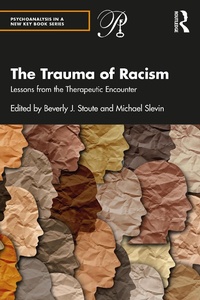
The Trauma of Racism
Lessons from the Therapeutic Encounter
1st Edition
Published on 31. October 2022
394 pages
978-1-000-71961-1 (ISBN)
Description

The Trauma of Racism: Lessons from the Therapeutic Encounter is a pioneering reflection on the psychology of racism and its impact on us all. With the intimacy of personal experience and depth of analytic exposition, the authors expose racism's searing effects on personal, clinical, and community interactions while providing pathways for change.
This book asserts that the insights and practice of psychoanalysis, applied behind the couch and in the community, create unique opportunities for change. Essayists address racially derived mental health inequities, including distortions, projections, stereotypes, and historical tropes. The Trauma of Racism invites personal and clinical exploration of how people learn, confront, and re-learn views on race. Narratives of the loss and grief and the burdens of slavery that crisscross the African American community are present. They are complemented by those of the psychological burdens and inspired acts of personal responsibility that respond to unequal access to wealth and opportunity along racial lines. In moving accounts portraying experiences of racism and access to privilege, the authors grapple with the possibilities of mutual understanding.
Readers concerned about racism will find themselves challenged and engaged. This book is intended for the general reader and for clinicians at any career stage. Likewise, scholars in the humanities, law, education, or public policy will find new opportunities to reflect and to act.
This book asserts that the insights and practice of psychoanalysis, applied behind the couch and in the community, create unique opportunities for change. Essayists address racially derived mental health inequities, including distortions, projections, stereotypes, and historical tropes. The Trauma of Racism invites personal and clinical exploration of how people learn, confront, and re-learn views on race. Narratives of the loss and grief and the burdens of slavery that crisscross the African American community are present. They are complemented by those of the psychological burdens and inspired acts of personal responsibility that respond to unequal access to wealth and opportunity along racial lines. In moving accounts portraying experiences of racism and access to privilege, the authors grapple with the possibilities of mutual understanding.
Readers concerned about racism will find themselves challenged and engaged. This book is intended for the general reader and for clinicians at any career stage. Likewise, scholars in the humanities, law, education, or public policy will find new opportunities to reflect and to act.
Reviews / Votes
'The authors offer a fresh, invigorating, and much-needed psychoanalytic treatise on race, race relations, and racism. The contributors that they have gathered represent multiple perspectives, diverse ethnocultural backgrounds, and different nationalities. Together these highly informed and somber voices create a moving chorus of cultural anthropology, psychoanalytic metapsychology, developmental studies, community politics, and, above all, clinical praxis.'Salman Akhtar, professor of Psychiatry, Jefferson Medical College, training and supervising analyst, Psychoanalytic Center of Philadelphia
'This remarkable new book is a long-overdue treatment of a subject that has historically been neglected in psychotherapeutic and psychoanalytic discourse. I was enlightened by the brilliant insights from colleagues who provided new ways of understanding racism and the challenges we face. Readers will learn a great deal of practical and clinical information, as well as becoming more familiar with the tragic history of racism.'
Glen O. Gabbard, clinical professor of Psychiatry, Baylor College of Medicine
'This book is an important and thoughtful guide to one of the more urgent questions facing psychotherapeutic practice today-how to address the individual psychological implications and effects of larger structural biases, inequities, and prejudices. The book deftly connects psychological frameworks with historical and cultural ones. It is a vital resource for clinicians and citizens seeking to understand and address legacies of historical trauma.'
Jonathan M. Metzl, director, Center for Medicine, Health, and Society and Frederick B. Rentschler II endowed professor, Vanderbilt University School of Medicine
'Psychoanalysis gave us multiple lenses for illuminating complex human behavior through its metapsychology of the individual. In addition, Freud, as a social and cultural theorist, gave us a quintessentially powerful means of coming face to face with the tragic view of how humans are eminently capable of treating one another. These two projects of psychoanalysis converge in The Trauma of Racism: Lessons from the Therapeutic Encounter. Here, Beverly Stoute and Michael Slevin provide a masterfully designed and edited catalogue of accounts of the trauma of distorting the individual ego and endangering generations of collective and degraded human lives in our fractured world ripped by racism and its manifold systemic pathways of racialization. All scholars committed to understanding and transforming the inner world and its external fields of reference to the outside, and in reverse, how psychologically charged external fields of reference activate inner world drama, will benefit immensely from this tome. Now, hopefully, we can teach and study race in earnest without the facile charge of being polemic.'
Maurice Apprey, professor of Psychiatry, is a member of the Academy of Distinguished Educators, School of Medicine, and dean of African American Affairs, University of Virginia
'This collection by Beverly Stoute and Michael Slevin is required reading for everyone practicing, supervising, or teaching the psychodynamic tradition. The authors provide the deep, subtle clinical thinking and practice wisdom on racism that until now has been lacking. But the reach of the book goes beyond clinical practice. Racism is searing. Its history shapes each of us regardless of racial identity. Its impact on the psyches of everyone in the U.S. is profound and traumatic. Anyone willing to look inward at themselves or outward at our society through the lens of racism could profit from this book. The authors' authenticity as they share critical reflections gained through work in the therapeutic encounter is a strength of a book that is a joy to read.'
Joanne Corbin, associate dean for Academic Affairs, University of Connecticut School of Social Work, former director, Smith College School for Social Work doctoral program
More details
Series
Edition
1. Auflage
Language
English
Place of publication
London
United Kingdom
Publishing group
Taylor & Francis Ltd
Target group
Professional and scholarly
Illustrations
4 Halftones, black and white; 4 Illustrations, black and white
ISBN-13
978-1-000-71961-1 (9781000719611)
Copyright in bibliographic data and cover images is held by Nielsen Book Services Limited or by the publishers or by their respective licensors: all rights reserved.
Schweitzer Classification
Other editions
Additional editions
Book
10/2022
1st Edition
Routledge
€187.20
Shipment within 10-20 days
Book
10/2022
1st Edition
Routledge
€44.50
Shipment within 10-20 days
Persons
Beverly J. Stoute, M.D., is a child, adolescent, and adult psychiatrist and psychoanalyst, a training and supervising analyst at the Emory University Psychoanalytic Institute, and a child and adolescent supervising analyst at the New York Psychoanalytic Society & Institute. She teaches on the faculty of multiple training programs and is an internationally recognized author, speaker, educator, clinician and organizational consultant ?in private practice in Atlanta, Georgia.
Michael Slevin, MSW, a member of the Washington Baltimore Center for Psychoanalysis, is in private practice in Baltimore, Maryland. He is a writer and editor on psychoanalytic issues. He has been active in bringing psychoanalytic ideas and practice into contexts outside the consulting room, to less privileged communities, and into political decision making.
Michael Slevin, MSW, a member of the Washington Baltimore Center for Psychoanalysis, is in private practice in Baltimore, Maryland. He is a writer and editor on psychoanalytic issues. He has been active in bringing psychoanalytic ideas and practice into contexts outside the consulting room, to less privileged communities, and into political decision making.
Content
Introduction Part 1: Historical Perspectives 1. Racism and Health Equity: A Challenge for the Therapeutic Dyad 2. Race and Racism in Psychoanalytic Thought: The Ghosts in Our Nursery, 2nd edition 3. Race, African Americans, and Psychoanalysis: Collective Silence in the Therapeutic Situation Part 2: Living with the Trauma of Racism 4. African American Boys: Adolescents Under the Shadow of Slavery's Legacy 5. Loss, Grief, and Fear in Everyday Lives of African American Women 6. Everyday Racisim: Psychological Effects 7. Thinking Clinically about Post-Traumatic Reactions to Racial Trauma 8. From the Racially Provocative to the Evocative: Shaping the Destiny of the Racist Moment 9. "And How Are the Children?": Intergenerational Trauma and the Development of Black Children in America 10. Black Rage: The Psychic Adaptation to the Trauma of Oppression 11. Observations on the Use of the N-Word Part 3: Learning and Re-Learning Race 12. Racial Socialization and Thwarted Mentalization: Psychoanalytic Reflections from the Lived Experience of James Baldwin's America 13. From Multicultural Competence to Radical Openness: A Psychoanalytic Engagement of Otherness 14. On Psychoanalysis, Race and Class in an Urban ER Part 4: Being Aware of White Privilege 15. How I Came to Understand White Privilege 16. On Racism and Being White: The Journey to Henry's Restaurant 17. "Am I the Only Black Kid that Comes Here?" 18. White Privilege and its Fissures: A Personal Perspective 19. "It Takes One to Know One" 20. Psychoanalysis by Surprise: An Ad Hoc Experiment in Community Psychoanalysis on a South African Wine Farm Part 5: Interpreting Racism in Jordan Peele's "Get Out" 21. Get Out of My Head: Experiencing Cultural Paranoia in Jordan Peele's "Get Out" 22. From "Guess Who's Coming to Dinner" to "Get Out": Attaining Psychic Freedom and Emancipation Across the Racial Divide
