

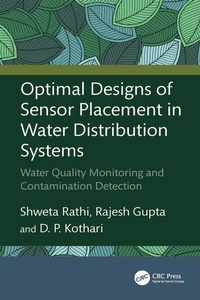
Optimal Designs of Sensor Placement in Water Distribution Systems
Water Quality Monitoring and Contamination Detection
1st Edition
Published on 25. September 2025
336 pages
978-1-040-41443-9 (ISBN)
Description

The dual purpose of regular monitoring and contaminant event detection in the water distribution systems (WDSs) can be achieved through sensors that can monitor general water quality constituents, such as pH, residual chlorine, conductivity, temperature, etc. This book details different sensor placement parameters considered for contamination detection and regular/routine water quality monitoring in WDSs and their evaluations. It covers genetic algorithm (GA)-based methodology, selecting a specified number of optimal sensor locations using combined weighted objectives. Applications to different pressure-deficient systems and intermittent systems are explained as part of a case study in India.
Features:
Reviews existing methodologies on the solutions to water contamination and sensor placements in the water distribution systems (WDSs).
Discusses regular water quality monitoring techniques including the methodology and guidelines of water quality monitoring techniques.
Includes applications on the methodologies under different cases, such as PDA, considering risk-based sensor placement.
Provides illustrative examples with the proposed alternative algorithm both for single- and multi-source networks.
Examines applications of the proposed GA-based optimal sensor location modeled to a real-life scenario.
This book is aimed at graduate students and researchers in civil engineering, civil and environmental engineering, environmental engineering, hydraulic engineering, water supply/resources engineering, and hydro-informatics.
Features:
Reviews existing methodologies on the solutions to water contamination and sensor placements in the water distribution systems (WDSs).
Discusses regular water quality monitoring techniques including the methodology and guidelines of water quality monitoring techniques.
Includes applications on the methodologies under different cases, such as PDA, considering risk-based sensor placement.
Provides illustrative examples with the proposed alternative algorithm both for single- and multi-source networks.
Examines applications of the proposed GA-based optimal sensor location modeled to a real-life scenario.
This book is aimed at graduate students and researchers in civil engineering, civil and environmental engineering, environmental engineering, hydraulic engineering, water supply/resources engineering, and hydro-informatics.
More details
Edition
1. Auflage
Language
English
Place of publication
London
United Kingdom
Publishing group
Taylor & Francis Ltd
Target group
College/higher education
Professional and scholarly
Illustrations
118 Tables, black and white; 41 Line drawings, black and white; 3 Halftones, black and white; 44 Illustrations, black and white
File size
46,48 MB
ISBN-13
978-1-040-41443-9 (9781040414439)
Copyright in bibliographic data and cover images is held by Nielsen Book Services Limited or by the publishers or by their respective licensors: all rights reserved.
Schweitzer Classification
Other editions
Additional editions
Shweta Rathi | Rajesh Gupta | D. P. Kothari
Optimal Designs of Sensor Placement in Water Distribution Systems
Water Quality Monitoring and Contamination Detection
Book
09/2025
1st Edition
CRC Press
€187.90
Shipment within 10-20 days
Persons
Shweta Rathi is Assistant Professor at National Institute of Technology, Kurukshetra, Haryana, India. She pursued her graduation from Nagpur University in 2000, Postgraduation in Environmental Engineering from Visvesvaraya National Institute of Technology (VNIT) in 2004, and later completed her Ph.D also from VNIT in 2017. Dr. Rathi has 16 years of teaching and research experience and was also involved in different academic activities such as Examination In-charge, Recruitment Committee, Curriculum Development, Laboratory Development, software purchase and other activities. She was Associate Professor and Head of the Department at Medi-Caps University of Indore, M.P. She was senior member of IQAC cell and was a member of BoS of Medi-Caps Universities. Dr. Rathi was selected in MPPSC in 2008.
Rajesh Gupta is Professor of Civil Engineering at Visvesvaraya National Institute of Technology, Nagpur, India. He graduated from Government Engineering College, Jabalpur, India in 1987. Dr. Gupta completed his Post Graduation in Environmental Engineering from VNIT (then VRCE) in 1990 and later PhD also from VRCE, Nagpur University, in 1996. He was Head of Civil Engineering Department during Jan 2009- July 2010, and also during July 2017- Dec 2220. He worked as Dean (Planning and Development) for a period of 3 years during July 2010- July 2013. His main area of interest is Water Supply, Environmental Engineering Systems Design and Modelling, Analysis and designWater distribution and waste water collection systems, Surge Analysis and Design of Surge Protection Systems, Design of Pipe Distribution Networksfor Irrigation. He has authored a book on "Analysis of Water Distribution Networks" and contributed 6 chapters in edited books. He has published and presented over 300 papers at National and International level, fifteen of which were awarded Best Paper Prizes.
D. P. Kothari, FIEEE, is Chairman BOG, THDC, Uttarakhand, India. He has held the positions of Director IIT Delhi, Principal VNIT Nagpur and VC, VIT, Vellore. Dr. Kothari has co-author/ authored more than 60 engineering books and guided more than 50 Phd scholars. He has co-authored/authored more than 830 research papers. He has received 70 national and international awards and visited abroad 38 times. He has also delivered 42 NPTEL video lectures with more than 1 lakh hits. He has received several living legends and lifetime achievement awards. He has been visiting professor in several foreign universities such as RMIT, Melbourne, Australia; University of Canterbury, Christ church New Zealand, Purdue University, USA and Imperial College, London. Kothari has just completed 50 years of teaching, research and administrative experience. His areas of interest in research are Hydro Thermal Scheduling, Power Quality, Optimization and Unit Commitment.
Rajesh Gupta is Professor of Civil Engineering at Visvesvaraya National Institute of Technology, Nagpur, India. He graduated from Government Engineering College, Jabalpur, India in 1987. Dr. Gupta completed his Post Graduation in Environmental Engineering from VNIT (then VRCE) in 1990 and later PhD also from VRCE, Nagpur University, in 1996. He was Head of Civil Engineering Department during Jan 2009- July 2010, and also during July 2017- Dec 2220. He worked as Dean (Planning and Development) for a period of 3 years during July 2010- July 2013. His main area of interest is Water Supply, Environmental Engineering Systems Design and Modelling, Analysis and designWater distribution and waste water collection systems, Surge Analysis and Design of Surge Protection Systems, Design of Pipe Distribution Networksfor Irrigation. He has authored a book on "Analysis of Water Distribution Networks" and contributed 6 chapters in edited books. He has published and presented over 300 papers at National and International level, fifteen of which were awarded Best Paper Prizes.
D. P. Kothari, FIEEE, is Chairman BOG, THDC, Uttarakhand, India. He has held the positions of Director IIT Delhi, Principal VNIT Nagpur and VC, VIT, Vellore. Dr. Kothari has co-author/ authored more than 60 engineering books and guided more than 50 Phd scholars. He has co-authored/authored more than 830 research papers. He has received 70 national and international awards and visited abroad 38 times. He has also delivered 42 NPTEL video lectures with more than 1 lakh hits. He has received several living legends and lifetime achievement awards. He has been visiting professor in several foreign universities such as RMIT, Melbourne, Australia; University of Canterbury, Christ church New Zealand, Purdue University, USA and Imperial College, London. Kothari has just completed 50 years of teaching, research and administrative experience. His areas of interest in research are Hydro Thermal Scheduling, Power Quality, Optimization and Unit Commitment.
Content
1. Introduction 2. Fundamentals of Water Distribution Systems 3. Performance Objectives and their Evaluation for Sensors Placement in Water Distribution Networks 4. Water Quality Modeling 5. Optimization Algorithms for Sensors Placement in Water Distribution Systems with Special Focus on Genetic Algorithm 6. Sensors Placement Using Single-Objective-Based Simple Methodologies 7. Multi-Objective-Based Methodologies for Optimizing Placement of Sensors Using Simple Heuristic Method and Genetic Algorithm 8. Application of GA-Based Methodology for Optimal Sensors Location in Pressure-Deficient Networks 9. Search Space Reduction in Optimizing the Location of Sensors in Intermittent and Continuous Modes of Water Distribution Systems 10. Advancements in Sensors Nework Designs and Applications
