

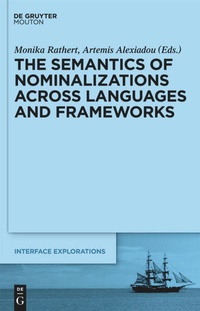
The Semantics of Nominalizations across Languages and Frameworks
Description

The volume explores the semantics of nominalizations from different theoretical points of view: formal and lexical semantics, cognitive-functional grammar, lexical-functional grammar, discourse representation theory. Data from a variety of languages are taken into account, including Hungarian, Italian, French, German and English. The papers discuss the semantics of distinct readings of nominalizations and meaning differences observed between competing affixes.
More details
Other editions
Additional editions
Persons
Content
2 - Contents [Seite 8]
3 - Contributors [Seite 10]
4 - Introduction [Seite 14]
5 - Nominals don't provide criteria of identity [Seite 22]
6 - Nominalization in context - conflicting readings and predicate transfer [Seite 38]
7 - A cognitive-functional perspective on deverbal nominalization in English. Descriptive findings and theoretical ramifications [Seite 64]
8 - A new account of possessors and event nominals in Hungarian [Seite 96]
9 - The semantics of eventive suffixes in French [Seite 122]
10 - Action nominals inside: lexical-semantic issues [Seite 154]
11 - Syntactic and semantic constraints on the formation and interpretation of -ung-nouns [Seite 182]
12 - The rivalry of French -ment and -age from a diachronic perspective [Seite 228]
13 - Author index [Seite 258]
14 - Subject index [Seite 261]
Syntactic and semantic constraints on the formation and interpretation of -ung-nouns (p. 169-170)
Antje Roßdeutscher and Hans Kamp
1. Introduction
This paper is devoted to -ung nominalization in German. German has many nouns that end on -ung and mostly these look like they are derived from verbs. Often the meanings of those nouns seem to be systematically related to the meanings of the underlying verbs, but there are also many cases where the semantic relation between noun and verb appears idiosyncratic and unpredictable. The task that these data present to the linguist is twopronged: Separate the systematic from the idiosyncratic cases and explain why the systematic relations are the way they are. A second question is when -ung-nouns can be formed at all. On the one hand -ung-nominalization has some of the features of a productive process: given a suitable verb we can form the corresponding -ung-noun and know what the word means, even though we have never seen or heard it before. But not all verbs are ‘suitable’. When a verb is not suitable, then there just isn’t any way you can form the corresponding -ung-noun; no matter how hard you try it will sound ‘wrong’. And here too there is idiosyncrasy: sometimes an -ung-noun exists, although its formation doesn’t appear to fit into any general pattern. So here too we are confronted with a two-pronged task: (i) separate the systematic from the idiosyncratic cases of -ung-formation and (ii) explain for the cases where -ung-nominalization is systematic what is responsible for its possibility. The two tasks are not independent. Where -ung-noun formation is systematic and productive, the meaning of the resulting noun is also systematically determined. This strongly suggests that what accounts for the possibility of -ung noun formation should also provide the basis for explaining the resulting semantics. In this paper we will concentrate specifically on the possibility of -ung formation. More about the semantics of possible -ungnouns can be found in Roßdeutscher (to appear).
Where -ung-nominalization is productive, we said, the meaning of the resulting -ung-noun is predictable from that of the verb from which the noun derives. But this dependency proves to be fairly complex. Many -ung-nouns are systematically ambiguous. A striking example is the noun Absperrung(from absperren, ‘to cordon off’, ‘to make inaccessible by erecting a fence or barricade’). Absperrung can denote (i) the event of cordoning off (a building or a street, say), (ii) the state resulting from such an event, and (iii) the fence or barricade erected during the event which is responsible for the state. Other -ung-nouns are only two-ways ambiguous: Mischung (from mischen, ‘to mix’) can either denote the ‘event of mixing’ or the mixture that is produced in the course of such an event. Schwächung (from schwächen, ‘to weaken’) can denote either weakening events or the corresponding result states, which consists in the theme being in a weakened condition. Lastly, some -ung-nouns are unambiguous, (e.g. Säuberung (from säubern, ‘to clean’), which can only denote cleaning events). A theory of -ung-nominalization should ideally be able to predict what denotations are possible for different -ung-nouns. That is, the rules which tell us when -ungnominalization is possible should tell us, as far as possible, also how the ‘input’ from which an -ung-noun can be derived determines what different readings it can have.
