

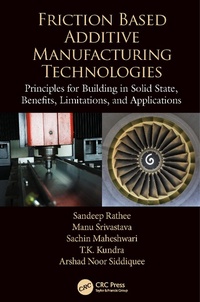
Friction Based Additive Manufacturing Technologies
Principles for Building in Solid State, Benefits, Limitations, and Applications
1st Edition
Published on 17. April 2018
172 pages
978-1-351-19086-2 (ISBN)
Description

Currently, most of the major commercial metal additive manufacturing (MAM) techniques rely on liquid phase processing. The liquid to solid phase transformations in these techniques results in microstructural issues and defects which in turn tantamount to inferior properties of fabricated build. Friction based additive manufacturing technologies are solid state processing techniques which work on the principles of friction based joining processes and layer by layer additive manufacturing. This book primarily addresses the basic understanding of seven friction based additive manufacturing techniques. These techniques include additive manufacturing methods based on rotary friction welding, linear friction welding, friction deposition, friction surfacing, friction stir additive manufacturing, friction assisted seam welding and additive friction stir. The principle of operations, benefits, limitations and recent developments of each technique has been described. It covers potentional and probable applications of each technique through review of various experimental studies.
Features
Targets friction based solid state additive manufacturing of metallic materials
Describes principle of operation of seven friction based additive manufacturing techniques
Reviews latest trends of these processes via experimental studies
Describes benefits and limitations of each technique
Covers current and probable applications of these techniques
Features
Targets friction based solid state additive manufacturing of metallic materials
Describes principle of operation of seven friction based additive manufacturing techniques
Reviews latest trends of these processes via experimental studies
Describes benefits and limitations of each technique
Covers current and probable applications of these techniques
More details
Edition
1. Auflage
Language
English
Place of publication
London
United Kingdom
Publishing group
Taylor & Francis Ltd
Target group
College/higher education
Illustrations
90 s/w Abbildungen, 10 farbige Abbildungen
15 Tables, black and white; 10 Illustrations, color; 41 Illustrations, black and white
File size
5,30 MB
ISBN-13
978-1-351-19086-2 (9781351190862)
Copyright in bibliographic data and cover images is held by Nielsen Book Services Limited or by the publishers or by their respective licensors: all rights reserved.
Schweitzer Classification
Other editions
Additional editions
Sandeep Rathee | Manu Srivastava | Sachin Maheshwari
Friction Based Additive Manufacturing Technologies
Principles for Building in Solid State, Benefits, Limitations, and Applications
Book
03/2021
1st Edition
CRC Press
€70.55
Shipment within 15-20 days
Sandeep Rathee | Manu Srivastava | Sachin Maheshwari
Friction Based Additive Manufacturing Technologies
Principles for Building in Solid State, Benefits, Limitations, and Applications
Book
04/2018
1st Edition
CRC Press
€258.50
Shipment within 15-20 days
Persons
Mr. Sandeep Rathee is working as a teaching cum research fellow at division of manufacturing processes and automation engineering in Netaji Subhas Institute of Technology, New Delhi. His PhD work is in the field of friction stir processing/welding. He is active in the field of friction stir processing /welding and additive manufacturing since last four years. His fields of research are friction stir welding/ processing, additive manufacturing, advanced manufacturing processes and optimization. He has over 25 publications in reputed international journals and refereed conferences. He has co- authored four book chapters in Springer books. He has a total teaching experience of around seven years. Following courses are taught by him at graduate and postgraduate level: Manufacturing Processes, Welding, Casting, Workshop Technology, Advanced Manufacturing Processes, Fluid Mechanics, etc.. He is a life member of Additive Manufacturing Society of India (AMSI), Vijnana Bharati (VIBHA), and Indian Institute of Welding (IIW) (applied for).
Dr Manu Srivastava is presently serving as an Associate Professor in Department of Mechanical Engineering, IMS Engineering College, Ghaziabad. She has completed her PhD in field of Additive Manufacturing. She is active in the field of additive manufacturing research since last seven years. Her area of research includes additive manufacturing, friction stir processing, friction based additive manufacturing, automation, manufacturing practices and optimization techniques. She has over 35 publications in international journals of repute and refereed international conferences. She has four chapters in Springer, Verlag series books. She has a total experience of 14 years in teaching and research. She has won several proficiency awards during the course of her career including merit awards, best teacher awards, etc. Following courses are taught by her at graduate level- Manufacturing Technology, Advanced Manufacturing processes, Material Science, CAM, Operations Research, Optimization Techniques, Engineering Mechanics, Computer Graphics, etc. She is a life member of Additive Manufacturing Society of India (AMSI), Vijnana Bharati (VIBHA), The Institution of Engineers (IEI India), Indian Society for Technical Education (ISTE) and Indian society of Theoretical and Applied Mechanics (ISTAM), Indian Institute of Welding (IIW) (applied for).
Dr. Sachin Maheshwari is currently serving Netaji Subhas Institute of Technology as a senior professor and Head of Department in the division of manufacturing processes and automation engineering. Additionally, he is also the nominated Dean, Faculty of Technology (Delhi University) and IRD (NSIT). He is a known name in field of advanced welding and manufacturing processes. He has completed his PhD from Indian Institute of Technology, Delhi in the field of welding and ME in industrial metallurgy from Indian Institute of Technology, Roorkee. His areas of interest include all variants of welding, advanced manufacturing especially additive manufacturing, optimization techniques and unconventional manufacturing processes. He has over 80 research papers in international journals and refereed conferences. He has guided several Ph.D. thesis. About ten Ph.D. thesis have been awarded and equal numbers are under progress. He has two patents. He has a total teaching and research experience of around 23 years and has taught a wide assortment of subjects during his teaching career. He is a seasoned academician who has marked his mark in Mechanical Engineering during last decade. He has rich experience of working on the statutory authorities & experience of handling academic assessment and accreditation procedures. He is associated with many research, academic and professional societies in various capacities.
Dr. T.K Kundra has served Indian Institute of Technology Delhi as Professor and Head of Department of Mechanical Engineering Department and continues to serve the same world-renowned institution. His areas of interest are optimal mechanical system design including micro systems and computer integrated manufacturing systems including additive manufacturing. His experience of teaching, research and design is spread over 48 years and includes teaching at AIT Bangkok, Addis Ababa University and studies at Loughborough University, Imperial College, Ohio State University, TU Darmstadt. He has been consulted by several organizations such as Hero Motors, BHEL, Eicher, ONGC, DRDO, British council, etc. He is a Chartered Engineer and Fellow Inst. of Engineers. He is author/co- author of about 100 technical papers, co-author of two text books on Numerical Control and/Computer aided Manufacturing and a book on Optimum Dynamic Design. He has also been awarded the honour of "Mechanical Engineer of Eminence". He has introduced/ developed/taught a wide spectrum of subjects (around 40) in his teaching career at Graduate /Post graduate level including mechanical design & optimization, plant equipment design including CNC manufacturing. He is associated with many profession societies in different capacities.
Arshad Noor Siddiquee is working as a Professor, Department of Mechanical Engineering, Jamia Millia Islamia (A Central University), Delhi, India. He received his Ph.D. and M.Tech from Indian Institute of Technology, Delhi, India after graduating from Government Engineering College, Jabalpur, India. His research areas include welding, conventional, and nonconventional manufacturing processes. He has taught wide spectrum of subjects in his teaching career of more than 20 years. He has authored/Co-authored over 100 research papers in reputed international journals. He has authored five books, four monographs and three patents. He is guiding several Ph.D. Scholars. He is leading a funded research project worth several million Indian rupees on friction stir welding/ processing. He is associated with many professional societies.
Dr Manu Srivastava is presently serving as an Associate Professor in Department of Mechanical Engineering, IMS Engineering College, Ghaziabad. She has completed her PhD in field of Additive Manufacturing. She is active in the field of additive manufacturing research since last seven years. Her area of research includes additive manufacturing, friction stir processing, friction based additive manufacturing, automation, manufacturing practices and optimization techniques. She has over 35 publications in international journals of repute and refereed international conferences. She has four chapters in Springer, Verlag series books. She has a total experience of 14 years in teaching and research. She has won several proficiency awards during the course of her career including merit awards, best teacher awards, etc. Following courses are taught by her at graduate level- Manufacturing Technology, Advanced Manufacturing processes, Material Science, CAM, Operations Research, Optimization Techniques, Engineering Mechanics, Computer Graphics, etc. She is a life member of Additive Manufacturing Society of India (AMSI), Vijnana Bharati (VIBHA), The Institution of Engineers (IEI India), Indian Society for Technical Education (ISTE) and Indian society of Theoretical and Applied Mechanics (ISTAM), Indian Institute of Welding (IIW) (applied for).
Dr. Sachin Maheshwari is currently serving Netaji Subhas Institute of Technology as a senior professor and Head of Department in the division of manufacturing processes and automation engineering. Additionally, he is also the nominated Dean, Faculty of Technology (Delhi University) and IRD (NSIT). He is a known name in field of advanced welding and manufacturing processes. He has completed his PhD from Indian Institute of Technology, Delhi in the field of welding and ME in industrial metallurgy from Indian Institute of Technology, Roorkee. His areas of interest include all variants of welding, advanced manufacturing especially additive manufacturing, optimization techniques and unconventional manufacturing processes. He has over 80 research papers in international journals and refereed conferences. He has guided several Ph.D. thesis. About ten Ph.D. thesis have been awarded and equal numbers are under progress. He has two patents. He has a total teaching and research experience of around 23 years and has taught a wide assortment of subjects during his teaching career. He is a seasoned academician who has marked his mark in Mechanical Engineering during last decade. He has rich experience of working on the statutory authorities & experience of handling academic assessment and accreditation procedures. He is associated with many research, academic and professional societies in various capacities.
Dr. T.K Kundra has served Indian Institute of Technology Delhi as Professor and Head of Department of Mechanical Engineering Department and continues to serve the same world-renowned institution. His areas of interest are optimal mechanical system design including micro systems and computer integrated manufacturing systems including additive manufacturing. His experience of teaching, research and design is spread over 48 years and includes teaching at AIT Bangkok, Addis Ababa University and studies at Loughborough University, Imperial College, Ohio State University, TU Darmstadt. He has been consulted by several organizations such as Hero Motors, BHEL, Eicher, ONGC, DRDO, British council, etc. He is a Chartered Engineer and Fellow Inst. of Engineers. He is author/co- author of about 100 technical papers, co-author of two text books on Numerical Control and/Computer aided Manufacturing and a book on Optimum Dynamic Design. He has also been awarded the honour of "Mechanical Engineer of Eminence". He has introduced/ developed/taught a wide spectrum of subjects (around 40) in his teaching career at Graduate /Post graduate level including mechanical design & optimization, plant equipment design including CNC manufacturing. He is associated with many profession societies in different capacities.
Arshad Noor Siddiquee is working as a Professor, Department of Mechanical Engineering, Jamia Millia Islamia (A Central University), Delhi, India. He received his Ph.D. and M.Tech from Indian Institute of Technology, Delhi, India after graduating from Government Engineering College, Jabalpur, India. His research areas include welding, conventional, and nonconventional manufacturing processes. He has taught wide spectrum of subjects in his teaching career of more than 20 years. He has authored/Co-authored over 100 research papers in reputed international journals. He has authored five books, four monographs and three patents. He is guiding several Ph.D. Scholars. He is leading a funded research project worth several million Indian rupees on friction stir welding/ processing. He is associated with many professional societies.
Author
Netaji Subhas Institute of Technology, New Delhi, India
PDPM Indian Institute of Information Technology Design and Manufacturing Jabalpur, India
Netaji Subhas Institute of Technology, New Delhi, India
Department of Mechanical Engineering, Indian Institute of Technology Delhi Hauz Khas, New Delhi, INDIA
Department of Mechanical Engineering, Delhi, India
Content
Introduction. Additive Manufacturing (AM) Technologies. Friction based Joining Techniques. Friction Joining based Additive Manufacturing Techniques. Friction Deposition based Additive Manufacturing Techniques. Friction Stir Welding based Additive Manufacturing Techniques. Applications and challenges of friction based additive manufacturing technologies. Conclusion.
