

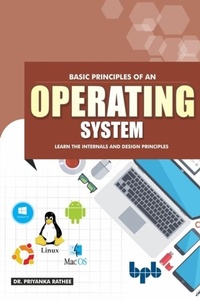
Basic Principles of an Operating System
Learn the Internals and Design Principles
1st Edition
Published on 24. January 2019
329 pages
978-93-88511-00-1 (ISBN)
Description

No detailed description available for "Basic Principles of an Operating System".
More details
Other editions
Additional editions
Book
10/2019
BPB Publications
€38.49
Article not available for order
Content
- Cover Page
- Title Page
- Copyright Page
- Dedication
- Preface
- Acknowledgement
- About the Author
- Table of Contents
- 1. Introduction and Structure of Operating System
- 1.1 What is Operating System?
- 1.2 History of Evolution of Operating System
- 1.3 Operating System Environments
- 1.4 Operating System Components and Goals
- 1.4.1 Core Operating System Components
- 1.4.2 Operating System Goals
- 1.5 Operating System Architecture
- 1.5.1 Monolithic Architecture
- 1.5.2 Layered Architecture
- 1.5.3 Microkernel Architecture
- 1.6 Hardware and Software Concepts
- 1.6.1 Evolution of Hardware Devices
- 1.6.2 Hardware Components
- 1.6.3 Hardware support for operating systems
- 1.6.4 Software Overview
- Review Questions
- 2. Operating System Services
- 2.1 Introduction
- 2.2 Application Programming Interface
- 2.3 Compiling, Linking, and Loading
- 2.4 Key Terminologies
- 2.5 Operating System Design and Implementation
- 2.5.1 Design Issues
- 2.5.2 Design Policies and Mechanisms
- 2.5.3 Operating System Implementation
- 2.6 Types of Operating System
- 2.6.1 Batch Processing System/Sequential Processing
- 2.6.2 Multiprogramming Operating System
- 2.6.3 Time-sharing and Multitasking Operating System
- 2.6.4 Real-time Systems
- 2.6.5 Distributed Operating System
- 2.6.6 Multiprocessor System/ Parallel or Tight Coupling System
- 2.7 CPU Modes
- 2.7.1 Basic Features of Operating System Services
- 2.7.2 Process Management
- 2.8 System Calls
- 2.8.1 Types of System Calls
- 2.9 System Programs
- 2.10 Interrupts
- 2.10.1 Interrupt Processing
- 2.10.2 Types of Interrupt
- Review Questions
- 3. Process Management
- 3.1 Introduction
- 3.1.1 Process Control Blocks/Process Descriptors
- 3.1.2 Process Operations
- 3.1.3 Context Switching
- 3.1.4 RPC and Client-Server Systems
- 3.2 Process States: Life Cycle of a Process
- 3.2.1 Process State Models
- 3.2.2 Process State Transitions
- 3.3 FORK() System Call
- 3.4 Process Scheduling
- 3.4.1 Scheduling Queues
- 3.4.2 Scheduler
- 3.5 Scheduling Techniques/Algorithms
- 3.5.1 Preemptive & Non-Preemptive Scheduling
- 3.5.2 First Come First Serve (FCFS) Scheduling Algorithm
- 3.5.3 Shortest Job First (SJF) Scheduling Algorithm
- 3.5.4 Shortest Remaining Time First (SJF-preemptive)
- 3.5.5 Longest Job First (LJF) Scheduling Algorithm
- 3.5.6 Round Robin Scheduling Algorithm
- 3.5.7 Priority Scheduling Algorithm
- 3.5.8 Multilevel Queue Scheduling Algorithm
- 3.5.9 Multilevel Feedback Queue Scheduling Algorithm
- 3.5.10 Highest Response Ratio First Algorithm
- 3.6 Thread Concepts
- 3.6.1 Process and Threads
- 3.7 Thread Operations
- 3.7.1 Types of Thread
- 3.8 Multithreading Model
- 3.9 Threading Issues
- 3.9.1 Fork() and exec System Call
- 3.9.2 Thread Cancellation
- 3.9.3 Signal Handling
- 3.9.4 Thread Pools
- 3.9.5 Thread-specific Data
- Review Questions
- 4. Inter Process Communication and Process Synchronization
- 4.1 Introduction
- 4.2 Key Terms to Understand Synchronization
- 4.2.1 Critical Section
- 4.2.2 Mutual Exclusion
- 4.2.3 Synchronization
- 4.3 Conditions to Achieve Synchronization
- 4.4 Peterson Solution of Critical Section Problem
- 4.5 Modern Tool of Synchronization-Semaphore
- 4.5.1 Binary Semaphore
- 4.5.2 Counting Semaphore
- 4.6 Hardware Implementation of Synchronization
- 4.7 Monitors
- 4.8 Interprocess Communication
- 4.8.1 Inter-process Communication Mechanisms/Models
- 4.9 Classical IPC Problems
- 4.9.1 Producer-Consumer Problem
- 4.9.2 Reader-writer Problem for Synchronization
- 4.9.3 Dining Philosopher Problem
- Review Questions
- 5. Deadlock
- 5.1 Definition of Deadlock
- 5.2 Conditions to Occur Deadlock Deadlock Characterization
- 5.3 Methods for Handling Deadlock
- 5.3.1 Deadlock Prevention
- 5.3.2 Deadlock Detection and Recovery
- 5.3.3 Deadlock Recovery
- 5.3.4 Deadlock Avoidance
- Review Questions
- 6. Memory Organization and Management
- 6.1 Background
- 6.2 Memory Organization
- 6.3 Memory Management Strategies
- 6.4 Memory Placement Strategies
- 6.4.1 First Fit Strategy
- 6.4.2 Best Fit Strategy
- 6.4.3 Worst Fit Strategy
- 6.4.4 Next Fit Strategy
- 6.5 Memory Allocation
- 6.5.1 Fixed Partition Multiprogramming
- 6.5.2 Variable Partition Multiprogramming
- 6.5.3 Compaction
- 6.6 Paging
- 6.6.1 Structure of Page Table
- 6.6.2 Hardware Support for Paging
- 6.6.3 Drawback of Paging
- 6.7 Segmentation
- 6.8 Segmentation involving Paging (Segmented Paging)
- Review Questions
- 7. Virtual Memory Organization
- 7.1 Background
- 7.2 Concept of Virtual Memory
- 7.2.1 Virtual Addresses to Real Address Mapping
- 7.3 Demand Paging
- 7.3.1 Page Fault
- 7.3.2 Dirty Bit or Modified Bit
- 7.4 Multilevel Paging
- 7.5 Inverted Paging
- 7.6 Page Replacement Algorithm
- 7.6.1 First in First Out (FIFO)
- 7.6.2 Optimal Page Replacement Algorithm
- 7.6.3 Least Recently used (LRU) Page Replacement Algorithm
- 7.7 Thrashing
- 7.7.1 Locality of Reference
- 7.7.2 Working Set Model
- Review Questions
- 8. File System Organization and Implementation
- 8.1 Introduction
- 8.1.1 Function of File Systems
- 8.1.2 File Operations
- 8.1.3 File Attributes
- 8.1.4 File Management
- 8.2 Access methods or file organization
- 8.2.1 Sequential Access
- 8.2.2 Direct Access
- 8.2.3 Indexed
- 8.3 Directory structure
- 8.3.1 Operations Performed on Directory
- 8.3.2 Logical Structures of Directory
- 8.4 File System Structure
- 8.5 File Allocation Methods
- 8.5.1 Contiguous File Allocation
- 8.5.2 Linked List File Allocation
- 8.5.3 Tabular File Allocation
- 8.5.4 Indexed File Allocation
- 8.6 UNIX i-node Implementation
- 8.7 Free Space Management in the Disk
- 8.7.1 Bit Vector
- 8.7.2 Linked List
- 8.7.3 Grouping
- 8.7.4 Counting
- Review Questions
- 9. Secondary Storage Structure
- 9.1 Introduction
- 9.1.1 Basic Terminologies
- 9.2 Disk Structure
- 9.2.1 Disk Attachment
- 9.3 Disk Management
- 9.3.1 Disk Formatting
- 9.3.2 Boot Block
- 9.3.3 Bad Blocks
- 9.3.4 Swap Space Management
- 9.4 Disk Scheduling Algorithms
- 9.4.1 First Some First Serve
- 9.4.2 Shortest Seek Time First
- 9.4.3 SCAN (Elevator Disk Scheduling)
- 9.4.4 C-SCAN
- 9.4.5 LOOK Scheduling
- 9.4.6 C-LOOK (Circular LOOK scan)
- 9.4.7 Last in first out (LIFO)
- Review Questions
- 10. Protection and Security
- 10.1 Introduction
- 10.2 Protection
- 10.2.1 Goals of Protection
- 10.2.2 Protection domain
- 10.2.3 Access Matrix
- 10.2.4 Access Control
- 10.3 Security
- 10.3.1 Security Levels
- 10.3.2 Authentication and Authorization
- 10.4 Threats to Operating System
- 10.4.1 Program Threats
- 10.4.2 System Threats
- 10.4.3 Difference between Virus, Worm, and Trojan Horse
- 10.5 Threat Monitoring
- 10.5.1 Firewall
- 10.5.2 Encryption
- Review Questions
- 11. Case Study
- 11.1 Introduction
- 11.1.1 History of UNIX
- 11.1.2 Features of UNIX Operating System
- 11.2 UNIX Architecture
- 11.3 UNIX File System and Shell Programming
- 11.3.1 UNIX File System Organization
- 11.3.2 UNIX File Permissions
- 11.3.3 File Modes
- 11.3.4 User Masking
- 11.3.5 Change Owner
- 11.3.6 UNIX Linked Files
- 11.3.7 UNIX Commands and Redirections
- 11.4 Elementary UNIX/LINUX Commands
- 11.4.1 UNIX File Colors
- 11.4.2 UNIX Files Notation
- 11.5 Mobile Operating System
- Review Questions
