

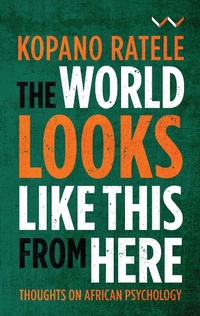
The World Looks Like This From Here
Description

Builds a compelling case for thinking and doing psychology differently in and for Africa
What does the world look like from Africa? What does it mean to think, feel, express without apology for being African? How does one teach society and children to be African-with full consciousness and pride? In institutions of learning, what would a textbook on African-centred psychology look like? How do researchers and practitioners engage in African social psychology, African-centred child development, African neuropsychology, or any area of psychology that situates African realities at the centre? Questions such as these are what Kopano Ratele grapples with in this lyrical, philosophical and poetic treatise on practising African psychology in a decolonised world view. Employing a style common in philosophy but rarely used in psychology, the book offers thoughts about the ideas, contestation, urgency and desire around a psychological praxis in Africa for Africans. While setting out a framework for researching, teaching and practicing African psychology, the book in part coaxes, in part commands and in part urges students of psychology, lecturers, researchers and therapists to reconsider and reach beyond their received notions of African psychology.
More details
Person
Content
- Intro
- Title
- Contents
- Author's note
- 1 (African)
- 2 The necessary adjective
- 3 Disorientation
- 4 Awake to Africa
- 5 A way of seeing
- 6 Off-centre
- 7 Words are not enough
- 8 Teaching Africa
- 9 Psychology is culture
- 10 Africa internationalised
- 11 Aiming for redundancy
- 12 Overlooked perspectives
- 13 Unselfconscious situatedness
- 14 Own goal
- 15 African scholarship
- 16 Education as ethical responsibility
- 17 Black children and white dolls
- 18 Search for Africa in psychology
- 19 Dethingifying
- 20 Three problems
- 21 Fog and friction
- 22 African enough?
- 23 Antipathy, apathy
- 24 Superhuman subhuman
- 25 Sources of negativity
- 26 Not all (blacks) think alike
- 27 Causes of confusion
- 28 Estrangement
- 29 The centre
- 30 Terminology
- 31 Defining by negation
- 32 Self-sabotage
- 33 A welcoming home
- 34 Defining by affirmation
- 35 Scholarly extraverts and introverts
- 36 It's African, except when it's not
- 37 Points on a continuum
- 38 Invisible Africa
- 39 Calls to decolonise
- 40 We need to talk
- 41 A heterogeneous terrain
- 42 It's power, stupid
- 43 Living with constant resistance
- 44 A psychological history of struggle
- 45 Healing potential
- 46 Porous hegemony
- 47 An offshore model
- 48 Only a situated understanding will do
- 49 Satisfied with alienation
- 50 A worldwide need
- 51 Diverse and dynamic orientations
- 52 Returning to definition
- 53 A psychology from nowhere
- 54 A proposal
- 108Psychology: A proposal for an introductory textbook by Okon Tleare Pa
- 55 (African) American psychology
- 56 Mischievous questions
- 57 Solutions to alienation
- 58 Conscientisation
- 59 A new course
- (African-centred) Psychology 101
- 60 Complicity
- 61 The lost self
- 62 An unacknowledged past
- 63 In and of the world
- 64 Origins of (African) psychology
- 65 Birth of a discipline
- 66 Paternity claims
- 67 Fatal intimacy
- 68 Lineage and authority
- 69 Being African
- 70 Interconnectivity
- 71 Four axioms
- 72 Above all
- 73 The past in the present
- 74 Making space for all
- 75 Caveat
- 76 A variegated approach
- 77 The ultimate goal
- 78 Real constraints
- 79 Debates and contests
- 80 A contingent term
- 81 Polyvocality
- 82 Four orientations
- 83 Notes on Western-oriented African psychology
- 84 The world as it is
- 85 Notes on psychological African studies
- 86 A note on cultural African psychology
- 87 Traditions and modernities
- 88 Further notes on cultural African psychology
- 89 A note on critical African psychology
- 90 Misperceiving the object
- 91 Permeable boundaries
- 92 European archives, African exchanges
- 93 Continued hopes and frustrations
- 94 (African) developmental psychology
- 95 (African) community psychology
- 96 Awake to yourself
- 97 Tenets of psychology
- 98 Psychological freedom
- 99 Think Africa in the world
- 100 Always the future
- Index
