

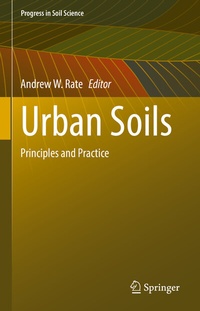
Urban Soils
Description

The authors reflect current developments in research and urban trends. In China, for example, the proportion of the population living in cities increased from 13% in 1950 to 45% in 2010 (World Bank data). Australia is one of the world's top ten urbanised countries with population greater than ten million, with approximately 90% of its population living in cities, mainly along Australia's coast. The most rapidly urbanising populations are currently in nations of the African continent. Soils in urban areas have multiple functions which are becoming more valued by urban communities: soils supply water, nutrients and physical support for urban plant and animal communities (parks, reserves, gardens), and are becoming increasingly valued for growing food. Soils may be used for building foundations, or as building materials themselves. Urban hydrology relies on the existence of unsealed soils for aquifer protection and flood control.
This volume presents the importance of urban ecosystems and the impacts of global change. It examines pedogenesis of urban soils: natural materials affected by urban phenomena, and natural processes acting on urban materials, including an examination of different climatic zones. There is a focus on soils formed on landfill, reclaimed land, dredge spoils as well as soil-related changes in urban geomorphology. There is plenty of discussion on urban soil as a source and sink as well as soil geochemistry and health.
The book is intended primarily as a text for upper-level undergraduate, and postgraduate (Masters) students. It will also be invaluable as a resource for professionals such as researchers, environmental regulators, and environmental consultants.
More details
Other editions
Additional editions
Person
Content
1. Urban Ecosystems: Soils and the Rise and Fall of Cities.- 2. Formation and Properties of Urban Soils.- 3. Spatial Variability and Data Analysis in Urban Soils.- 4. Urban Soil Functions.- 5. Urban Soil Physics.- 6. Inorganic Contaminants in Urban Soils.- 7. Organic Contaminants in Urban Soils.- 8. Soil Biological Processes in Urban Soils.- 9. Urban Soil as a Source and Sink.- 10. Urban Soil and Human Health.- 11. Urban Soil Remediation.- 12. The Future of Urban Soils.
