

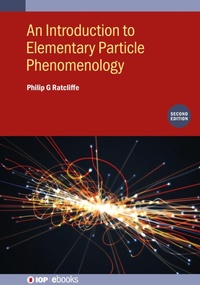
An Introduction to Elementary Particle Phenomenology (Second Edition)
Description

The book covers all aspects of laboratory elementary particle phenomenology, dealing with the two main interactions as described by the electroweak theory and quantum chromodynamics. It outlines the historical development of the theoretical framework, including the experimental motivations and discoveries of the last and present centuries. The interplay between theory and experiment is central to the presentation, as is the physical reasoning behind every step taken.
This 2nd edition includes various important topics omitted from the first printing and also includes new material, both experimental and theoretical, that has emerged over the last decade of intense activity at CERN and elsewhere. The book additionally includes many exercises with complete worked answers. It outlines what might lie beyond our present knowledge and what we hope to discover in future experiments.
The book will be useful for undergraduate and masters particle physics courses (not too specialised in either theory or experiment). It is also valuable supplementary reading for any related course.
More details
Other editions
Additional editions
Person
Philip G Ratcliffe has been a research assistant at Cambridge and London Universities and with the INFN Milan and Turin sections. In 1996 he moved to the School of Sciences in Como, at the University of Insubria, to take up a permanent position as a University Researcher in Theoretical Physics. His research activities regard elementary particle physics theory and phenomenology and he has spent periods visiting such institutions and laboratories as CERN, MIT, SLAC, Fermilab, BNL, INT (Seattle), the CPT in Marseille and the University of Paris.
Content
- Introduction
- Symmetries (discrete and continuous)
- Hadronic physics (the quark-parton model)
- The new particles (discovery and study)
- The standard model (where we are now)
- Beyond the standard model (where we might be going)
Appendices
A. Background notes
B. Quantum mechanics
C. Scattering theory
D. Exercises
