

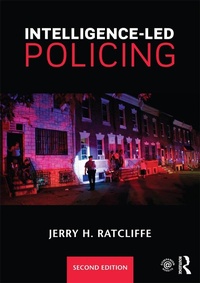
Intelligence-Led Policing
2nd Edition
Published on 14. April 2016
234 pages
978-1-317-51040-6 (ISBN)
Description

What is intelligence-led policing? Who came up with the idea? Where did it come from? How does it relate to other policing paradigms? What distinguishes an intelligence-led approach to crime reduction? How is it designed to have an impact on crime? Does it prevent crime? These are just a few of the questions that this book seeks to answer.
This revised and updated second edition includes new case studies and viewpoints, a revised crime funnel based on new data, and a new chapter examining the expanding role of technology and big data in intelligence-led policing. Most importantly, the author builds upon an updated definition of intelligence-led policing as it has evolved into a framework capable of encompassing more operational police activity than simply organized crime and recidivist offenders.
Topics covered in this book include:
* The origins and aims of intelligence-led policing
* A comparison of intelligence-led policing with other conceptual models of policing
* An exploration of analysis concepts and the role of analysis in target-selection
* Evaluations of intelligence-led policing as a crime-control strategy
Written by an expert in the field, this book offers a comprehensive and engaging introduction to intelligence-led policing for students, practitioners and scholars of policing, criminal intelligence and crime analysis. This book will be of particular interest to professionals within the law enforcement environment; senior officers, middle management, analysts and operational staff. A companion website offers a range of resources for students and instructors, including slides, chapter headings with supporting notes, key terms and names, critical-thinking questions, and quizzes.
This revised and updated second edition includes new case studies and viewpoints, a revised crime funnel based on new data, and a new chapter examining the expanding role of technology and big data in intelligence-led policing. Most importantly, the author builds upon an updated definition of intelligence-led policing as it has evolved into a framework capable of encompassing more operational police activity than simply organized crime and recidivist offenders.
Topics covered in this book include:
* The origins and aims of intelligence-led policing
* A comparison of intelligence-led policing with other conceptual models of policing
* An exploration of analysis concepts and the role of analysis in target-selection
* Evaluations of intelligence-led policing as a crime-control strategy
Written by an expert in the field, this book offers a comprehensive and engaging introduction to intelligence-led policing for students, practitioners and scholars of policing, criminal intelligence and crime analysis. This book will be of particular interest to professionals within the law enforcement environment; senior officers, middle management, analysts and operational staff. A companion website offers a range of resources for students and instructors, including slides, chapter headings with supporting notes, key terms and names, critical-thinking questions, and quizzes.
Reviews / Votes
"Jerry Ratcliffe has updated and reinvigorated his comprehensive analysis of 'intelligence-led policing' - a primary innovation in contemporary policing. Ratcliffe is a thoroughly accessible writer and this new edition will be core reading for policing scholars, students and practitioners around the world."Professor Karen Bullock, University of Surrey, UK
"Jerry Ratcliffe has captured the cutting edge evolution of Intelligence-Led Policing demonstrating its analytic and quantitative applications to an operational environment. The book is a comprehensive resource on ILP for decision-makers and researchers alike."
Professor David L. Carter, Michigan State University, USA
"This updated edition of ILP builds on Jerry Ratcliffe's original work - which has informed a generation of police leaders, operational practitioners and students. This latest version revisits what ILP 'is', and includes a range of new material, including important observations around technology, smarter policing and future opportunities. This outstanding book sets the benchmark for all those with an interest in understanding how ILP really works."
R. Mark Evans OBE, Deputy Chief Executive: Strategy, New Zealand Police and Visiting Professor, University College London, UK
"This new edition of Intelligence-Led Policing is a welcome update that is not only academically thorough and well researched, but is also written for the practitioner. It is full of practical insights for modern policing practice and should be essential reading for today's thinking police officer."
Renee J. Mitchell J.D., Sergeant, Sacramento Police Department, USA
"Ratcliffe's book is a must read for police and policing scholars around the world. This new, second edition carefully unpacks the key principles of intelligence-led policing, considers the digital explosion and rapid changes in high speed data mining techniques, and makes the case why police across the globe need to adopt intelligence-led policing as an organizational process approach to crime reduction, disruption and prevention. Bringing together the rigor of science and policing craft insights, Ratcliffe's book Intelligence-Led Policing offers a genuine pathway for effectively managing risky people and places and dealing with both routine and complex, transnational crime problems in a rapidly changing world."
Lorraine Mazerolle, Professor of Criminology, University of Queensland, Australia
"This important and clearly written book will be essential reading for police officers and police researchers across the globe. Professor Ratcliffe writes with the benefit of experience as a police officer, close familiarity with intelligence-led policing in many different jurisdictions, and a comprehensive knowledge of the relevant literature."
Professor Nick Tilley, Jill Dando Institute of Crime Science, UCL, UK
More details
Edition
2nd edition
Language
English
Place of publication
London
United Kingdom
Publishing group
Taylor & Francis Ltd
Target group
Professional and scholarly
Adult education
Edition type
Revised edition
Illustrations
26 s/w Abbildungen, 12 s/w Tabellen, 1 s/w Photographie bzw. Rasterbild, 25 s/w Zeichnungen
12 Tables, black and white; 25 Line drawings, black and white; 1 Halftones, black and white; 26 Illustrations, black and white
File size
4,46 MB
ISBN-13
978-1-317-51040-6 (9781317510406)
Copyright in bibliographic data and cover images is held by Nielsen Book Services Limited or by the publishers or by their respective licensors: all rights reserved.
Schweitzer Classification
Other editions
New editions
Jerry H. Ratcliffe
Intelligence-Led Policing
E-Book
12/2025
3rd Edition
Routledge
€55.49
Available for download
Additional editions
Jerry H. Ratcliffe
Intelligence-Led Policing
Book
04/2016
2nd Edition
Routledge
€282.25
Shipment within 10-20 days
Jerry H. Ratcliffe
Intelligence-Led Policing
Book
04/2016
2nd Edition
Routledge
€89.60
Shipment within 10-20 days
Previous edition
Craig Hughes | Tony Blockley
Intelligence-led Policing
E-Book
02/2025
1st Edition
Routledge
€27.49
Available for download
Person
Jerry H. Ratcliffe is a Professor with the Department of Criminal Justice and Director of the Center for Security and Crime Science at Temple University, Philadelphia. He is a former police officer with London's Metropolitan Police (UK) where he served for several years on patrol duties, in an intelligence and information unit, and as a member of the Diplomatic Protection Group.
Content
1. Introduction
2. Origins of intelligence-led policing
3. The magnitude of the crime challenge
4. Defining intelligence-led policing
5. Police decision-making
6. Interpreting the criminal environment
7. Influencing decision-makers
8. Having an impact on crime
9. Technology and ILP
10. Evaluating intelligence-led policing
11. Challenges for the future
2. Origins of intelligence-led policing
3. The magnitude of the crime challenge
4. Defining intelligence-led policing
5. Police decision-making
6. Interpreting the criminal environment
7. Influencing decision-makers
8. Having an impact on crime
9. Technology and ILP
10. Evaluating intelligence-led policing
11. Challenges for the future
