

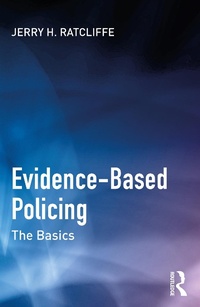
Evidence-Based Policing
The Basics
1st Edition
Published on 30. December 2022
272 pages
978-1-000-81823-9 (ISBN)
Description

What is evidence-based policing and how is it done? This book provides an answer to both questions, offering an introduction for undergraduate students and a hands-on guide for police officers wanting to know how to put principles into practice. It serves as a gentle introduction to the terminology, ideas, and scientific methods associated with evidence-based policy, and outlines some of the existing policing applications.
A couple of introductory chapters summarize evidence-based policy and its goals and origins. The core of the book eases the reader through a range of practical chapters that answer questions many people have about evidence-based practice in policing. What does good science look like? How do I find reliable research? How do I evaluate research? What is a hypothesis? How do randomized experiments work? These chapters not only provide a practical guide to reading and using existing research, but also a roadmap for readers wanting to start their own research project. The final chapters outline different ways to publish research, discuss concerns around evidence-based policing, and ask what is in the future for this emerging field. Annotated with the author's own experiences as a police officer and researcher, and filled with simple aids, flowcharts, and figures, this practical guide is the most accessible introduction to evidence-based policing available. It is essential reading for policing students and police professionals alike.
Further resources are available on the book's website at evidencebasedpolicing.net.
A couple of introductory chapters summarize evidence-based policy and its goals and origins. The core of the book eases the reader through a range of practical chapters that answer questions many people have about evidence-based practice in policing. What does good science look like? How do I find reliable research? How do I evaluate research? What is a hypothesis? How do randomized experiments work? These chapters not only provide a practical guide to reading and using existing research, but also a roadmap for readers wanting to start their own research project. The final chapters outline different ways to publish research, discuss concerns around evidence-based policing, and ask what is in the future for this emerging field. Annotated with the author's own experiences as a police officer and researcher, and filled with simple aids, flowcharts, and figures, this practical guide is the most accessible introduction to evidence-based policing available. It is essential reading for policing students and police professionals alike.
Further resources are available on the book's website at evidencebasedpolicing.net.
Reviews / Votes
Evidence-based policing must engage a wider audience, including students and police officers new to the subject. Jerry Ratcliffe's accessible and practical book is an ideal introduction. It not only shows why EBP is so important, but also how to do policing with better evidence for better results. If every police officer could master the content of this book, the world would be a safer place.Lawrence W. Sherman, Cambridge University and Honorary President, Society for Evidence-Based Policing
As a police practitioner who understands the complexity of evidence-based policing, I highly recommend Jerry's new book which breaks it down into manageable bite-size chunks. With simple figures, insightful callouts, flowcharts, and short, easy-to-read chapters, this is the perfect guide to this emerging paradigm.
Renee Mitchell, Police Sergeant (Sacramento PD retd.) and President of the American Society of Evidence-Based Policing
Police leaders who are interested in understanding the knowledge base of their profession need this book. It helps executives make smart, informed decisions about new plans, programs, and initiatives they may be considering. It also gives leaders the information necessary to collaborate with academics on research projects that will benefit their agencies and the profession.
John Hall, Deputy Inspector, New York City Police Department and NIJ LEADS scholar
This book breaks down and practically explains evidence-based policing. Not only is it a useful guide for police officers wanting to understand if their strategies, tactics, or policies are having the desired impact, it should be used by researchers wanting to work with police to better understand evidence-based policing.
Mike Newman, Detective Inspector, Queensland Police Service, Australia
More details
Edition
1. Auflage
Language
English
Place of publication
London
United Kingdom
Publishing group
Taylor & Francis Ltd
Target group
College/higher education
Professional and scholarly
Illustrations
38 Halftones, color; 38 Illustrations, black and white
ISBN-13
978-1-000-81823-9 (9781000818239)
Copyright in bibliographic data and cover images is held by Nielsen Book Services Limited or by the publishers or by their respective licensors: all rights reserved.
Schweitzer Classification
Other editions
Additional editions
Book
12/2022
1st Edition
Routledge
€75.70
Shipment within 15-20 days
Book
12/2022
1st Edition
Routledge
€173.31
Shipment within 15-20 days
Person
Jerry H. Ratcliffe is a former British police officer, Professor of Criminal Justice at Temple University, US, and host of the popular Reducing Crime podcast.
Content
1. What is evidence-based policing? 2. What are the origins of evidence-based policy? 3. What does good science look like? 4. What is the scientific method? 5. How do you identify a specific problem? 6. How do you find reliable research? 7. How do you evaluate policy research? 8. How do you develop a hypothesis and research question? 9. What are some core research concepts? 10. How do you make research methodology choices? 11. How do randomized experiments work? 12. How do you design a powerful experiment? 13. How do you know if an intervention is significant? 14. Where do you publish results? 15. What are the challenges with evidence-based policing? 16. What is next for evidence-based policing?
