

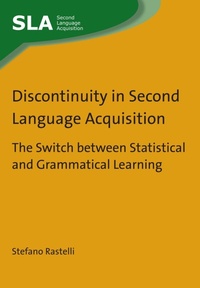
Discontinuity in Second Language Acquisition
The Switch between Statistical and Grammatical Learning
Published on 12. September 2014
272 pages
978-1-78309-248-2 (ISBN)
Description

With a particular focus on the morphosyntactic features of second language, this book discusses the idea that language acquisition is a discontinuous and 'quantized' process and thus that some items might be learned twice, statistically and grammatically. It argues that the switch from one way of learning to another is statistically-driven and grammatically motivated. The volume brings together and discusses insights and evidence from learner corpora analysis and electrophysiological data in an attempt to provide the reader with a unified outlook and it suggests a new, developmentally-oriented interpretation of findings. The topics discussed will be of interest to researchers working in the field of psycho- and neurolinguistics and SLA.
Reviews / Votes
The first quality distinguishing the Italian psycholinguist Stefano Rastelli's book Discontinuity in Second Language Acquisition: The Switch between Statistical and Grammatical Learning (henceforth, Discontinuity) is its coherence as a single-author volume focused entirely on SLA, predominantly by adults. The second is the breadth and depth of Rastelli's knowledge of current theory and research in linguistics, cognitive psychology, neurolinguistics, and SLA, and his ability to synthesize and integrate work from all four. The third is the originality of his perspective. -- Michael H. Long, University of Maryland, US * Applied Linguistics 2016: 1-8 *More details
Series
Language
English
Place of publication
Bristol
United Kingdom
Publishing group
Channel View Publications Ltd
Target group
Professional and scholarly
Product notice
Reflowable
ISBN-13
978-1-78309-248-2 (9781783092482)
Copyright in bibliographic data and cover images is held by Nielsen Book Services Limited or by the publishers or by their respective licensors: all rights reserved.
Schweitzer Classification
Other editions
Additional editions
Stefano Rastelli
Discontinuity in Second Language Acquisition
The Switch between Statistical and Grammatical Learning
Book
09/2014
Multilingual Matters
€158.10
Shipment within 10-20 days
Person
Stefano Rastelli teaches Second Language Acquisition at the Universities of Pavia and Verona, Italy. He is an associate member of CAROLE (Center for Advanced Research and Outreach in Language Education), University of Greenwich. His research focuses on second language processing and syntactic theory and he has published numerous research articles in international journals.
Content
1. Second Language Acquisition facit faltus ('takes a leap')
2. Discontinuity as Chunks Feed into Grammar
3. Discontinuity in the Maturing and in the Adapting Brain
4. Discontinuity and the Neurocognition of Second Language
5. Statistical Learning of a Second Language
6. Parts of L2 Grammar that Resist Statistical Learning
Conclusions
References
2. Discontinuity as Chunks Feed into Grammar
3. Discontinuity in the Maturing and in the Adapting Brain
4. Discontinuity and the Neurocognition of Second Language
5. Statistical Learning of a Second Language
6. Parts of L2 Grammar that Resist Statistical Learning
Conclusions
References
