

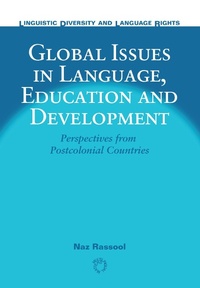
Global Issues in Language, Education and Development
Perspectives from Postcolonial Countries
1st Edition
Published on 12. March 2007
304 pages
978-1-85359-953-8 (ISBN)
Description

The question of why the issue of language features increasingly at the centre of debates about education for social and economic development at the beginning of the 21st Century is compelling. Within a rapidly changing world, language, literacy and communication are seen as constituting key elements in the process of lifelong learning. Contemporary technological development and cultural shifts intersect in complex ways with the legacy of colonialism and underdevelopment within developing countries with a colonial history. This book addresses some of these issues related to language and development. Part I explores the relationship between colonial and postcolonial social policies on the unresolved language problems that prevail in many developing countries. Part II comprises case studies of Mali, Pakistan and South Africa. Part III draws on key motifs identified in the previous two sections, and discusses linguistic diversity as an important variable of cultural capital within the interactive global cultural economy. The book's focus on language, education and development makes it essential reading in Development Studies, International and Comparative Education, Sociology and Educational Policy Studies. Its focus on language issues within the global cultural economy would make it an important text in Applied Linguistic Studies.
Reviews / Votes
Naz Rasool's work combines academic rigour with sensitiveness. The first comes from a careful study of the empirical data on the use of language in the domains of education and employment; the second from an understanding of how these realities actually impact the lives of ordinary people, especially the disadvantaged. She begins with a theoretical overview of how colonialism impacts the colonized and how language is used to construct new colonial identities and networks of the distribution of power and patronage. Two historical moments have been chosen to examine major transformations in colonized countries: the first, the carving up of Africa at the Berlin Conference in 1884-1885; the second, the partition of India in 1947. The fractures and displacement following these divisions have given rise to conflicts between ethnolinguistic groups which are still with us. The colonial discourse created hierarchies, especially in relation to the acquisition of the colonial language, which is also with us. The way these elites use the education system to perpetuate their privileged status is a theme which occurs several times in the book.Part-2 comprises case studies of Mali, South Africa and Pakistan. Contributed by scholars specializing in these areas, it provides the empirical evidence which supports the major arguments and conclusions of the book. The last part is about these conclusions, of which the most significant one is about the importance of pursuing multilingual language-in-education policies. This strategy seeks to secure indigenous cultural capital along with the development of knowledges and skills which are needed for operating in a globalized world. -- Dr Tariq Rahman, Distinguished National Professor of Sociolinguistic History, National Institute of Pakistan Studies, Quaid-i-Azam University, Islamabad, Pakistan Dr Tariq Rahman, Distinguished National Professor of Sociolinguistic History, National Institute of Pakistan Studies, Quaid-i-Azam University, Islamabad, Pakistan It is a rare achievement for scholarship connecting economic, cultural and educational issues to be presented so lucidly. Naz Rassool and her co-authors brilliantly unite the global and the local, the historical and the postcolonial, the theoretical and the practical, general trends and detailed specific case studies. The book maintains a coherent focus on the linguistic dimension of cultural and economic globalisation processes, and the constraints that hinder more equitable and multilingual policies in education. It should be prescribed reading for anyone concerned with educational competence-building worldwide. -- Robert Phillipson, Professor, Copenhagen Business School, Denmark Global Issues in Language, Education and Development delivers a thought-provoking and frequently sobering assessment of linguistic hegemony in multiple postcolonial contexts. It does so by melding macro-theoretical analysis and reflection with case study analysis. Rassool's perspective is a refreshing one that challenges the notion that the spread of (ex)colonial languages has been, especially in the last 20 years or so, a mostly, if not wholly, positive development characterized almost exclusively by masses of people clamouring loudly and happily for English. -- Christof Demont-Henrich * Journal of Sociolinguistics 12/05/2008 *
More details
Series
Language
English
Place of publication
Bristol
United Kingdom
Publishing group
Channel View Publications Ltd
Target group
Professional and scholarly
Edition type
Digital original
ISBN-13
978-1-85359-953-8 (9781853599538)
Copyright in bibliographic data and cover images is held by Nielsen Book Services Limited or by the publishers or by their respective licensors: all rights reserved.
Schweitzer Classification
Other editions
Additional editions
Naz Rassool
Global Issues in Language, Education and Development
Perspectives from Postcolonial Countries
Book
03/2007
Multilingual Matters
€48.20
Shipment within 10-20 days
Naz Rassool
Global Issues in Language, Education and Development
Perspectives from Postcolonial Countries
Book
03/2007
Multilingual Matters
€163.50
Article not available at the moment
Person
Professor Naz Rassool teaches in the Institute of Education at the University of Reading. She has published widely within the fields of the political economy of language in education; literacy and development and language relations within the global cultural economy, New Managerialism in education, and the sociology of technology in education. She is the author of Literacy for Sustainable Development in the Age of Information (1999), co-author, with Louise Morley, of School Effectiveness: Fracturing the Discourse (1999) and co-editor with Kevin Brehony, of Nationalisms Old and New (1999). She is also co-editor of the international journal Pedagogy, Culture and Society.
Content
Part 1 Language Diversity in Development Discourse
Introduction
Chapter 1: Language and the Colonial State
Chapter 2: Postcolonial Development, Language and Nationhood
Chapter 3: The Global Cultural Economy: Issues of Language, Culture and Politics
Chapter 4: Language in the Global Cultural Economy: Implications for Postcolonial Societies
Part 2 Case Studies
Chapter 5: Language and Education Issues in Policy and Practice in Mali, West Africa, by Maggie Canvin
Chapter 6: Language and Literacy Issues in South Africa: Policy and Practice? by Kathleen Heugh
Chapter 7: Contemporary Issues in Language, Education and Development in Pakistan by Naz Rassool and Sabiha Mansoor
Part 3: Globalization and Linguistic Diversity
Chapter 8: Postcolonial Perspectives: Major Issues in Language and Development in the Global Cultural Economy
Introduction
Chapter 1: Language and the Colonial State
Chapter 2: Postcolonial Development, Language and Nationhood
Chapter 3: The Global Cultural Economy: Issues of Language, Culture and Politics
Chapter 4: Language in the Global Cultural Economy: Implications for Postcolonial Societies
Part 2 Case Studies
Chapter 5: Language and Education Issues in Policy and Practice in Mali, West Africa, by Maggie Canvin
Chapter 6: Language and Literacy Issues in South Africa: Policy and Practice? by Kathleen Heugh
Chapter 7: Contemporary Issues in Language, Education and Development in Pakistan by Naz Rassool and Sabiha Mansoor
Part 3: Globalization and Linguistic Diversity
Chapter 8: Postcolonial Perspectives: Major Issues in Language and Development in the Global Cultural Economy
