

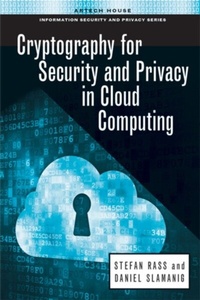
Cryptography for Security and Privacy in Cloud Computing
1st Edition
Published on 1. January 2013
260 pages
978-1-60807-576-8 (ISBN)
Description

As is common practice in research, many new cryptographic techniques have been developed to tackle either a theoretical question or foreseeing a soon to become reality application. Cloud computing is one of these new areas, where cryptography is expected to unveil its power by bringing striking new features to the cloud. Cloud computing is an evolving paradigm, whose basic attempt is to shift computing and storage capabilities to external service providers. This resource offers an overview of the possibilities of cryptography for protecting data and identity information, much beyond well-known cryptographic primitives such as encryption or digital signatures. This book represents a compilation of various recent cryptographic primitives, providing readers with the features and limitations of each.
More details
Other editions
Additional editions
Stefan Rass | Daniel Slamanig
Cryptography for Security and Privacy in Cloud Computing
Book
11/2013
Artech House Publishers
€161.93
Shipment within 10-20 days
Content
- Intro
- Cryptography for Security and Privacy in Cloud Computing
- Contents
- Chapter 1 Introduction
- 1.1 MODERN CRYPTOGRAPHY
- 1.2 CLOUD COMPUTING
- 1.3 DIGITAL IDENTITY, AUTHENTICATION, AND ACCESS CONTROL
- 1.4 PRIVACY-ENHANCING TECHNOLOGIES
- 1.5 OUTLINE
- References
- Chapter 2 Fundamentals
- 2.1 NUMBER THEORY
- 2.1.1 Drawing Random Coprime Elements
- 2.1.2 Computing Inverse Elements Modulo a Prime
- 2.1.3 Computing Negative Powers Modulo a Prime
- 2.1.4 Getting (Large) Primes
- 2.1.5 Quadratic Residues, Legendre Symbol, and Jacobi Symbol
- 2.2 RINGS, GROUPS, FIELDS, AND LATTICES
- 2.2.1 Finding a Generating Element
- 2.2.2 Groups of Quadratic Residues
- 2.2.3 Constructing a Subgroup
- 2.2.4 Constructing General Finite Fields
- 2.2.5 Homomorphy and Isomorphy
- 2.2.6 Elliptic Curves
- 2.2.7 Pairings
- 2.2.8 Lattices
- 2.3 CODING
- 2.4 COMPUTATIONAL COMPLEXITY
- 2.4.1 Computational Intractability
- 2.4.2 Factorization-Related Assumptions
- 2.4.3 Discrete-Logarithm-Related Assumptions
- 2.4.4 Lattice Assumptions
- 2.5 CRYPTOGRAPHIC PRIMITIVES AND SECURITY MODELS
- 2.5.1 Reductionist Security
- 2.5.2 Random OracleModel and Standard Model
- 2.5.3 Cryptographic Hash Functions
- 2.5.4 Hashing to Algebraic Structures
- 2.5.5 Merkle Trees
- 2.5.6 Secret-Sharing
- 2.5.7 Public Key Cryptography
- 2.5.8 Public Key Encryption
- 2.5.9 Digital Signature Schemes
- 2.5.10 Commitment Schemes
- 2.5.11 Zero-Knowledge Proofs
- References
- Chapter 3 Protection of Identifying Information
- 3.1 PRIVACY PRESERVING AUTHENTICATION
- 3.1.1 Anonymous Password Authentication and AuthenticatedKey Exchange
- 3.1.2 Anonymous Authentication from PKE
- 3.1.3 Group and Ring Signatures
- 3.1.4 Revocable Anonymity
- 3.1.5 Blind Signatures for Anonymous Transactions
- 3.2 ANONYMOUS CREDENTIAL SYSTEMS
- 3.2.1 Camenisch-Lysyanskaya Credentials (Idemix)
- 3.2.2 Brands Credentials (U-Prove)
- 3.3 PRIVACY PRESERVING DISCLOSURE OF DATA
- 3.3.1 k-Anonymity, l-Diversity, and t-Closeness
- 3.3.2 Redactable and Sanitizable Signatures
- 3.4 PRIVACY PRESERVING ACCESS TO RESOURCES
- 3.4.1 Anonymous Communication
- 3.4.2 Private Information Retrieval
- 3.4.3 Oblivious RAM
- References
- Chapter 4 Privacy-Enhancing Encryption
- 4.1 ACCESS CONTROL THROUGH ENCRYPTION
- 4.1.1 Attribute-Based Encryption
- 4.1.2 Predicate Encryption
- 4.1.3 Functional Encryption
- 4.1.4 Summary
- 4.2 COMPUTING ON ENCRYPTED DATA
- 4.2.1 Group Homomorphic Encryption
- 4.2.2 Somewhat Homomorphic Encryption
- 4.2.3 Fully Homomorphic Encryption
- 4.2.4 Alternative Approaches
- 4.2.5 Summary
- References
- Chapter 5 Remote Data Storage
- 5.1 REMOTE DATA CHECKING
- 5.1.1 Proofs of Retrievability (PoR)
- 5.1.2 Provable Data Possession (PDP)
- 5.1.3 Comparison of PoR and PDP
- 5.2 SECURE DATA DEDUPLICATION
- 5.2.1 Convergent or Message-Locked Encryption
- 5.2.2 Proofs of Ownership
- 5.3 SEARCHABLE ENCRYPTION
- 5.3.1 Categorization
- 5.3.2 Symmetric Searchable Encryption
- 5.3.3 Asymmetric Searchable Encryption
- 5.3.4 Security of Searchable Encryption
- 5.4 AVAILABILITY IN THE CLOUD
- References
- Chapter 6 Practical Issues
- 6.1 THE ROLE AND LIMITS OF CRYPTOGRAPHY
- 6.2 IMPLEMENTATIONS AND STANDARDIZATION
- 6.2.1 Implementations
- 6.2.2 Standardization
- 6.3 SELECTED CLOUDS
- 6.3.1 Commercial Clouds
- 6.3.2 Secure Cloud Storage Architectures
- 6.4 OUTLOOK
- References
- List of Symbols
- Abbreviations
- About the Authors
