

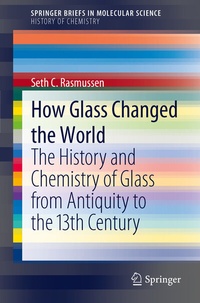
How Glass Changed the World
Description

Glass production is thought to date to ~2500 BC and had found numerous uses by the height of the Roman Empire. Yet the modern view of glass-based chemical apparatus (beakers, flasks, stills, etc.) was quite limited due to a lack of glass durability under rapid temperature changes and chemical attack. This "brief" gives an overview of the history and chemistry of glass technology from its origins in antiquity to its dramatic expansion in the 13th century, concluding with its impact on society in general, particularly its effect on chemical practices.
Reviews / Votes
"This book is exciting and enjoyable to read, especially for anyone who is interested in glass. The book provides a dynamic introduction to glass via the history of glassmaking . . this book is highly recommended, whether you are a novice or an expert in glass research or you are just interested in glass and glassmaking. It is easy to read and understand, even for those individuals with minimal background knowledge in science and chemistry. This is a must read!" (Michael B. Jacobs, Journal of Chemical Education, Vol. 92 (3), 2015)More details
Other editions
Additional editions
Person
Seth C. Rasmussen is an Associate Professor of Chemistry at North Dakota State University (NDSU) in Fargo (seth.rasmussen@ndsu.edu). He received his B.S in Chemistry from
Washington State University in 1990 and his Ph.D. in Inorganic Chemistry from Clemson University in 1994, under the guidance of Prof. John D. Peterson. As a postdoctoral associate at
the University of Oregon, he then studied conjugated organic polymers under Prof. James E. Hutchison. In 1997, he accepted a teaching position at the University of Oregon, before moving
to join the faculty at NDSU in 1999. Active in the fields of materials chemistry and the history of chemistry, his research interests
include the design and synthesis of conjugated materials, photovoltaics (solar cells), organic light emitting diodes, the application of history to chemical education, the history of materials, and chemical technology in antiquity. As both author and editor, Prof. Rasmussen has contributed to books in both materials and history and has published more than 50 research papers. He is a
member of various international professional societies including the American Chemical Society, Materials Research Society, Alpha Chi Sigma, Society for the History of Alchemy and Chemistry, and the International History, Philosophy & Science Teaching Group.
Prof. Rasmussen currently serves as the Program Chair for the History of Chemistry division of the American Chemical Society and as Series Editor for Springer Briefs in Molecular Science: History of Chemistry.
