

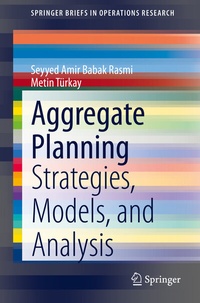
Aggregate Planning
Strategies, Models, and Analysis
Published on 25. January 2021
XII, 56 pages
978-3-030-58118-3 (ISBN)
Description

This book helps readers understand the main issues, challenges, strategies, and solution methods in Aggregate Planning (AP), an important part of Supply Chain Management. The design of the book supports readers in the fields of engineering and management to learn practical knowledge about AP in a short look. Moreover, it delivers materials that consider multiple criteria in an AP model that is also required in sustainable developments. In spite of the simple structure of the book, it approaches more complicated mathematical models with single/multiple objective functions to include more practical decisions in AP. It addresses those issues without increasing the complexity of the book to keep it useful for practitioners.
More details
Series
Edition
1st ed. 2021
Language
English
Place of publication
Cham
Switzerland
Publishing group
Springer International Publishing
Target group
Professional and scholarly
Product notice
Reflowable
Illustrations
XII, 56 p. 4 illus., 3 illus. in color.
File size
1,08 MB
ISBN-13
978-3-030-58118-3 (9783030581183)
DOI
10.1007/978-3-030-58118-3
Schweitzer Classification
Other editions
Additional editions
Book
01/2021
Springer
€53.49
Shipment within 7-9 days
Persons
Seyyed Amir Babak Rasmi is a Postdoctoral Research Fellow in the Center for Next-Generation Logistics, a Research Partnership between the Georgia Institute of Technology, USA and the National University of Singapore's Department of Industrial Systems Engineering and Management. He earned his Ph.D. in Industrial Engineering at Koc University, Istanbul, Turkey and his MSc in Industrial Engineering at Sharif University of Technology, Tehran, Iran. His research interests include supply chain management, logistics, simulation modelling, and optimization.
Metin Turkay is a Professor of Industrial Engineering at Koc University, Istanbul, Turkey. He earned his Ph.D. in Industrial Engineering at Carnegie Mellon University, USA. His research interests include sustainable supply chains, logistics system engineering, and process system engineering. He has written several books and contributed many chapters, including several with Springer.
Metin Turkay is a Professor of Industrial Engineering at Koc University, Istanbul, Turkey. He earned his Ph.D. in Industrial Engineering at Carnegie Mellon University, USA. His research interests include sustainable supply chains, logistics system engineering, and process system engineering. He has written several books and contributed many chapters, including several with Springer.
Content
- Intro
- Preface
- Acknowledgements
- Contents
- 1 Introduction to Aggregate Planning and Strategies
- 1.1 Definition and Scopes
- 1.1.1 Cost Categories in Aggregate Planning
- 1.1.2 Decision Levels
- 1.1.3 Why Aggregate Planning?
- 1.2 Strategies and Approaches
- 1.2.1 Adjusting Capacity
- 1.2.2 Managing Demand
- 1.3 Aggregate Planning for Services
- 1.4 Aggregate Plans versus Disaggregate Plans
- 1.4.1 Definition and Concepts
- 1.4.2 Solution Approaches
- 1.5 Sustainable Aggregate Planning
- 1.5.1 Environmental Issues
- 1.5.2 Social Issues
- References
- 2 Mathematical Models for Aggregate Planning
- 2.1 Modeling an Aggregate Plan
- 2.1.1 Basic Assumptions
- 2.1.2 Parameters and Decision Variables
- 2.1.3 Basic Model
- 2.2 Modeling Aggregate Plans with Additional Practical Modifications
- 2.2.1 Aggregate Plan with Production Setup Cost, Backlog, and Promotion Programs
- 2.2.2 Aggregate Plan with Sustainability Considerations
- 2.2.2.1 Including Sustainability in Aggregate Planning
- 2.2.2.2 A Tri-Objective Sustainable Aggregate Planning
- References
- 3 Solution Methods for Aggregate Planning Problems Using Python
- 3.1 Solving a Generic Mathematical Program Using Python
- 3.2 Solving Model BM1
- 3.3 Solving Model BM2
- 3.4 Solving Model SAP
- References
- 4 Analysis and Conclusions
- 4.1 Analysis of the ND Points of the SAP Model
- 4.2 Conclusions
- References
- Correction to: Aggregate Planning
