

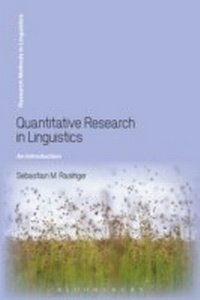
Quantitative Research in Linguistics
An Introduction
1st Edition
Published on 14. June 2008
240 pages
978-1-4411-2463-0 (ISBN)
Description

This textbook presents a comprehensive introduction to analysing quantitative linguistic data. Starting with an in-depth examination of what quantitative data is, and how it differs from qualitative data, the book examines what the linguist is trying to find out through analysing data, and how quantitative techniques can help him or her to arrive at meaningful and accurate conclusions.
The book introduces: - using statistics, variables, reliability of data, describing data, analysing data, testing hypotheses and dealing with problematic data. Each chapter includes graphs and figures explaining theory through worked examples, chapter summaries, and exercises to aid student understanding. An appendix containing a summary of statistical formulae, excel commands and statistical tables is included and is an invaluable resource.
Presenting a down-to-earth and readable introduction to quantitative research, this book is a useful how-to guide for students encountering quantitative data for the first time, or for postgraduates embarking on linguistic research projects.
The book introduces: - using statistics, variables, reliability of data, describing data, analysing data, testing hypotheses and dealing with problematic data. Each chapter includes graphs and figures explaining theory through worked examples, chapter summaries, and exercises to aid student understanding. An appendix containing a summary of statistical formulae, excel commands and statistical tables is included and is an invaluable resource.
Presenting a down-to-earth and readable introduction to quantitative research, this book is a useful how-to guide for students encountering quantitative data for the first time, or for postgraduates embarking on linguistic research projects.
Reviews / Votes
For the maths-shy linguistics student with no statistics training, this long-needed, reader-friendly book demystifies what quantitative research is and how it's done. Assuming no prior knowledge, students are introduced to various research methods and shown the steps to designing, analysing and interpreting data. Statistical analyses are brilliantly explained and illustrated with examples from published research with which students will already be familiar. Intended for both undergraduate and graduate students, this textbook presents a concise, clear and well-illustrated introduction to the quantitative analysis of language. It is comprehensive and example-based, and it covers the basics of quantitative analysis of linguistic data and explores how this differs from qualitative approaches. At the same time, the book is also practical, helping the reader understand how to conceptualize, construct, and implement a quantitative investigation in linguistics. Reviewed in Times Higher Education Supplement, 28 May 2009 Presenting a down-to-earth and readable introduction to quantitative research, this book is useful how-to guide for students encountering quantitative data for the first time, or for postgraduates embarking on linguistic research projects. Rasinger's new book provides a comprehensive and accessible introduction to quantitative research methods in linguistics. Aimed at an advanced undergraduate and early postgraduate audience, the book addresses a longstanding need in the field for a textbook specifically geared toward students who may have already developed a nuanced understanding of language and linguistics but who have had little to no exposure to statistical methods. As such, the book stands to make an important contribution to the teaching of linguistics, whether as a classroom resource for teachers or as a guide to individual students as they undertake their own research projects. ... this textbook presents a concise, clear, and well-illustrated introduction to the quantitative analysis of language. It is comprehensive and example-based, and it covers the basics of quantitative analysis of linguistic data and explores how this differs from qualitative approaches. At the same time, the book is also practical, helping the reader to understand how to conceptualize, construct, and implement a quantitative investigation in linguistics.More details
Series
Edition
1. Auflage
Language
English
Place of publication
New York
United States
Target group
College/higher education
ISBN-13
978-1-4411-2463-0 (9781441124630)
Copyright in bibliographic data and cover images is held by Nielsen Book Services Limited or by the publishers or by their respective licensors: all rights reserved.
Schweitzer Classification
Other editions
Additional editions
Book
06/2008
Continuum International Publishing Group Ltd.
€49.75
Article exhausted; check different version

Book
06/2008
Continuum International Publishing Group Ltd.
€113.00
Article exhausted; check different version
Person
Sebastian M. Rasinger is Associate Professor of Applied Linguistics at Anglia Ruskin University, Cambridge, UK.
Content
1. Introduction
2. Quantitative Research: some basic issues
3. Research Design and Sampling
4. Questionnaire Design and Coding
5. A First Glimpse at Data
6. Describing Data Properly: central location and dispersion
7. Analysing Data: a few steps further
8. Testing Hypotheses
9. Analysing Dodgy Data: when things are not quite normal
10. Appendices and Solutions
Bibliography
2. Quantitative Research: some basic issues
3. Research Design and Sampling
4. Questionnaire Design and Coding
5. A First Glimpse at Data
6. Describing Data Properly: central location and dispersion
7. Analysing Data: a few steps further
8. Testing Hypotheses
9. Analysing Dodgy Data: when things are not quite normal
10. Appendices and Solutions
Bibliography
