

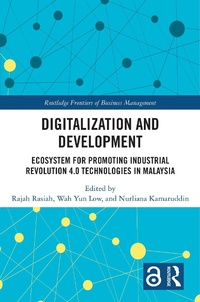
Digitalization and Development
Ecosystem for Promoting Industrial Revolution 4.0 Technologies in Malaysia
1st Edition
Published on 31. January 2023
294 pages
978-1-000-85138-0 (ISBN)
Description

This book examines the diffusion of digitalization and Industry 4.0 technologies in Malaysia by focusing on the ecosystem critical for its expansion. The chapters examine the digital proliferation in major sectors of agriculture, manufacturing, e-commerce and services, as well as the intermediary organizations essential for the orderly performance of socioeconomic agents.
The book incisively reviews policy instruments critical for the effective and orderly development of the embedding organizations, and the regulatory framework needed to quicken the appropriation of socioeconomic synergies from digitalization and Industry 4.0 technologies. It highlights the importance of collaboration between government, academic and industry partners, as well as makes key recommendations on how to encourage adoption of IR4.0 technologies in the short- and long-term.
This book bridges the concepts and applications of digitalization and Industry 4.0 and will be a must-read for policy makers seeking to quicken the adoption of its technologies.
The Open Access version of this book, available at www.taylorfrancis.com, has been made available under a Creative Commons Attribution-Non Commercial-No Derivatives 4.0 license.
The book incisively reviews policy instruments critical for the effective and orderly development of the embedding organizations, and the regulatory framework needed to quicken the appropriation of socioeconomic synergies from digitalization and Industry 4.0 technologies. It highlights the importance of collaboration between government, academic and industry partners, as well as makes key recommendations on how to encourage adoption of IR4.0 technologies in the short- and long-term.
This book bridges the concepts and applications of digitalization and Industry 4.0 and will be a must-read for policy makers seeking to quicken the adoption of its technologies.
The Open Access version of this book, available at www.taylorfrancis.com, has been made available under a Creative Commons Attribution-Non Commercial-No Derivatives 4.0 license.
More details
Series
Edition
1. Auflage
Language
English
Place of publication
London
United Kingdom
Publishing group
Taylor & Francis Ltd
Target group
College/higher education
Illustrations
30 Tables, black and white; 44 Line drawings, black and white; 14 Halftones, black and white; 58 Illustrations, black and white
File size
9,49 MB
ISBN-13
978-1-000-85138-0 (9781000851380)
Copyright in bibliographic data and cover images is held by Nielsen Book Services Limited or by the publishers or by their respective licensors: all rights reserved.
Schweitzer Classification
Other editions
Additional editions
Rajah Rasiah | Wah Yun Low | Nurliana Kamaruddin
Digitalization and Development
Ecosystem for Promoting Industrial Revolution 4.0 Technologies in Malaysia
Book
01/2023
1st Edition
Routledge
€71.80
Shipment within 10-20 days
Rajah Rasiah | Wah Yun Low | Nurliana Kamaruddin
Digitalization and Development
Ecosystem for Promoting Industrial Revolution 4.0 Technologies in Malaysia
Book
01/2023
1st Edition
Routledge
€232.10
Shipment within 10-20 days
Persons
Rajah Rasiah is Distinguished Professor of Economics and Executive Director of the Asia-Europe Institute, Universiti Malaya.
Wah Yun Low is Honorary Professor of Psychology at the Faculty of Medicine, Universiti Malaya, Kuala Lumpur.
Nurliana Kamaruddin is Deputy Executive Director of Academic and Students Affairs and Senior Lecturer at the Asia-Europe Institute, Universiti Malaya.
Wah Yun Low is Honorary Professor of Psychology at the Faculty of Medicine, Universiti Malaya, Kuala Lumpur.
Nurliana Kamaruddin is Deputy Executive Director of Academic and Students Affairs and Senior Lecturer at the Asia-Europe Institute, Universiti Malaya.
Content
List of figures
List of tables
List of contributors
Foreward
Preface
List of abbreviations
1. Problematizing Digitalization and Industrial Revolution 4.0
Rajah Rasiah, Nurliana Kamaruddin, and Wah Yun Low
2. Improving Food Production through Digitalizing the Fertigation System
Mohd Afzanizam Abdul Rashid
3. Proliferation of IR4.0 Technologies in Large-Scale Agriculture
Suresh Palpanaban
4. Diffusion of IR4.0 Technologies in Electronics Manufacturing: The Role of the Embedding Ecosystem
Yeap Khai Leang and Rajah Rasiah
5. Ecosystem Supporting Industry 4.0 Technologies in Textile and Clothing Manufacturing
Kiranjeet Kaur, Hemant Kedia, and Rajah Rasiah
6. Did Digitalization Help Manufacturers Cope with the Covid-19 Pandemic?
Shankaran Nambiar and Yip Tien Ming
7. Creative Digital Pedagogies for Student Engagement: Preparing Students for Industry 4.0
Dorothy DeWitt and Norlidah Alias
8. Online Education in Malaysia: Institutional Change to Stimulate Digital Literacy
Nurliana Kamaruddin, Cecilia Cheong Yin Mei, Wah Yun Low, and Azirah Hashim
9. E-commerce Expansion in Malaysia
Tham Siew Yean and Andrew Kam Jia Yi
10. Digitalization and the Gig Economy: Ecosystem System Supporting Consumer Services
Khairul Hanim Pazim, Yosuke Uchiyama, Fumitaka Furuoka, Beatrice Lim, and Jingi Li
11. The Role of TVET in IR4.0 for Malaysia
Cheong Kee Cheok and Li Ran
12. The Role of STRAND in Malaysia's Industrial Transformation
Naguid Mohd Nor and Nazreen Mohd Nasir
13. Government Initiatives to Promote Adoption of IR4.0 Technologies in Manufacturing
Abdul Latif and Saliza Saari
14. Addressing Cybersecurity Issues
Maslina Daud and Rajah Rasiah
Index
List of tables
List of contributors
Foreward
Preface
List of abbreviations
1. Problematizing Digitalization and Industrial Revolution 4.0
Rajah Rasiah, Nurliana Kamaruddin, and Wah Yun Low
2. Improving Food Production through Digitalizing the Fertigation System
Mohd Afzanizam Abdul Rashid
3. Proliferation of IR4.0 Technologies in Large-Scale Agriculture
Suresh Palpanaban
4. Diffusion of IR4.0 Technologies in Electronics Manufacturing: The Role of the Embedding Ecosystem
Yeap Khai Leang and Rajah Rasiah
5. Ecosystem Supporting Industry 4.0 Technologies in Textile and Clothing Manufacturing
Kiranjeet Kaur, Hemant Kedia, and Rajah Rasiah
6. Did Digitalization Help Manufacturers Cope with the Covid-19 Pandemic?
Shankaran Nambiar and Yip Tien Ming
7. Creative Digital Pedagogies for Student Engagement: Preparing Students for Industry 4.0
Dorothy DeWitt and Norlidah Alias
8. Online Education in Malaysia: Institutional Change to Stimulate Digital Literacy
Nurliana Kamaruddin, Cecilia Cheong Yin Mei, Wah Yun Low, and Azirah Hashim
9. E-commerce Expansion in Malaysia
Tham Siew Yean and Andrew Kam Jia Yi
10. Digitalization and the Gig Economy: Ecosystem System Supporting Consumer Services
Khairul Hanim Pazim, Yosuke Uchiyama, Fumitaka Furuoka, Beatrice Lim, and Jingi Li
11. The Role of TVET in IR4.0 for Malaysia
Cheong Kee Cheok and Li Ran
12. The Role of STRAND in Malaysia's Industrial Transformation
Naguid Mohd Nor and Nazreen Mohd Nasir
13. Government Initiatives to Promote Adoption of IR4.0 Technologies in Manufacturing
Abdul Latif and Saliza Saari
14. Addressing Cybersecurity Issues
Maslina Daud and Rajah Rasiah
Index
