

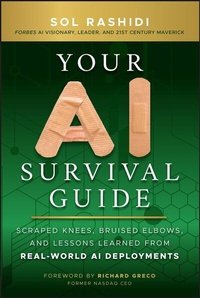
Your AI Survival Guide
Description

Practical and proven AI deployment strategies for non-technical business leaders
In Your AI Survival Guide: Scraped Knees, Bruised Elbows, and Lessons Learned from Real-World AI Deployments, business executive and technologist Sol Rashidi delivers an insightful and practical discussion of how to deploy artificial intelligence in your company. Having helped IBM launch Watson in 2011, Sol has first-hand knowledge of the ups, downs, and change management intricacies that can help you with a successful deployment beyond all the AI hype. She walks you through various frameworks for how to establish your AI strategy, pick your use cases, prepare your non-technology teams, and overcome the most common obstacles standing in the way of successfully implementing AI in your business, based on her many years of deploying AI projects in businesses, which few can claim.Sol demystifies the topic of artificial intelligence in a way that business leaders and business owners-and those who want to be more business minded-can easily understand. The book also offers:
- Real-world use cases from ten different industries, including retail, healthcare, energy, insurance, agriculture, and more; ten different functions, including supply chain, manufacturing, procurement, legal, and more; and personal stories, anecdotes, and insights gained from implementations
- Techniques for facilitating executive-level buy-in for your most ambitious and promising AI strategies
- Jargon-free and accessible language that simplifies a seemingly complicated topic
- And practical advice that's not based on AI hype
More details
Other editions
Additional editions
Person
With awards like "Top 100 AI Thought Leaders", "50 Most Powerful Women in Tech", "Top 75 Innovators", "Global 100 Power List", and many more, SOL RASHIDI is a technologist and business executive in the artificial intelligence and data space, who's helped launch some of the earliest business applications, including IBM Watson. She's a keynote speaker, presenter, and strategist who has held several C-suite positions at Fortune 500 companies.
Content
Foreword xi
Chapter 1 Overcoming the Inertia 1
Inertia 3
Who Is This Book For? 5
Organizational Benefits 6
Business Benefits 7
Business Growth 8
Chapter 2 The Rogue Executive 11
Why the "Rogue Executive"? 12
My Formative Years 14
Sports 16
Leveling Up 16
Coach Doug 17
My Transition to Artificial Intelligence 18
Joining the C-Suite Ranks 21
Where Rubber Meets the Road 23
Chapter 3 Bend the Rules, Don't Break the Spirit 25
The Framework 26
Ask "Why?" 27
Develop Your AI Strategy 28
Think Big, Start Small, Scale Quickly 30
Choose Your Technology Partner 31
Pace Yourself 32
The Five Pillars 35
Chapter 4 How to Start 37
The Experience You Need 38
Framework for AI Initiatives 41
Phase 1: Conducting a Readiness Assessment 43
Readiness Questionnaire 45
Questionnaire Results 51
Phase 2: Your AI Strategy 55
Demonstration of How It Works 60
Phase 3: Creating and Selecting Use Cases 61
Use-Case Ideation 61
Use-Case Selection 63
How to Score Criticality and Complexity 64
Real-World and Practical Walk-Through 69
Phase 4: Preparing and Designing 72
The Vision 74
The Impacts 76
The Approach 78
The Process 84
The Support 89
Phase 5: Selecting a Solution 91
Tool Selection 92
Interoperability with Your Experts 97
Phase 6: Deploying and Going Live 99
Key Outcomes 101
Chapter 5 Your Project Killers: The Wrong People 105
Change Ain't Easy 105
Team Virtues 107
The 10 AI Archetypes 110
The Naysayer 111
The Evangelist 111
The Doer 112
The Discerner 112
The Blind 113
The Curmudgeon 113
The Saint 114
The Optimist 114
The Data Scientist 114
The Know-It-All 115
Change Management 115
The Dumpster Fire 118
Chapter 6 Human in the Loop 123
What is "Human in the Loop" 124
Responsible AI 124
The Four (4) Layers of Responsibility 125
The Six (6) Tenets of Responsible AI 128
Transparency 128
Accountability 129
Fairness 130
Privacy 130
Inclusiveness 131
Diversity and Nondiscrimination 132
Human in the Loop 132
My Nightmare 133
Chapter 7 How AI Will Impact Every Industry and Function 137
The Tipping Point for AI 138
How AI Is Impacting Various Businesses 139
Blue Chips 140
Well-Off Private Companies 140
Small Business Operations 141
Start-Ups and Scale-Ups 141
Small Businesses 142
How AI Is Impacting Industries 143
Agriculture 143
Travel and Leisure 145
Manufacturing 145
Retail 146
Media and Entertainment 148
Healthcare 149
Consumer Electronics 150
Fashion and Apparel 151
Education 152
Food and Beverage 153
Environment Health and Safety 154
Conclusion 155
How Artificial Intelligence Is Changing Functions 155
Legal 156
Procurement 156
Project Management Office 157
Human Resources 158
Customer Service 159
Sales 161
Training and Development 162
Finance 163
Research and Development 164
Marketing 166
Conclusion 167
Chapter 8 AI Jargon and Development 169
What Is AI? 169
What Is Not AI? 171
The Difference Between Artificial Intelligence and Human Intelligence 172
Jargon, Terms, and Definitions 173
Computer Science 173
Data 176
Analytics and Data Science 176
AI Terms 178
How We Got Here 182
Early 20th Century: Conceptual Foundations 183
Mid to Late 20th Century: Expansion, Growth, and Challenges 184
Late 20th Century: Rapid Growth 185
2010s-Present: Modern AI 187
Conclusion 189
Chapter 9 What the Future Holds 191
What Keeps Me Up at Night 194
What's Next 197
Appendix: Sources 201
Index 205
CHAPTER 1
Overcoming the Inertia
"In a world that thrives on conformity, standing apart tests your resilience."
-Sol
I'm no Elon Musk or Peter Thiel. I'm not a Sam Altman (CEO of OpenAI) or even close to the geniuses who created neural networks or Watson and DeepMind. I'm not here to preach or prosecute on all the glories of artificial intelligence (AI), nor am I here to give you a technical dissertation on its intricacies. I'm not an academic or researcher, nor do I get paid to write code or promote vendors or tools.
I'm simply a practitioner who worked her way up through the corporate ladder-one who worked relentlessly with blind determination not knowing exactly where her career would go, one who eventually made it to the C-suite as the Chief Data Officer, Chief Analytics Officer, Chief Data and Analytics Officer, and Chief Data and AI Officer for many Fortune 500s, one who accidentally fell into the world of data in the early 2000s and into artificial intelligence in 2011 when I helped IBM launch Watson.
I never thought that doing AI deployments, I would face so many unexpected challenges, but the reality is that you can take a licking along the way because transformations involve change, and well.people are generally averse to change. This is why I have the scraped knees, bruised elbows, and wounded pride from my experience in real-world deployments. Over the years I've tried multiple approaches, implemented numerous strategies, and have had countless alignment discussions selling, convincing, aligning, conceiving, designing, deploying, training, monitoring, and measuring the successes and failures-trying to figure out the art of AI deployments and how to balance the messiness with the possibilities. The approach I share with you in this book is practical and realistic, and it's based on real failures and successes where I've captured the lessons learned over the years.
I believe in the "crawl, walk, run" approach because I've seen what happens when you try to run without crawling first. What I will share with you is very pragmatic and grounded. There will be no selling or advising on anything that pushes you too far, and nothing in this book is based on theory, heresy, or academia. I will be realistic with you about what artificial intelligence can and can't do (right now), and I will help you sift through the hype.
This book is intended to help you start your AI journey and succeed, while familiarizing you with and minimizing the friction points that I have experienced. Many books you read will mention that you need a strategy, you need to pick a use case, you need data, and you need governance. I will outline for you, step-by-step, how to select a strategy, how to ideate, and how to select a use case, and I will provide you with an "essentials lists" rooted in real, roll-up-your-sleeves work.
I know how to do AI deployments because I've had the tenacity to take on early, unproven, and questionable projects that disrupt the status quo. I think and do things differently, and I'm perfectly fine with pushing boundaries and pushing people who lack imagination. Building the reputation of a "rogue executive," I developed intuition, an innate ability to see the "art of the possible" and the "art of the practical." This, combined with my relentless pursuit for progress and need to make an impact, has brought me to this point. It wasn't easy; it came with many sleepless nights where I doubted myself.
Furthermore, where I am today in my career has nothing to do with how I started my career. I was in sales at first and then became a project lead. At one point I was even a financial advisor for Morgan Stanley (Series 7 certified and all). Somehow in the early 2000s tech found me, and I pivoted. The real change occurred, however, when I helped IBM launch Watson in 2011. I fell in love with AI and have been doing deployments for some very prominent companies, since.
I'll be the first to tell you I'm technical but not a "techie." I'm business minded but not the president of a Fortune 5 company. What I am, however, is an executive who doesn't mind rolling up her sleeves and getting into the details while also playing a strategic thought leader. I can pivot quickly between the two worlds. I pride myself on having an entrepreneurial spirit and pushing boundaries where few have the energy. Over the years and through the trenches, I've built a backbone versus relying on a wishbone. I'm not afraid of the work or the challenges, and I stay grounded in my successes because I believe you're only as good as your last innovation.
With that, I will pass onto you the knowledge I've gained over the years. This book will give you real frameworks, techniques, how-tos, and approaches to make your AI journey a success beyond the hype of what you have read elsewhere. It's grounded in experience and from someone who has not been afraid of the work.
While some executives focus on self-promotion and preservation, I've focused on trying what most don't dare to do. I hope you like reading what I'm about to share!
Inertia
Like riding a bike, some things must be done before you can learn how to do them. You can read all the books and manuals you want, but nothing prepares you better than jumping in, trying, falling, and trying again! This is how AI is done. This is how life is done! AI is not a silver bullet! It's not a light switch that turns on! It is not a magical solution nor a quick fix. In fact, it can uncover some unpleasant realities about your business, its operations, your employees, and larger issues at hand.
I've been a business leader in the AI game since the days when flip phones were cool. From triumphs to face plants, I've seen it all. Learning AI for business? It's just like learning to ride a bike. It seems wobbly and impossible at first, but once you start pedaling, the most difficult part is done.
As mentioned earlier, I transitioned from a no-name project lead to an established C-suite executive (four times over) and fell into this space accidentally. I didn't study computer science or mathematics, and I sure can't write sophisticated code. However, I learned the ways, and you can too.
This entire book is crafted for you if you're:
- A business leader wanting to explore the benefits of AI without all the messiness and failures I've had to go through
- A business owner who thinks it will benefit the organization but don't know where to start
- A practitioner who wants to make a case for AI but doesn't have the experience of developing a strategy.
- A person who just wants to get into AI but doesn't know where to start
- Someone curious who just wants to be informed and educated about how it's done
Regardless of your role and reasons, just know that 70% of the success of your AI deployment has nothing to do with the technology. As a matter of fact, the tech is the easiest part of the lifecycle. Most of the work is dealing with human capital and relationships, aligning with goals, overcoming fears, picking the right strategy, picking the right use case, and finding the ambition, the energy, and the rogue in you.
It's also important to note that this book is not a guide or a manual for:
- large technology-based companies that are already deeply involved in AI innovation,
- nor is it for the researchers who are shaping the future of cognitive computing and machine learning.
Instead, it is a call to action for business leaders, business owners, practitioners, and the curious, who serve companies where technology has played a supportive role rather than a leading one. This book will be your compass and serve as your call to action.
There will be less emphasis on technical know-how and more emphasis on business acumen. Together we will explore the different types of AI deployments and how they will amplify and accelerate your everyday work, regardless of your maturity.
As you progress through the book, consider each chapter as a building block. The book is structured in a way to discuss different facets of deploying AI in the following manner:
- Chapter 2 is about leadership and finding the rogue executive within you. You must dare to be different to do this! There's a memoir of how I got started; I share with you my story so you know my humble beginnings and gain confidence in knowing that if I did it, you can too.
- In Chapter 3, we'll progress into some key principles I learned along the way about bending the rules but not breaking the spirit. It's focused on how to introduce AI into your company by following these steps: 1) asking yourself why you want to do this; 2) learning to pace yourself through better forecasting; 3) thinking through a strategy; and 4) thinking big, starting small, and scaling quickly.
- Chapter 4 is where we get into the weeds of things. It's long, it's detailed, and it will walk you through every step of an AI deployment. I felt getting into the details early in the book would be of value to you.
- Chapter 5 is about knowing your biggest project killer: your team. We will discuss how to build one from scratch and how to work with people you've inherited. We'll talk about the virtues you want in people on your team, as well as the 10 AI archetypes of people you...
