

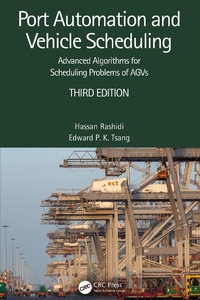
Port Automation and Vehicle Scheduling
Advanced Algorithms for Scheduling Problems of AGVs
3rd Edition
Published on 10. August 2022
304 pages
978-1-000-62930-9 (ISBN)
Description

Container terminals are constantly being challenged to adjust their throughput capacity to match fluctuating demand. Examining the optimization problems encountered in today's container terminals, Port Automation and Vehicle Scheduling: Advanced Algorithms for Scheduling Problems of AGVs, Third Edition provides advanced algorithms for handling the scheduling of Automated Guided Vehicles (AGVs) in ports.
Building on the earlier editions, previously titled Vehicle Scheduling in Port Automation: Advanced Algorithms for Minimum Cost Flow Problems, this book has undergone extensive revisions and includes two new chapters. New material addresses the solutions to the modeling of decisions in Chapter 3, while in Chapter 11 the authors address an emerging challenge in automated container terminals with integrated management.
Key Features:
Classifies the optimization problems of the ports into five scheduling decisions. For each decision, it supplies an overview, formulates each of the decisions as constraint satisfaction and optimization problems, and then covers possible solutions, implementation, and performance.
Explores in Part One of the book the various optimization problems in modern container terminals, while details in Part Two advanced algorithms for the minimum cost flow (MCF) problem and for the scheduling problem of AGVs in ports.
Offers complete package that can help readers address the scheduling problems of AGVs in ports.
This is a valuable reference for port authorities and researchers, including specialists and graduate students in operation research. For specialists, it provides novel and efficient algorithms for network flow problems. For students, it supplies the most comprehensive survey of the field along with a rigorous formulation of the problems in port automation.
Building on the earlier editions, previously titled Vehicle Scheduling in Port Automation: Advanced Algorithms for Minimum Cost Flow Problems, this book has undergone extensive revisions and includes two new chapters. New material addresses the solutions to the modeling of decisions in Chapter 3, while in Chapter 11 the authors address an emerging challenge in automated container terminals with integrated management.
Key Features:
Classifies the optimization problems of the ports into five scheduling decisions. For each decision, it supplies an overview, formulates each of the decisions as constraint satisfaction and optimization problems, and then covers possible solutions, implementation, and performance.
Explores in Part One of the book the various optimization problems in modern container terminals, while details in Part Two advanced algorithms for the minimum cost flow (MCF) problem and for the scheduling problem of AGVs in ports.
Offers complete package that can help readers address the scheduling problems of AGVs in ports.
This is a valuable reference for port authorities and researchers, including specialists and graduate students in operation research. For specialists, it provides novel and efficient algorithms for network flow problems. For students, it supplies the most comprehensive survey of the field along with a rigorous formulation of the problems in port automation.
More details
Edition
3rd edition
Language
English
Place of publication
London
United Kingdom
Publishing group
Taylor & Francis Ltd
Target group
Professional and scholarly
Illustrations
41 Tables, black and white; 75 Line drawings, black and white; 4 Halftones, black and white; 79 Illustrations, black and white
ISBN-13
978-1-000-62930-9 (9781000629309)
Copyright in bibliographic data and cover images is held by Nielsen Book Services Limited or by the publishers or by their respective licensors: all rights reserved.
Schweitzer Classification
Other editions
Additional editions
Hassan Rashidi | Edward P. K. Tsang
Port Automation and Vehicle Scheduling
Advanced Algorithms for Scheduling Problems of AGVs
Book
10/2024
3rd Edition
CRC Press
€69.80
Shipment within 10-20 days
Hassan Rashidi | Edward P. K. Tsang
Port Automation and Vehicle Scheduling
Advanced Algorithms for Scheduling Problems of AGVs
Book
08/2022
3rd Edition
CRC Press
€166.30
Shipment within 10-20 days
Persons
Hassan Rashidi earned a BSc in computer engineering in 1986 and an MSc in systems engineering and planning in 1989 with the highest honors at the Isfahan University of Technology, Isfahan, Iran. He joined the Department of Computer Science, University of Essex, United Kingdom, as a PhD student in 2002 and earned his PhD in 2006. He was a researcher in British Telecom research center in United Kingdom in 2005. He is currently a professor of computer science at Allameh Tabataba'i University, Tehran, Iran, and a visiting academic at the University of Essex. He is an international expert in the applications of the network simplex algorithm to automated vehicle scheduling and has published many conference and journal papers.
Edward Tsang has a first degree in business administration (major in finance) and an MSc and a PhD in computer science. He has broad interests in applied artificial intelligence, particularly constraint satisfaction, computational finance, heuristic search, and scheduling. He is currently a professor at the School of Computer Science and Electronic Engineering at the University of Essex, where he leads the computational finance group and the constraint satisfaction and optimization group. He is also the director of the Centre for Computational Finance and Economic Agents, an interdisciplinary center. He founded the Technical Committee for Computational Finance and Economics under the IEEE Computational Intelligence Society.
Edward Tsang has a first degree in business administration (major in finance) and an MSc and a PhD in computer science. He has broad interests in applied artificial intelligence, particularly constraint satisfaction, computational finance, heuristic search, and scheduling. He is currently a professor at the School of Computer Science and Electronic Engineering at the University of Essex, where he leads the computational finance group and the constraint satisfaction and optimization group. He is also the director of the Centre for Computational Finance and Economic Agents, an interdisciplinary center. He founded the Technical Committee for Computational Finance and Economics under the IEEE Computational Intelligence Society.
Content
1. Introduction
PART 1 OPTIMIZATION PROBLEMS FACING MODERN CONTAINER TERMINALS
2. Problems in Container Terminals
3. Formulations of the Problems
4. Solutions to the Decisions: Review and Suggestions
PART 2 ADVANCED ALGORITHMS FOR THE SCHEDULING PROBLEM OF AUTOMATED GUIDED VEHICLES
5. Vehicle Scheduling: A Minimum Cost Flow Problem
6. Network Simplex: The Fastest Algorithm
7. Network Simplex Plus: Complete Advanced Algorithm
8. Dynamic Network Simplex: Dynamic Complete Advanced Algorithm
9. Greedy Vehicle Search: An Incomplete Advanced Algorithm
10. Multi-Load and Heterogeneous Vehicles Scheduling: Hybrid Solutions
11. Integrated Management of Equipment in Automated Container Terminals
12. Conclusions and Future Research
Appendix: Information on Web
PART 1 OPTIMIZATION PROBLEMS FACING MODERN CONTAINER TERMINALS
2. Problems in Container Terminals
3. Formulations of the Problems
4. Solutions to the Decisions: Review and Suggestions
PART 2 ADVANCED ALGORITHMS FOR THE SCHEDULING PROBLEM OF AUTOMATED GUIDED VEHICLES
5. Vehicle Scheduling: A Minimum Cost Flow Problem
6. Network Simplex: The Fastest Algorithm
7. Network Simplex Plus: Complete Advanced Algorithm
8. Dynamic Network Simplex: Dynamic Complete Advanced Algorithm
9. Greedy Vehicle Search: An Incomplete Advanced Algorithm
10. Multi-Load and Heterogeneous Vehicles Scheduling: Hybrid Solutions
11. Integrated Management of Equipment in Automated Container Terminals
12. Conclusions and Future Research
Appendix: Information on Web
