

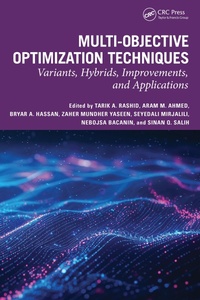
Multi-objective Optimization Techniques
Variants, Hybrids, Improvements, and Applications
1st Edition
Published on 31. March 2025
358 pages
978-1-040-32234-5 (ISBN)
Description

The book establishes how to design, develop, and test different hybrids of multi-objective optimization algorithms. It presents several application areas of multi-objective optimization algorithms.
Presents a thorough analysis of equations, mathematical models, and mechanisms of multi-objective optimization algorithms.
Explores different alternatives of multi-objective optimization algorithms to solve binary, multi-objective, noisy, dynamic, and combinatorial optimization problems.
Illustrates how to design, develop, and test different hybrids of multi-objective optimization algorithms.
Discusses multi-objective optimization techniques for cloud, fog, and edge computing.
Highlights applications of multi-objective optimization in diverse sectors such as engineering, e-healthcare, and scheduling.
The text is primarily written for senior undergraduates, graduate students, and academic researchers in the fields of electrical engineering, electronics, communications engineering, computer science and engineering, and mathematics.
Presents a thorough analysis of equations, mathematical models, and mechanisms of multi-objective optimization algorithms.
Explores different alternatives of multi-objective optimization algorithms to solve binary, multi-objective, noisy, dynamic, and combinatorial optimization problems.
Illustrates how to design, develop, and test different hybrids of multi-objective optimization algorithms.
Discusses multi-objective optimization techniques for cloud, fog, and edge computing.
Highlights applications of multi-objective optimization in diverse sectors such as engineering, e-healthcare, and scheduling.
The text is primarily written for senior undergraduates, graduate students, and academic researchers in the fields of electrical engineering, electronics, communications engineering, computer science and engineering, and mathematics.
More details
Edition
1. Auflage
Language
English
Place of publication
London
United Kingdom
Publishing group
Taylor & Francis Ltd
Target group
College/higher education
Professional and scholarly
Illustrations
106 Tables, black and white; 121 Line drawings, black and white; 5 Halftones, black and white; 126 Illustrations, black and white
File size
11,17 MB
ISBN-13
978-1-040-32234-5 (9781040322345)
Copyright in bibliographic data and cover images is held by Nielsen Book Services Limited or by the publishers or by their respective licensors: all rights reserved.
Schweitzer Classification
Other editions
Additional editions
Tarik A. Rashid | Aram Mahmoon Ahmed | Bryar A. Hassan
Multi-objective Optimization Techniques
Variants, Hybrids, Improvements, and Applications
Book
approx. 07/2026
1st Edition
CRC Press
€66.00
Not yet published
Tarik A. Rashid | Aram Mahmoon Ahmed | Bryar A. Hassan
Multi-objective Optimization Techniques
Variants, Hybrids, Improvements, and Applications
Book
03/2025
1st Edition
CRC Press
€241.70
Shipment within 10-20 days
Persons
Tarik Ahmed Rash is a professor, in the Department of computer science and Engineering, at the University of Kurdistan Hewler (UKH), Iraq. His areas of research cover the fields of artificial intelligence, nature-inspired algorithms, swarm intelligence, computational intelligence, machine learning, and data mining. He is a member of IEEE, Machine Intelligence Research Labs. He has authored and edited overall 117 Web of Science and Scopus publication documents, including 3 books and 27 book chapters in CRC, Springer, Elsevier, and IET.
Aram M. Ahmed is presently working as a lecturer and researcher, in the Department of information technology, University of Human Development, Sulaimani, Iraq. He is interested in modeling biological and natural systems into computational techniques. He is an active researcher who has published books and papers in peer-review academic journals with high impact factors.
Bryar A. Hassan pursued bachelor's and master's degrees in software engineering from the University of Southampton, and the joint Ph.D. degree in information technology. He is a renowned assistant professor in computer science at the University of Kurdistan Hewler. He is on the list of the World's Top 2% Scientists Rankings 2023 (by Stanford University and Elsevier). He has worked as a software developer and entrepreneur for several years. He is currently a renowned assistant professor; he inspires students through innovative teaching and cutting-edge research in artificial intelligence and optimisation algorithms. His research interests include artificial intelligence, optimisation algorithms, medical computing, semantic web, and NLP.
Zaher Mundher Yaseen is an Assistant professor and pioneer research scientist in the field of civil and environmental engineering. Currently, he is working at King Fahd University of Petroleum and Minerals, Saudi Arabia. The scope of his research is quite abroad, covering water resources engineering, environmental engineering, knowledge-based system development, climate and the implementation of data analytic and artificial intelligence. He has published over 500 research articles within international journals and total number of citations over 22000 (Google Scholar H-Index = 83). He has collaborated with over 60 international countries and more than 950 researchers. He has served as a reviewer for more than 140 international journals and academic editor in several Clarivate ISI journals.
Professor Seyedali Mirjalili is a globally recognized expert in Artificial Intelligence and Optimization. He founded the Centre for Artificial Intelligence Research and Optimization in 2019 and serves as a Professor of Artificial Intelligence at Torrens University Australia. Recently, he joined VSB - Technical University of Ostrava to be a part of the REFRESH project. Prof. Mirjalili is renowned for developing nature-inspired algorithms, which have been widely adopted in various engineering applications. He has published over 600 papers, with more than 120,000 citations and an H-index of 120, and has been among the top 1% of highly cited researchers globally since 2019. Prof. Mirjalili has also shared his expertise on prestigious platforms, including delivering a talk for TED, where he highlighted the transformative potential of Artificial Intelligence. Notably, The Australian recognized him as a global leader in Artificial Intelligence since 2022 and 2023. Prof. Mirjalili is a senior member of IEEE and an associate editor for leading journals such as Applied Soft Computing, Engineering Applications of Artificial Intelligence, and Neurocomputing.
Nebojsa Bacanin currently works as a full professor and as a vice-rector for scientific research at Singidunum University, Belgrade, Serbia. He is involved in scientific research in the field of computer science and his specialty includes stochastic optimization algorithms, swarm intelligence, soft-computing, and optimization and modeling, as well as artificial intelligence algorithms, swarm intelligence, machine learning, image processing, and cloud and distributed computing. He has published more than 220 scientific papers in high-quality journals and international conferences indexed in Clarivate Analytics JCR, Scopus, WoS, IEEE Explore, and other scientific databases.
Sinan Salih is a lecturer and scientific researcher at Al-Bayan University. He had published 60 research papers during the past few years and received hundreds of citations, with 27 H-Index on google scholar. His major research interests are including machine learning, optimization problems, nature-inspired algorithms, and enhancing their advanced versions.
Aram M. Ahmed is presently working as a lecturer and researcher, in the Department of information technology, University of Human Development, Sulaimani, Iraq. He is interested in modeling biological and natural systems into computational techniques. He is an active researcher who has published books and papers in peer-review academic journals with high impact factors.
Bryar A. Hassan pursued bachelor's and master's degrees in software engineering from the University of Southampton, and the joint Ph.D. degree in information technology. He is a renowned assistant professor in computer science at the University of Kurdistan Hewler. He is on the list of the World's Top 2% Scientists Rankings 2023 (by Stanford University and Elsevier). He has worked as a software developer and entrepreneur for several years. He is currently a renowned assistant professor; he inspires students through innovative teaching and cutting-edge research in artificial intelligence and optimisation algorithms. His research interests include artificial intelligence, optimisation algorithms, medical computing, semantic web, and NLP.
Zaher Mundher Yaseen is an Assistant professor and pioneer research scientist in the field of civil and environmental engineering. Currently, he is working at King Fahd University of Petroleum and Minerals, Saudi Arabia. The scope of his research is quite abroad, covering water resources engineering, environmental engineering, knowledge-based system development, climate and the implementation of data analytic and artificial intelligence. He has published over 500 research articles within international journals and total number of citations over 22000 (Google Scholar H-Index = 83). He has collaborated with over 60 international countries and more than 950 researchers. He has served as a reviewer for more than 140 international journals and academic editor in several Clarivate ISI journals.
Professor Seyedali Mirjalili is a globally recognized expert in Artificial Intelligence and Optimization. He founded the Centre for Artificial Intelligence Research and Optimization in 2019 and serves as a Professor of Artificial Intelligence at Torrens University Australia. Recently, he joined VSB - Technical University of Ostrava to be a part of the REFRESH project. Prof. Mirjalili is renowned for developing nature-inspired algorithms, which have been widely adopted in various engineering applications. He has published over 600 papers, with more than 120,000 citations and an H-index of 120, and has been among the top 1% of highly cited researchers globally since 2019. Prof. Mirjalili has also shared his expertise on prestigious platforms, including delivering a talk for TED, where he highlighted the transformative potential of Artificial Intelligence. Notably, The Australian recognized him as a global leader in Artificial Intelligence since 2022 and 2023. Prof. Mirjalili is a senior member of IEEE and an associate editor for leading journals such as Applied Soft Computing, Engineering Applications of Artificial Intelligence, and Neurocomputing.
Nebojsa Bacanin currently works as a full professor and as a vice-rector for scientific research at Singidunum University, Belgrade, Serbia. He is involved in scientific research in the field of computer science and his specialty includes stochastic optimization algorithms, swarm intelligence, soft-computing, and optimization and modeling, as well as artificial intelligence algorithms, swarm intelligence, machine learning, image processing, and cloud and distributed computing. He has published more than 220 scientific papers in high-quality journals and international conferences indexed in Clarivate Analytics JCR, Scopus, WoS, IEEE Explore, and other scientific databases.
Sinan Salih is a lecturer and scientific researcher at Al-Bayan University. He had published 60 research papers during the past few years and received hundreds of citations, with 27 H-Index on google scholar. His major research interests are including machine learning, optimization problems, nature-inspired algorithms, and enhancing their advanced versions.
Content
1. Introduction to Metaheuristic Algorithms. 2. A Review of Recent Multi-objective Optimization Algorithms. 3. A New Binary Multi-objective Grasshopper Optimization Algorithm. 4. Multi-objective Fox Optimization Algorithms. 5. A New Multi-objective Cat Swarm Optimization Algorithm. 6. Multi-objective Ant Nesting Optimization Algorithms. 7. Advanced Hybrid Multi-objective Optimization Algorithms. 8. Multi-objective Optimization for Engineering Applications. 9. Multi-objective Optimization for Feature Selection in E-Health Applications. 10. Multi-objective Optimization for Scheduling Applications. 11. Multi-objective Optimization for Cloud, Fog, and Edge Computing. 12. Conclusion.
