

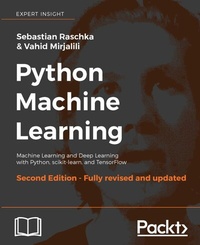
Python Machine Learning, Second Edition
Machine Learning and Deep Learning with Python, scikit-learn, and TensorFlow
2nd Edition
Published on 3. June 2024
622 pages
978-1-78712-602-2 (ISBN)
Description

No detailed description available for "Python Machine Learning, Second Edition".
All prices
More details
Other editions
Additional editions
Sebastian Raschka | Vahid Mirjalili
Python Machine Learning - Second Edition
Machine Learning and Deep Learning with Python, scikit-learn, and TensorFlow
Book
09/2017
Packt Publishing
€53.60
Shipment within 3-4 weeks
Persons
Raschka Sebastian :
Sebastian Raschka is an Assistant Professor of Statistics at the University of Wisconsin-Madison focusing on machine learning and deep learning research. As Lead AI Educator at Grid AI, Sebastian plans to continue following his passion for helping people get into machine learning and artificial intelligence.Mirjalili Vahid :
Vahid Mirjalili is a deep learning researcher focusing on CV applications. Vahid received a Ph.D. degree in both Mechanical Engineering and Computer Science from Michigan State University.
Sebastian Raschka is an Assistant Professor of Statistics at the University of Wisconsin-Madison focusing on machine learning and deep learning research. As Lead AI Educator at Grid AI, Sebastian plans to continue following his passion for helping people get into machine learning and artificial intelligence.Mirjalili Vahid :
Vahid Mirjalili is a deep learning researcher focusing on CV applications. Vahid received a Ph.D. degree in both Mechanical Engineering and Computer Science from Michigan State University.
Content
Table of Contents - Giving Computers the Ability to Learn from Data
- Training Machine Learning Algorithms the Ability to Learn from Data
- A Tour of Machine Learning Classifiers Using Scikit-Learn
- Building Good Training Sets - Data Preprocessing
- Compressing Data via Dimensionality Reduction
- Learning Best Practices for Model Evaluation and Hyperparameter Tuning
- Combining Different Models for Ensemble Learning
- Applying Machine Learning to Sentiment Analysis
- Embedding a Machine Learning Model into a Web Application
- Predicting Continuous Target Variables
- Working with Unlabeled Data - Clustering Analysis
- Implementing a Multilayer Artificial Neural Network from Scratch
- Parallelizing Neural Network Training with TensorFlow
- Going Deeper: The Mechanics of TensorFlow
- Classifying Images with Deep Convolutional Neural Networks
- Modeling Sequential Data using Recurrent Neural Networks
- Training Machine Learning Algorithms the Ability to Learn from Data
- A Tour of Machine Learning Classifiers Using Scikit-Learn
- Building Good Training Sets - Data Preprocessing
- Compressing Data via Dimensionality Reduction
- Learning Best Practices for Model Evaluation and Hyperparameter Tuning
- Combining Different Models for Ensemble Learning
- Applying Machine Learning to Sentiment Analysis
- Embedding a Machine Learning Model into a Web Application
- Predicting Continuous Target Variables
- Working with Unlabeled Data - Clustering Analysis
- Implementing a Multilayer Artificial Neural Network from Scratch
- Parallelizing Neural Network Training with TensorFlow
- Going Deeper: The Mechanics of TensorFlow
- Classifying Images with Deep Convolutional Neural Networks
- Modeling Sequential Data using Recurrent Neural Networks

