

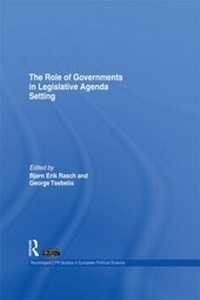
The Role of Governments in Legislative Agenda Setting
1st Edition
Published on 4. July 2013
304 pages
978-1-136-87046-0 (ISBN)
Description

Setting the agenda for parliament is the most significant institutional weapon for governments to shape policy outcomes, because governments with significant agenda setting powers, like France or the UK, are able to produce the outcomes they prefer, while governments that lack agenda setting powers, such as the Netherlands and Italy in the beginning of the period examined, see their projects significantly altered by their Parliaments.
With a strong comparative framework, this coherent volume examines fourteen countries and provides a detailed investigation into the mechanisms by which governments in different countries determine the agendas of their corresponding parliaments. It explores the three different ways that governments can shape legislative outcomes: institutional, partisan and positional, to make an important contribution to legislative politics.
It will be of interest to students and scholars of comparative politics, legislative studies/parliamentary research, governments/coalition politics, political economy, and policy studies.
With a strong comparative framework, this coherent volume examines fourteen countries and provides a detailed investigation into the mechanisms by which governments in different countries determine the agendas of their corresponding parliaments. It explores the three different ways that governments can shape legislative outcomes: institutional, partisan and positional, to make an important contribution to legislative politics.
It will be of interest to students and scholars of comparative politics, legislative studies/parliamentary research, governments/coalition politics, political economy, and policy studies.
More details
Series
Language
English
Place of publication
London
United Kingdom
Publishing group
Taylor & Francis Ltd
Target group
College/higher education
Illustrations
21 s/w Abbildungen, 44 s/w Tabellen, 21 s/w Zeichnungen
44 Tables, black and white; 21 Line drawings, black and white; 21 Illustrations, black and white
File size
11,34 MB
ISBN-13
978-1-136-87046-0 (9781136870460)
Copyright in bibliographic data and cover images is held by Nielsen Book Services Limited or by the publishers or by their respective licensors: all rights reserved.
Schweitzer Classification
Other editions
Additional editions
Bjorn Erik Rasch | George Tsebelis
The Role of Governments in Legislative Agenda Setting
Book
11/2015
1st Edition
Routledge
€71.80
Shipment within 10-20 days
Bjorn Erik Rasch | George Tsebelis
The Role of Governments in Legislative Agenda Setting
Book
11/2010
1st Edition
Routledge
€232.10
Shipment within 15-20 days
Persons
George Tsebelis is Anatol Rapoport Collegiate Professor, Department of Political Science, University of Michigan. He is the author of numerous articles on political institutions. His articles have appeared in professional Journals as American Political Science Review, British Journal of Political Science, Rationality and Society and Journal of Theoretical Politics. He is the author of "Nested Games: Rational Choice in Comparative Politics" (University of California Press, 1990), Bicameralism (with Jeanette Money; Cambridge University Press, 1997), and Veto Players (Princeton University Press, 2002).
Bjorn Erik Rasch, Professor, Department of Political Science, University of Oslo. He has written numerous articles on parliaments, and has published nine books (in Norwegian). The most recent one studies parliamentary government and constitutional reforms (Kampen om regjeringsmakten, Fagbokforlaget 2004). His English language articles have appeared journals as Legislative Studies Quarterly, Public Choice, European Journal of Political Economy and Scandinavian Political Studies. Rasch was member of a Constitutional Commission appointed by the Norwegian parliament in late 2003 to review and modernize the Court of Impeachment. He also was member of a committee who designed a new electoral system for the Sami Parliament in Northern Norway. From 2005 Rasch has headed and coordinated the study programs in political science at the University of Oslo.
Bjorn Erik Rasch, Professor, Department of Political Science, University of Oslo. He has written numerous articles on parliaments, and has published nine books (in Norwegian). The most recent one studies parliamentary government and constitutional reforms (Kampen om regjeringsmakten, Fagbokforlaget 2004). His English language articles have appeared journals as Legislative Studies Quarterly, Public Choice, European Journal of Political Economy and Scandinavian Political Studies. Rasch was member of a Constitutional Commission appointed by the Norwegian parliament in late 2003 to review and modernize the Court of Impeachment. He also was member of a committee who designed a new electoral system for the Sami Parliament in Northern Norway. From 2005 Rasch has headed and coordinated the study programs in political science at the University of Oslo.
Content
1. Governments and Legislative Agenda Setting: An Introduction George Tsebelis and Bjorn Erik Rasch 2. Germany: Limited Government Agenda Control and Strong Minority Rights Christoph Hoennige and Ulrich Sieberer 3. France: Systematic Institutional Advantage of Government Sylvain Brouard 4. Italy: Government Alternation and Legislative Agenda Setting Francesco Zucchini 5. United Kingdom: Extreme Dominance by the Executive... Most of the Time Mads Qvortrup 6. Hungary: Changing Government Advantages-Challenging a Dominant Executive Gabriella Ilonszki and Krisztina Jager 7. Netherlands: Legislative Agenda Setting and the Politics of Strategic Lock-Ins Arco Timmermans 8. Switzerland: Agenda-Setting Power of Government in a Separation-of-Powers Framework Daniel Schwarz, Andre Baechtiger and Georg Lutz 9. Greece: Government as the Dominant Player Aris Alexopoulos 10 Spain: Majoritarian Choices, Disciplined Party Government and Compliant Legislature Natalia Ajenjo and Ignatio Molina 11. Portugal: Active and Influential Parliament Eugenia da Conceicao-Heldt 12. Russia: The Executive in a Leading Role Iulia Shevchenko and Grigorii Golosov 13. Agenda Control and Veto Rights to Opposition Parties Robert Klemmensen 14. Norway: Institutionally Weak Governments and Parliamentary Voting on Bills Bjorn Erik Rasch 15. Japan: Decades of Partisan Advantages Impending Cabinet's Agenda Setting Power Silke Riemann 16.Conclusion Bjorn Erik Rasch and George Tsebelis
