

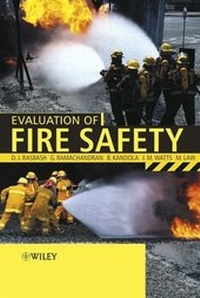
Evaluation of Fire Safety
Published on 9. March 2004
496 pages
978-0-470-02007-4 (ISBN)
Description

Fire safety is a major concern in many industries, particularly asthere have been significant increases in recent years in thequantities of hazardous materials in process, storage or transport.Plants are becoming larger and are often situated in or close todensely populated areas, and the hazards are continuallyhighlighted with incidents such as the fires and explosions at thePiper Alpha oil and gas platform, and the Enschede fireworkfactory. As a result, greater attention than ever before is nowbeing given to the evaluation and control of these hazards.
In a comprehensive treatment of the subject unavailableelsewhere, this book describes in detail the applications of hazardand risk analysis to fire safety, going on to develop and applyquantification methods. It also gives an explanation inquantitative terms of improvements in fire safety in associationwith the costs that are expended in their achievement. Furthermore,a quantitative approach is applied to major fire and explosiondisasters to demonstrate crucial faults and events.
Featuring:
* Full international coverage and a review of several major firesand explosion disasters.
* Presentation of the properties and science of fire includingthe latest research.
* Detailed coverage of the performance of fire safetymeasures.
This is an essential book for practitioners in fire safetyengineering, loss prevention professionals, technical personnel ininsurance companies as well as academics involved in fire scienceand postgraduate students. This book is also a useful reference forfire safety officers, building designers, engineers in the processindustries, safety practitioners and risk assessmentconsultants.
More details
Other editions
Additional editions
D. Rasbash | G. Ramachandran | B. Kandola
Evaluation of Fire Safety
Software
05/2006
Wiley
€123.91
No shipping information available
D. Rasbash | G. Ramachandran | B. Kandola
Evaluation of Fire Safety
Book
02/2004
Wiley
€188.50
Shipment within 10-20 days
Persons
David Rasbash was a pioneer in the field of Fire Safety Engineering. Rasbash was a chemical engineer who graduated from Imperial College, London, during World War II. He began publishing and teaching about the evaluation of fire safety in the 1970s.
G. Ramachandran is the author of Evaluation of Fire Safety, published by Wiley.
B. Kandola is the author of Evaluation of Fire Safety, published by Wiley.
J. Watts is the author of Evaluation of Fire Safety, published by Wiley.
M. Law is the author of Evaluation of Fire Safety, published by Wiley.
Content
Preface.
PART I: STRUCTURE OF THE FIRE PROBLEM.
1 The place of fire safety in the community.
2 The fire safety system.
3 Review of some major fire & explosion disasters.
4 Requirements from public and private authorities for fire safety.
PART II: QUANTIFYING FIRE SAFETY.
5 Physical data.
6 Sources of statistical data.
7 Occurrence and growth of fire.
8 Life loss.
9 Property damage.
10 Performance of fire safety measures.
PART III: METHODS OF MEASURING FIRE SAFETY.
11 Deterministic fire safety modeling.
12 Model Validation.
13 Point systems - a single index.
14 Logic trees.
15 Stochastic fire risk modeling.
16 Fire safety concepts tree and derivative approaches.
17 Fire safety assessment in the process industries.
Index.
PART I: STRUCTURE OF THE FIRE PROBLEM.
1 The place of fire safety in the community.
2 The fire safety system.
3 Review of some major fire & explosion disasters.
4 Requirements from public and private authorities for fire safety.
PART II: QUANTIFYING FIRE SAFETY.
5 Physical data.
6 Sources of statistical data.
7 Occurrence and growth of fire.
8 Life loss.
9 Property damage.
10 Performance of fire safety measures.
PART III: METHODS OF MEASURING FIRE SAFETY.
11 Deterministic fire safety modeling.
12 Model Validation.
13 Point systems - a single index.
14 Logic trees.
15 Stochastic fire risk modeling.
16 Fire safety concepts tree and derivative approaches.
17 Fire safety assessment in the process industries.
Index.
