

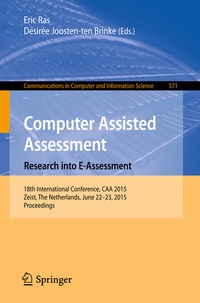
Computer Assisted Assessment. Research into E-Assessment
18th International Conference, CAA 2015, Zeist, The Netherlands, June 22-23, 2015. Proceedings
Published on 23. December 2015
X, 155 pages
978-3-319-27704-2 (ISBN)
Description

This book constitutes the refereed proceedings of the 18th International Conference on Computer Assisted Assessment, CAA 2015, held in Zeist, The Netherlands, in June 2015.
The 15 revised full papers presented were carefully reviewed and selected from numerous submissions. The papers present current developments in technology-enhanced assessment. Topics covered include: automatic item generation, computer adapted testing, the use of multimedia in assessment, e-assessment policies.
More details
Series
Edition
1st ed. 2015
Language
English
Place of publication
Cham
Switzerland
Publishing group
Springer International Publishing
Target group
Professional and scholarly
Product notice
Reflowable
Illustrations
X, 155 p. 29 illus. in color.
File size
8,18 MB
ISBN-13
978-3-319-27704-2 (9783319277042)
DOI
10.1007/978-3-319-27704-2
Schweitzer Classification
Other editions
Additional editions
Eric Ras | Desirée Joosten-ten Brinke
Computer Assisted Assessment. Research into E-Assessment
18th International Conference, CAA 2015, Zeist, The Netherlands, June 22-23, 2015. Proceedings
Book
12/2015
Springer
€53.49
Shipment within 10-15 days
Persons
Content
- Intro
- Preface
- Organization
- Contents
- The Psychometric Evaluation of a Summative Multimedia-Based Performance Assessment
- Abstract
- 1 Introduction
- 2 Design and Development
- 3 Method
- 3.1 Participants
- 3.2 Materials
- 3.3 Procedure
- 4 Results
- 4.1 MBPA Performance
- 4.2 Hypotheses Testing
- 5 Discussion and Conclusion
- References
- A Method for Generating Nonverbal Reasoning Items Using n-Layer Modeling
- Abstract
- 1 Introduction
- 2 Item Modeling and the Problem with Cloning
- 3 n-Layer Item Modeling: A Method to Address the Limitations of Cloning
- 4 Purpose of Study
- 5 Method
- 5.1 Nonverbal Reasoning Item Type
- 5.2 n-Layer Item Modeling Procedure
- 5.3 Item Generation with IGOR
- 6 Results
- 7 Conclusions
- 7.1 Directions for Future Research
- Acknowledgments
- References
- Computer Adaptive Assessment for Learning in a Virtual Learning Environment
- Abstract
- 1 Research Goal and Theoretical Framework
- 2 Research Method
- 2.1 Respondents
- 2.2 The Learning Modules and Learning Environment
- 2.3 Data Collection
- 2.4 Analysis
- 3 Intended Results and Contribution to Practice
- References
- Testing Competences Worldwide in Large Numbers
- Abstract
- 1 Introduction
- 1.1 Testing Competences
- 1.2 Worldwide Examination
- 1.3 Large-Scale Assessments
- 2 The ISO/IEC 17024:2012 Standard
- 2.1 Compliance with ISO/IEC 17024:2012
- 3 Example: EXIN Agile Scrum Master
- 3.1 Certification Scheme
- 4 Discussion
- References
- The Success Factor in Assessment: Motivation or Playing? A Case Study in Gamification
- Abstract
- 1 Introduction
- 2 Method
- 3 Findings
- 4 Conclusion and Discussion
- References
- A Practical Procedure for the Construction and Reliability Analysis of Fixed-Length Tests with Rando ...
- Abstract
- 1 Introduction
- 1.1 Background
- 2 A Proposal for a Testing Procedure in Higher Education
- 2.1 Assumptions
- 2.2 Proposed Structure of an Item Bank
- 2.3 Number of Test Items for an Item Bank
- 2.4 Level of Difficulty for Test Items
- 3 Estimating the Level of Difficulty for a Test
- 3.1 Correction for Difficulty Levels Between Students
- 4 Test Reliability
- 4.1 Lopez-Cronbach's Alpha
- 4.2 KR20
- 4.3 Test Reliability for Individual Students
- 4.4 Simulations for Estimating the Accuracy of Calculated Reliability Parameters
- 4.5 Results of the Simulation
- 4.6 Conclusion of the Simulation
- 5 Conclusion
- 5.1 Further Research
- 5.2 Practical Implications
- References
- Tomb of Osiris: Gamifying the Assessment of Collaborative Complex Problem Solving Skills on Tangible ...
- Abstract
- 1 The MicroDYN Approach with Tangible User Interfaces
- 2 Game Design
- 2.1 Overview
- 2.2 Elements of Game Flow
- 2.3 Compromises Regarding Game Design
- 3 Game Implementation
- 4 Discussions and Future Work
- References
- Comparative Judgment Within Online Assessment: Exploring Students Feedback Reactions
- 1 Introduction
- 2 Theoretical Framework
- 3 Research Methods
- 3.1 Setting up CJ
- 3.2 Setting up the Interviews
- 4 Results and Main Conclusions
- 5 Implications to Research and Practice
- References
- Automatically Generated Metrics for Multilingual Inline Choice Questions on Reading Comprehension
- Abstract
- 1 Introduction
- 2 Related Research
- 2.1 The Identification of Gaps in the Text
- 2.2 Distractor Generation
- 2.3 Features of Assessment Items that Impact Item Difficulty
- 3 Inline Choice Item Generation
- 3.1 Gap Identification in the Text
- 3.2 Distractor Creation
- 4 Attaching Metrics to the Inline Choice Items
- 4.1 Text Difficulty Metrics
- 4.2 Gap Disparity
- 5 Experimentation with the System
- 5.1 The Text Corpus for the Creation of Test Items
- 5.2 Manual and Automatic Creation of Gaps and Distractors
- 5.3 Text and Term Difficulty
- 5.4 Gap Dispersity
- 6 Conclusion
- Acknowledgements
- References
- A Perspective on Computer Assisted Assessment Techniques for Short Free-Text Answers
- 1 Introduction
- 2 Nature of Data and Tasks
- 3 Techniques
- 3.1 Natural Language Processing (NLP)
- 3.2 Information Extraction and Pattern Matching
- 3.3 Machine Learning
- 3.4 Document Similarity
- 3.5 Clustering
- 4 Evaluation
- 5 Discussion
- 6 Conclusion
- References
- Detecting Cascading Errors in Mathematic Exercises
- 1 Introduction
- 2 Unit Testing
- 3 Exercise Design
- 3.1 Covering the Solution Space
- 3.2 User Interface
- 4 Exercise Implementation
- 4.1 Comparing Mathematic Expressions
- 5 Conclusion
- References
- Understanding the Role of Time on Task in Formative Assessment: The Case of Mathematics Learning
- Abstract
- 1 Introduction
- 2 Framework
- 2.1 Computer Assisted Formative Assessment
- 2.2 Dispositional Learning Analytics
- 3 Method
- 3.1 Educational Context
- 3.2 E-tutorial MyMathLab
- 3.3 LA Dispositions Instruments
- 3.4 Procedures
- 4 Results
- 4.1 Descriptive Statistics and Correlations
- 4.2 Partial Linear Prediction Models
- 4.3 Time on Task and Academic Performance
- 4.4 Learning Dispositions and Academic Performance
- 5 Conclusions and Implications
- Acknowledgements
- References
- Towards Policy on Digital Summative and Formative Assessment
- Abstract
- 1 Introduction
- 1.1 Theoretical Framework
- 1.2 Research Questions
- 2 Method
- 3 Results
- 4 Conclusion
- 5 Discussion
- References
- Maximising Student Success with Automatic Formative Feedback for Both Teachers and Students
- Abstract
- 1 Introduction
- 2 OpenMentor
- 2.1 Transferring OpenMentor to Other UK Universities
- 2.2 Further Empirical Studies
- 3 Automated Feedback Direct to Students
- 3.1 Implications
- 4 Conclusions
- References
- Formative Quizzing and Learning Performance in Dutch First-Year Higher Education Students
- Abstract
- 1 Introduction
- 2 Methods
- 3 Results
- 4 Discussion
- References
- Author Index
