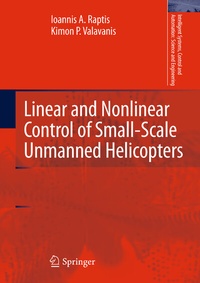
Linear and Nonlinear Control of Small-Scale Unmanned Helicopters
Description

There has been significant interest for designing flight controllers for small-scale unmanned helicopters. Such helicopters preserve all the physical attributes of their full-scale counterparts, being at the same time more agile and dexterous. This book presents a comprehensive and well justified analysis for designing flight controllers for small-scale unmanned helicopters guarantying flight stability and tracking accuracy. The design of the flight controller is a critical and integral part for developing an autonomous helicopter platform. Helicopters are underactuated, highly nonlinear systems with significant dynamic coupling that needs to be considered and accounted for during controller design and implementation. Most reliable mathematical tools for analysis of control systems relate to modern control theory. Modern control techniques are model-based since the controller architecture depends on the dynamic representation of the system to be controlled. Therefore, the flight controller design problem is tightly connected with the helicopter modeling.
This book provides a step-by-step methodology for designing, evaluating and implementing efficient flight controllers for small-scale helicopters. Design issues that are analytically covered include:
An illustrative presentation of both linear and nonlinear models of ordinary differential equations representing the helicopter dynamics. A detailed presentation of the helicopter equations of motion is given for the derivation of both model types. In addition, an insightful presentation of the main rotor's mechanism, aerodynamics and dynamics is also provided. Both model types are of low complexity, physically meaningful and capable of encapsulating the dynamic behavior of a large class of small-scale helicopters.
An illustrative and rigorous derivation of mathematical control algorithms based on both the linear and nonlinear representation of the helicopter dynamics. Flight controller designs guarantee that the tracking objectives of the helicopter's inertial position (or velocity) and heading are achieved. Each controller is carefully constructed by considering the small-scale helicopter's physical flight capabilities. Concepts of advanced stability analysis are used to improve the efficiency and reduce the complexity of the flight control system. Controller designs are derived in both continuous time and discrete time covering discretization issues, which emerge from the implementation of the control algorithm using microprocessors.
Presentation of the most powerful, practical and efficient methods for extracting the helicopter model parameters based on input/output responses, collected by the measurement instruments. This topic is of particular importance for real-life implementation of the control algorithms.
This book is suitable for students and researches interested in the development and the mathematical derivation of flight controllers for small-scale helicopters. Background knowledge in modern control is required.
More details
Other editions
Additional editions