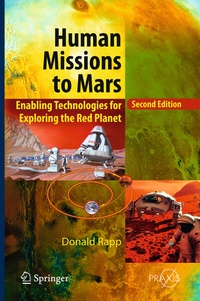
Human Missions to Mars
Description

A mission to send humans to explore the surface of Mars has been the
ultimate goal of planetary exploration since the 1950s, when von Braun
conjectured a flotilla of 10 interplanetary vessels carrying a crew of at
least 70 humans. Since then, more than 1,000 studies were carried out
on human missions to Mars, but after 60 years of study, we remain in the
early planning stages. The second edition of this book now includes anannotated history of Mars mission studies, with quantitative data wherever
possible.
Retained from the first edition, Donald Rapp looks at human missions
to Mars from an engineering perspective. He divides the mission into a
number of stages: Earth's surface to low-Earth orbit (LEO); departing from
LEO toward Mars; Mars orbit insertion and entry, descent and landing;ascent from Mars; trans-Earth injection from Mars orbit and Earth return.
For each segment, he analyzes requirements for candidate technologies.
In this connection, he discusses the status and potential of a wide range
of elements critical to a human Mars mission, including life support
consumables, radiation effects and shielding, microgravity effects, abort
options and mission safety, possible habitats on the Martian surface andaero-assisted orbit entry decent and landing. For any human mission to
the Red Planet the possible utilization of any resources indigenous to
Mars would be of great value and such possibilities, the use of indigenous
resources is discussed at length. He also discusses the relationship of lunar
exploratio
n to Mars exploration.Detailed appendices describe the availability of solar energy on the Moon
and Mars, and the potential for utilizing indigenous water on Mars.
The second edition provides extensive updating and additions to the first
edition, including many new figures and tables, and more than 70 new
references, as of 2015.Reviews / Votes
"This second edition of Donald Rapp's book is an impressive, comprehensive, and well-organized work that begins by exploring the history of the planning of human flights to Mars. ... There are three very comprehensive Appendices, which derive full statistical data for collecting solar energy on the Moon and Mars, and the quantities of water to be found on Mars at different localities (including a discussion of the topical 'slope lineae'). A Glossary completes the text." (Richard McKim, The Observatory, Vol. 136 (1253), August, 2016)
More details
Other editions
New editions
Additional editions