

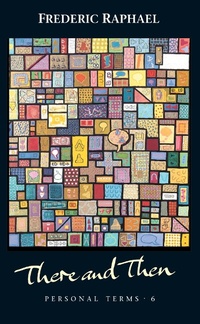
There and Then
Personal Terms VI
Published on 1. January 2013
216 pages
978-1-84777-289-3 (ISBN)
Description

We had been instructed to start promptly at six, since the hall was needed again at eight. We pushed through the curtained doorway, like instrumentalists without instruments, and onto the stepped stage. The audience was still coming in. Uncertain of our running time, and with no one to introduce us, I thought we had better start. I got as far as 'Byr- ' when Alan decided he did indeed need his glasses. He delivered his rehearsed ad lib, claiming that his vanity was second only to Byron's, and put on his specs.
It is July 1981, and Alan Bates succumbs to a fit of nerves as he and Frederic Raphael attempt to carry off an underrehearsed performance at the Queen Elizabeth Hall. This wry glimpse behind the scenes of the London literary scene sits, in Raphael's notebooks, amid clear-eyed analysis of the riots and social unrest then erupting in Britain's cities under Margaret Thatcher's government. Compulsively readable, by turns mischievous and coruscating, this latest volume of Raphael's reflections casts light on a period that saw the beginnings of a decisive shift in British and American culture. Along the way, there are finely incised pen-portraits of public figures ranging from Shirley Conran to Peter Sellers and from Robert Redford to Mary Whitehouse.
It is July 1981, and Alan Bates succumbs to a fit of nerves as he and Frederic Raphael attempt to carry off an underrehearsed performance at the Queen Elizabeth Hall. This wry glimpse behind the scenes of the London literary scene sits, in Raphael's notebooks, amid clear-eyed analysis of the riots and social unrest then erupting in Britain's cities under Margaret Thatcher's government. Compulsively readable, by turns mischievous and coruscating, this latest volume of Raphael's reflections casts light on a period that saw the beginnings of a decisive shift in British and American culture. Along the way, there are finely incised pen-portraits of public figures ranging from Shirley Conran to Peter Sellers and from Robert Redford to Mary Whitehouse.
Reviews / Votes
Glittering gobbets of a cultural wizard, the Jewish CircleFrederic Raphael proves no less the pyrotechnic penseur in his private diaries than he is in his 20-odd novels and such cineaste-favoured screenplays as Darling and Eyes Wide Shut.
Ticks and Crosses, subtitled Personal Terms 4, is a volume of jottings from journals covering the late 1970s. Unless it has been much polished years after the events, it confirms Raphael as one of that impressively rare breed to whom ideas and apercus spring off the cuff,as fully formed as Athena from the head of Zeus (and appositely replete with classical allusion). Imagine writing all day for a literary living and still having the elan to dash off some bons mots - apotropaic? Clerisy? Chthonicin? - in a late-night notebook!
The title, Ticks and Crosses, is taken from the terse symbols by which Raphael's Cambridge mentor, Guy Lee, delivered his verdict on translations of Catullus. It's a great title, for this book is best described as notes in the margin of its writer's eminently cultured, highly social, fortysomething life. He seems to have lived mostly in the Dordogne with his soulmate wife Beetle (a model for the exemplary Barbara of Raphael's best-known novel, Glittering Prizes), playing tennis for competitive pleasure and fending off, as much as meeting the minds of, those who would court him from Fox Studios.
He tries out the plots of novels, digresses into a little light history, and reflects on Jewish identity: How did the two Jews in the Politburo of the USSR feel? Was Wittgenstein a true Jew? What is the relationship between Jews and money?
A pageant of glitterati, from Hollywood to the House of Commons, stalks his pages - with walk-on parts for the Wandering Jew and Vladimir Nabokov. Shirley Williams enjoys Raphael's strawberry tarts and tells louche college tales against Brigid Brophy. AJ Ayer strike shim as "a man who drops so many names he is forever on his knees retrieving them for his index".
Break bread or a few set points with Raphael and you risk being enshrined in verbal vitriol. Gary Cooper "has all the quick-wittedness of a broom handle". A producer's wife was "so soused in perfume that she seemed still to be here two days after they had left."
Scorsese "sat and sniffed his benezedrine, a gasping, electric dwarf." Enoch Powell, with whom Raphael appears on Any Questions, exudes "small husky menace" advising doing the show with a full bladder: "you perform better".
Occasionally, the boot is on the authorial foot: Raphael found sitting for the portrait painter John Bratby, a "spiritually slimming experience; by the time I left, my vanity had lost a lot of weight."
For all his sparkling one-liners - "Movie people need interior decorators to furnish their souls"; "Couples often go to bed on a mattress of memories"- I found myself unexpectedly moved by Raphael as the loving, trainer-buying father behind the important man of letters and by the ethnic insecurity lurking in his deep pockets of his success. Thus his nightmare: "I dreamed I was in Auschwitz. The number 2 bus ran past the railings."
In a '70s take on the old French fairytale, his Bluebeard's wife is beside herself, not because she's discovered other women hanging dead behind a locked door, but because she hasn't. This is essential Raphael: writing through darkness to the human comedy beyond. The lonely sniper in middle age: a review of Ticks and Crosses
Writer's notebooks, says Frederic Raphael in the introduction to this fourth instalment of his own, are 'often among their most enjoyable legacy'. Dostoyevsky, Gide and Henry James are three of the writers he proceeds to name in this regard, the implication being that he is quite worthy of figuring in their company. Raphael has suffered in his time, but never from an excess of modesty. In these notebooks he shows himself alert to every vanity but his own, a shortcoming that, far from repelling a reader, becomes part and parcel of their fascination. He is one of those writers who most reveals himself in his acerbic anatomy of others.
Ticks and Crosses covers the period from 1976 to 1978, when Raphael (born in 1931) was still in his pomp as a novelist and screenwriter. His screenplays for Darling and Far from the Madding Crowd were still recent enough for peers to call him 'a legend' and for Hollywood studios to offer him work (which he both craves and disdains). The Glittering Prizes had just been on the BBC, and his opinions were regularly sought by chat shows and newspapers. How remarkable then, that these diaries are so touchy and twitchy. If he was this insecure during his golden years, what is he like now, when the prizes look rather tarnished? For Raphael it isn't enough to succeed: others must fail. Poor old AJ Ayer, his one-time idol, is cawingly mocked for thinking 'the singular of sensibilia was sensibilium. Gotcha!'
Asked what he thinks of the new John Fowles novel, he replies: 'I never speak ill of the dead'. His colleague John Schlesinger is 'so dull a presence and so null an intelligence'; Martin Scorcese is 'a gasping, electric dwarf'.
Kenneth Tynan, whose 'fluently stuttering tongue claps and clatters like a flawed bell', is disparaged so bitterly as to make one suspicious: perhaps Raphael was more like Tynan that he cared to acknowledge. Both were stylistic dandies, both enjoyed early fame before a steep decline, both were drawn into an unhappy love affair with Los Angeles. This last may be the source of the self-loathing that dogs these pages. Raphael is also a gifted classicist and translator, a calling he may have neglected in favour of the Hollywood shilling: 'One act of cringing per annum in California is enough to keep in funds; in London it requires a dozen'. Certainly he shows more affection for Catallus than he does for his friends - indeed, he writes of the poet almost as if he were a friend. Not that friendship merits much kinder treatment: 'Who does not slightly like to hear something against his friends, lest the day come when he wants to dump them and lacks a licensing grudge?' Nice!
A compulsive aphorist, Raphael uses these notebooks to test drive his ringing phrases, which can be of variable quality. I enjoyed his verdict on Nabokov ('His scholarship combined the prissiness of Casaubon with the superbe of Faberge'), but 'To bite the hand that feeds one is the three-star dining of the truly arrogant' sounds flat while 'Martin has the charm of a man who is determined to be his own woman' is baffling. He is always competitive, and always ready to take offence. One feels it would ruin his day just to misquote a bit of Propertius. Did public school make him this way? He loathed Charterhouse, and writes with appalled eloquence on the psychological sadism that the place fostered: 'The destruction of love . . . is at the heart of the public school ethos'.
The surprise of the book is that he is a devoted family man. Perhaps having learned from the 'fearful coldness' of his father, Raphael seems happiest playing tennis with his wife and children. The pride he takes in his artist daughter Sarah is especially poignant in light of her early death. When he permits himself human feeling, one has a glimpse of a character quite different from the lonely sniper who takes pot shots at his friends and rivals. This inadvertent portrait of the writer in middle age is instructive and slightly chilling, for it demonstrates that success, far from being an emollient, can goad the competitive man to even sharper extremes of resentment and disgust. Dido, the dumped boy
Frederic Raphael must have been culling, deleting, explaining, and, surely, polishing a generation's bag of jokes, anecdotes, reminiscences, scholarly quotations and impressive generalizations (omitting the minority that do not impress) in notebooks for years. Editing and organizing them for publication came next, and when he was seventy-one or thereabout he brought out the first volume of Personal Terms (2001). This volume, the fourth (not including a volume about his childhood), has brought him to 1978, and there are still thirty years to be recorded: a lifetime or at least a generation.
The latest volume covers less than two years. The task he has set himself is perhaps too burdensome. There can't be much incentive to move beyond the 1970s to a future you have already lived, so see an already experienced future become the present and then the past, with miserable certainty, and be unable to redeem it. Every family has its family tragedies, and to live through them a second time without hope surely equals the choicest of Greek curses. Why keep a diary? To prove you were right after all? Why edit it for public enjoyment when the distinction of the diary is to show your lack of concern with public opinion, your readiness to bruise a few fleshless ghosts?
Sorting out your enemies before a jury of the recently deceased may not have been Raphael's original intention, but he is clearly reluctant to omit this part of the ritual when he has spent so long sharpening the banerillas, if that is the right thing to do with them. To sign a truce with an enemy, even a dead enemy, is wasteful: will the reader be able to distinguish targets who have a whole sac of venom waiting for them, from those who have merely irritated the writer? Kingsley Amis, for example, appears in the first lines of the professedly emollient introduction, 'in one of his transports of bibulous lamentation', and then all he does is complain about the loneliness of the writer's life. (For Raphael at his most unmerciful, see his words for Kenneth and Kathleen Tynan.)
Frederic Raphael has many characteristics now grown uncommon: for instance, he likes work. He is, however, too ready to take serious offence: after treasuring an enmity for twenty-five years, it may become too precious to discard. In the hands of an expert grudge-bearer, that quarter-century is not wasted, but it may be misapplied: will we care, by 2020, who paid for supper, or was it lunch? In 2020, 'three small portly black dogs of the pedigree ugliness the rich favour' may simply be out of fashion; likewise politics, and the purpose of their existence; Jews likewise; and remarks such as 'it is tempting to read into Virgil the art of the public homosexual, less victim of ruinous passions (was Dido his dumped boy?) than dependent on acclaim and advancement'. Above all, it is essential to read Raphael with the greatest respect. Even the plainest metaphors ('the 727 bumped us down, landing like a library book angrily returned, slap on a narrow counter') contain the maker's mark. You could no more get away with plagiarizing his dialect than live on vitamins. His sexual analyses have a mosaic quality which makes them distinctive: 'His mind grows the dark things he dreads and dreams to do to her'.
Less enthralling is his conversation with a tall stooge ('six foot of swank creamed with provincial subservience') from which we learn that Raphael's French is amazingly good, unlike his Greek, when a lapse ('he said "katon", I thought he had said "dtheka"'. How is this possible?) triggers a burst of anger on the backroads of Crete. He's more interesting on Latin, to which he returns repeatedly, in a fever of creative dissatisfaction, to struggle with Juvenal and Catullus, to gain a few more yards of understanding, and the precious praise of Cambridge classicists.
Raphael has a half-dozen stellar observations per page and a small percentage of palpable non-hits: it's a relief, if you are human, when there is a misfire. The fireworks of Geneva combined with a two-star restaurant are 'like dining, fairly well, on the eve of a bloodless coup, or during an air-raid without raiders or casualties'. The holiday narratives of the 1970s have lost all novelty, except to their author; but his precise labelling and classifying of the sub-prime fauna among whom he lives and writer and works is never less than luminous and something lightning-bright.
More details
Series
Language
English
Place of publication
Manchester
United Kingdom
Publishing group
Carcanet Press Ltd
File size
1,25 MB
ISBN-13
978-1-84777-289-3 (9781847772893)
Copyright in bibliographic data and cover images is held by Nielsen Book Services Limited or by the publishers or by their respective licensors: all rights reserved.
Schweitzer Classification
Other editions
Additional editions
Book
07/2013
Carcanet Press Ltd
€29.50
Article exhausted; check different version
Person
Frederic Raphael was born in Chicago in 1931 and educated at Charterhouse and St John's College, Cambridge. His novels include The Glittering Prizes (1976), A Double Life (1993), Coast to Coast (1998) and Fame and Fortune (2007); he has also written short stories and biographies of Somerset Maugham and Byron. Frederic Raphael is a leading screenwriter, whose work includes the Academy Award-winning Darling (1965), Two for the Road (1967), Far from the Madding Crowd (1967), and the screenplay for Stanley Kubrick's last film, Eyes Wide Shut (1999). The first volume of Personal Terms was published by Carcanet in 2001, with subsequent volumes in 2004, 2006, 2008, 2011 and 2013. The Times Literary Supplement said, 'Aphoristic, lapidary and sumptuously reflective by turns, Personal Terms is a joy to read both for Raphael's prose and mental powers. It is a work of iridescent intelligence, seductive charm, urbane temper and unflagging delight...'
Content
Introduction
19791980 1981
Index
19791980 1981
Index
