

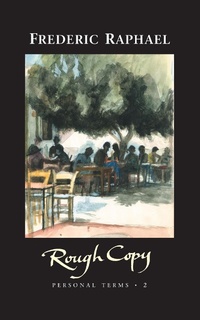
Rough Copy
Personal Terms II
Published on 14. June 2013
244 pages
978-1-84777-743-0 (ISBN)
Description

A Sunday Telegraph Book of the Year, 2004
'My notebooks are my conscience,' writes Frederic Raphael. 'They contain a writer's letters to himself.' This second volume of his notebooks covers the first three years of the 1970s: years of slump, treacheries and deceits in the film world, of literary achievement and private tragi-comedies - the storm that washes away weeks of hard work in the garden of the Raphaels' French farmhouse, the serious accident in which his father nearly dies, before being unexpectedly restored to alarmingly irascible life.
Raphael's sharp wit spares no one, not the sacred monsters of the movie business and the literary world, nor the incidental characters whose unguarded stories and personalities become the material for fiction. Least of all does he spare himself. Rough Copy is a self-portrait of a writer whose precision and honesty are both entertaining and searching.
'My notebooks are my conscience,' writes Frederic Raphael. 'They contain a writer's letters to himself.' This second volume of his notebooks covers the first three years of the 1970s: years of slump, treacheries and deceits in the film world, of literary achievement and private tragi-comedies - the storm that washes away weeks of hard work in the garden of the Raphaels' French farmhouse, the serious accident in which his father nearly dies, before being unexpectedly restored to alarmingly irascible life.
Raphael's sharp wit spares no one, not the sacred monsters of the movie business and the literary world, nor the incidental characters whose unguarded stories and personalities become the material for fiction. Least of all does he spare himself. Rough Copy is a self-portrait of a writer whose precision and honesty are both entertaining and searching.
Reviews / Votes
Reviewed in The Sunday TimesThis second volume of Raphael's cahiers takes us into the early 1970s, when their writer is busy straddling, sometimes awkwardly, the worlds of literature, where he acts with 'showbiz brazenness', and showbiz, where he performs the part of the 'intellectual parachutist'.His tendency towards aphorism makes for amusing reading, particularly when blended with querulousness ('England's unresponsiveness is like a boycott') or mournful self-pity ('I shall die on a day when the undertakers are in a hurry to get away').Along the way, Raphael also describes his father's car accident, a peculiar meeting with Nabokov and the trouble with Henry James. Reviewed by Richard Davenport-Hines in the Times Literary Supplement, 2nd July 2004
The first volume of Personal Terms was hailed as a minor masterpiece on its publication in 2001.It comprised extracts (covering the period 1950-69) from the notebooks that Frederic Raphael has kept throughout his career as novelist, dramatist and screenplay writer.Partly inspired by Somerset Maugham's Writer's Notebook (1949), they were handwritten in cahiers, of the kind used by lyceens, and have a very Gallic flavour.This second volume (covering 1970-73) evokes comparisons with Valery's "Analects" as well as Francois Mauriac's "Bloc-notes", although the more luscious passages (describing Paul Bocuses's restaurant near Lyons, for example, or the hotel Scholly in the Dordoge) recall Liane de Pougy's "Mes Cahiers bleus".
Rough Copy is an alluring mixture of hugely intelligent reflections, minutely observed reportage and mordant social comedy.Its mood is wise, cosmopolitan and privileged; its prose is rich, elegant and disciplined.Every page gives a sense of Raphael's privileges: he has brilliant personal gifts, congenial circumstances, opportunities for intimate meetings with great creative minds like Nabokov.The stories of provincial theatres, Soho power lunches and Hollywood producers which Raphael intersperses with domestic scenes and maxims about human vices makes him the Maupassant of the television age.
Raphael used his cahiers to test his analytical intelligence, his descriptive powers and the authenticity of his feelings.In them he evaluated people and (as becomes implacably clear in this volume) often found them wanting.Friendship seems increasingly to him a disappointing, even emetic business of unequal reciprocation, and a crass, time-consuming act of self-abnegation for the creative worker.Several of the most striking passages in Rough Copy detail unsatisfactory meetings with old friends, who no longer seem sincere, intelligent or companionable. "Queenie and Kenneth were once our closest, or at least most regular, friends", begins one set of notes charting the chill disillusion and paralysing distaste creeping through two old Cambridge friendships.A gruesome visit from another old Cambridge friend and his repulsive children is described with deadly humour and disdain.There is distinct unfriendliness (as well as icy wit) in many of Raphael's references to his friends, contemporaries and colleagues, including Arnold Wesker, Jonathan Miller and John Schlesinger.His increasing misanthropy includes the hapless providers of his family's main amenities: the references to his children's schoolteachers at Bedales seem particularly sour, ungrateful, impatient and ungentlemanly.
Occasionally Raphael is just too much of a cleverboots: he is too proud of his sharp retorts to minor idiocies, too pleased with his brilliant sallies.His shrewd account of inspecting a Georgian country house as a possible film location concludes with its owner, whose "martial vocabulary [is] robust camouflage for a spindly character", driving Raphael "at rallying speed along the greasy lanes" of the estate.His host "wastes no time in casual geniality; his smiles are rationed like the smokes of someone who is trying to give it up.If he could bring himself to sincerity, he would be as hard as nails".Sometimes, in Rough Copy, Raphael seems to ration his sympathies, and stint his friendships, in much the same way. Selected by the politician, journalist and author George Walden as his Book of the Year 2004 in the Sunday Telegraph
This second volume of extracts from his notebooks, described as letters to himself (Personal Terms was the first), covers the early Seventies, and contains the sharpest writing of the year.Subjects range from Wittgenstein to home life in France, by way of memoirs of actors, writers and publishers, some of them brilliantly skewered.After the Oscar for his film script of Darling, Raphael was warned that, having become too successful, he should not expect too much praise for his books.He has been duly punished, not just for his success, but for his intellect and wit.You cannot expect to write this well and get away with it. The Independent, Friday 28 May, 2004
Frederic Raphael's notebooks (this second selection covers 1970-73) reveal the 'chip of ice' that, according to Graham Greene, lurks in the heart of a writer. Driving to see his father in hospital, close to death after a car accident, Raphael notes how he was 'excited by the purpose with which I drove; purposeful but not pleased: in a thriller'. Later in the book, Raphael scrutinises himself even while reading: 'The legs shuffle and regroup like children in a museum. The tongue goes marching between the teeth.' The people Raphael encounters, as he shuttles between the literary and movie worlds, are forensically scrutinised. Sean Connery exhibits a 'shifty modesty... a weary slyness'. Peter Bogdanovich refers to himself 'in a tone of well-deserved awe: a name-dropper who drops his own name.' The critic JW Lambert wears 'his handsomeness like a suit that needed pressing: lustreless and baggy'. Raphael views fellow scribes with the traditional generosity of the writing trade. DH Lawrence 'wrote loud copy for a philosophy which had no roots'. Laurence Durrell 'mints fine phrases, but what use is the currency?' Spiky, acute and immodest, Raphael's notebooks offer stimulating entertainment. For an insight into the writer's mind, you'll find nothing better.
More details
Series
Language
English
Place of publication
Manchester
United Kingdom
Publishing group
Carcanet Press Ltd
File size
0,59 MB
ISBN-13
978-1-84777-743-0 (9781847777430)
Copyright in bibliographic data and cover images is held by Nielsen Book Services Limited or by the publishers or by their respective licensors: all rights reserved.
Schweitzer Classification
Other editions
Additional editions
Book
05/2004
Carcanet Press Ltd
€21.00
Article exhausted; check different version
Person
Frederic Raphael was born in Chicago in 1931 and educated at Charterhouse and St John's College, Cambridge. His novels include The Glittering Prizes (1976), A Double Life (1993), Coast to Coast (1998) and Fame and Fortune (2007); he has also written short stories and biographies of Somerset Maugham and Byron. Frederic Raphael is a leading screenwriter, whose work includes the Academy Award-winning Darling (1965), Two for the Road (1967), Far from the Madding Crowd (1967), and the screenplay for Stanley Kubrick's last film, Eyes Wide Shut (1999). The first volume of Personal Terms was published by Carcanet in 2001, with subsequent volumes in 2004, 2006, 2008, 2011 and 2013. The Times Literary Supplement said, 'Aphoristic, lapidary and sumptuously reflective by turns, Personal Terms is a joy to read both for Raphael's prose and mental powers. It is a work of iridescent intelligence, seductive charm, urbane temper and unflagging delight...'
Content
Introduction
1970
1971
1972
1973
Index
1970
1971
1972
1973
Index
