

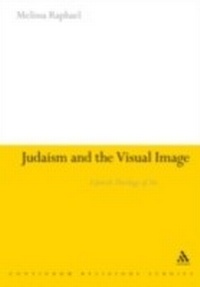
Judaism and the Visual Image
A Jewish Theology of Art
1st Edition
Published on 19. February 2009
256 pages
978-1-4411-9056-7 (ISBN)
Description

The widespread assumption that Jewish religious tradition is mediated through words, not pictures, has left Jewish art with no significant role to play in Jewish theology and ethics.
Judaism and the Visual Image argues for a Jewish theology of image that, among other things, helps us re-read the creation story in Genesis 1 and to question why images of Jewish women as religious subjects appear to be doubly suppressed by the Second Commandment, when images of observant male Jews have become legitimate, even iconic, representations of Jewish holiness. Raphael further suggests that 'devout beholding' of images of the Holocaust is a corrective to post-Holocaust theologies of divine absence from suffering that are infused by a sub-theological aesthetic of the sublime. Raphael concludes by proposing that the relationship between God and Israel composes itself into a unitary dance or moving image by which each generation participates in a processive revelation that is itself the ultimate work of Jewish art.
Judaism and the Visual Image argues for a Jewish theology of image that, among other things, helps us re-read the creation story in Genesis 1 and to question why images of Jewish women as religious subjects appear to be doubly suppressed by the Second Commandment, when images of observant male Jews have become legitimate, even iconic, representations of Jewish holiness. Raphael further suggests that 'devout beholding' of images of the Holocaust is a corrective to post-Holocaust theologies of divine absence from suffering that are infused by a sub-theological aesthetic of the sublime. Raphael concludes by proposing that the relationship between God and Israel composes itself into a unitary dance or moving image by which each generation participates in a processive revelation that is itself the ultimate work of Jewish art.
Reviews / Votes
"Judaism and the Visual Image is a timely and most welcome theological contribution to the burgeoning interest in Jewish art and aesthetics - as well as a much needed introduction of art and aesthetics into contemporary Jewish thought and philosophy. Moving from the book of Genesis through modern to postmodern Jewish thought and art, this work by Melissa Raphael pivots around embodied, gendered images of the Jewish people and of messianic dance that are at once aesthetically nuanced and ethically serious." - Zachary Braiterman, Associate Professor, Syracuse University, USA 'The escalating interest in Jewish art and aesthetics is disscussed in Raphael's book. The proffessor of Jewish theology at the University of Gloucestershire re-examines Genesis and the Creation, and aesthetics in contemporary Jewish thought and philosophy.' - Estelle Lovatt, Jewish Telegraph, 14/08/09. Raphael ends Judaism and the Visual Image by tantalizing readers with the possibility that a Jewish theology of art can ground a Jewish political theology, one that values the return to history as much as did Emil Fackenheim's work, yet is not necessarily attached to Zionism. May her next book come soon, and affordably. This book builds on Raphael's previous publications Theology and Embodiment and The Female Face of God in Auschwitz but does not have an explicitly feminist theological agenda. Instead, Raphael applies a gender-aware lens to develop a Jewish theory of aesthetics. * Religion and Gender *More details
Edition
1. Auflage
Language
English
Place of publication
New York
United States
Target group
Professional and scholarly
ISBN-13
978-1-4411-9056-7 (9781441190567)
Copyright in bibliographic data and cover images is held by Nielsen Book Services Limited or by the publishers or by their respective licensors: all rights reserved.
Schweitzer Classification
Other editions
Additional editions
Book
09/2019
Bloomsbury Academic
€62.15
Shipment within 15-20 days
Book
02/2009
Continuum International Publishing Group Ltd.
€198.50
Shipment within 15-20 days
Person
Melissa Raphael is Professor of Jewish Theology at the University of Gloucestershire, UK.
Content
Introduction
1. Approaches to Images in Jewish Art and Thought
2. Genesis 1 and the Creation of the Image
3. What does a Jewish Woman Look Like? Gender and Images of Jews in Art
4. Sublimity and Representation of the Holocaust in Art
5. Towards a Theology of the Holocaust Image
6. The Dancing Figure of Jewish History
Bibliography
Index
1. Approaches to Images in Jewish Art and Thought
2. Genesis 1 and the Creation of the Image
3. What does a Jewish Woman Look Like? Gender and Images of Jews in Art
4. Sublimity and Representation of the Holocaust in Art
5. Towards a Theology of the Holocaust Image
6. The Dancing Figure of Jewish History
Bibliography
Index
