

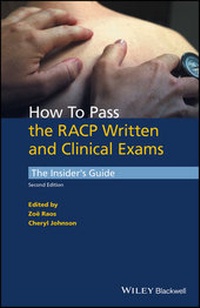
How to Pass the RACP Written and Clinical Exams
Description

More details
Other editions
Additional editions
Persons
Content
Preface xv
About the Authors xvii
Acknowledgements xix
Illustrations xxi
General Disclaimer xxiii
Section 1 The Written Exam 1
1 Introduction to the Written Exam 3
Why Does The RACP Have a Written Exam? 4
When is the Best Time to Sit? 5
How Long Does It Take to Prepare for the Written Exam? 5
Am I Ready to Sit This Exam? 5
Decision Made. Sitting the Written 6
2 Preparation 11
One Year Out - What to Do Before You Even Start Studying 11
3 How to Start Studying for the Written Exam 15
How to Manage Your Time 15
Dealing with Stress 20
Advice from Registrars on Studying and Keeping Sane(ish) 21
Evidence-Based Study - Break It Down! 24
Getting Down to Work - How to Start Studying 25
4 Topics That Need to Be Covered for the Written Exam 29
What is My Goal? Why Am I Putting Myself Through This? 29
How to Think Like An Examiner for the Written Exam 30
Organising Your Study Time - A Plan of Attack 30
The FRACP Curriculum 31
Topics to Cover 31
Money for Jam 32
Immunology - Special Mention 33
Visual Material in the Exam 34
5 Study Group 35
General Principles That Make Study Groups Effective 35
What Do You Do at Study Group? 36
6 Now We Know How to Study, What Stuff Do We Study From? 39
Wallpapering Your Mind 39
Comprehensive List of Resources for Wallpapering Your Mind 40
Lecture-Based Resources 40
MCQ-Based Resources 42
Textbooks and Online Resources 44
Other Useful Textbooks and Resources 46
Technological Advances to Help With Your Study 48
Journals: A Suggested Approach 49
Useful Websites 50
7 Old FRACP Exam Questions 53
Without Us, or You, Breaking the Rules, How Can the Modern Candidate Cope Without FRACP Past and Remembered Papers? 54
What is the Point of Doing Old FRACP and Course Questions? 54
8 Two-Week Revision Courses 57
Dunedin FRACP Written Examination Revision Course 58
FRACP Written Exam Prep Course - Melbourne 59
Royal Prince Alfred BPT Exam Revision Course - Sydney 59
Short Courses Worthy of Consideration 60
9 Putting It All Together - The Final Three Months 63
Practicalities of Getting to the Exam 63
What to Study 63
Keeping as Calm as Possible 64
Leading Up to the Big Day - The Weeks Before 64
The Day Before 65
On the Day - How to Get Through the Exam 66
10 After the Exam 69
What to Do If You Pass 69
What to Do If You Don't Pass 69
Section 2 The Clinical Exam 71
11 Introduction to the FRACP Clinical Exam 73
Why Is There a Clinical Exam? 75
Getting Your Timing Right: When to Sit the Clinical Exam 75
12 The Clinical Exam Marking Schedule 77
13 Two Weeks of Ground Work 85
Three Key Parts to Passing the Clinical Exam 86
How to Get Humble and Ask for Help 87
The Kit Bag 88
Book Reviews 92
Course Reviews 96
Personal Appearance - First Impressions Count 98
The 'Infection Control' Effect 104
14 How to Start - Doing Your First Practice Cases 105
Know Your Enemies 106
A Few Tricks of the Trade 106
Practising Cases - Who Can Help You the Most? 106
Who Can Help Me Pass This Exam? 107
Mock Exams: Well Worth the Humiliation 109
15 An Introduction to the Long Case 111
What is a Long Case Anyway? 111
Point to Prove in the Long Case 113
Aspects of a Long Case 113
Practising for Long Cases 116
How Many Long Cases Should You Do? 117
Practicalities of Practising 118
What to Do If There Aren't Enough Patients to See 119
Key Long Cases 119
Taking Orderly Notes for Your Long Case 121
Role of the Study Group for the Long Case 122
16 Mastering and Presenting your Long Case 125
A Suggested Style for Long Case Presentation 125
Organising Your Presentation 126
Verbal Signposts 127
Presenting a Case Well - Speech and Drama 101 127
Presentation Template That Worked for Us 128
The Grilling 138
The Aftermath 138
Sentences That Save Time and Sound Slick 139
17 Special Points for Paediatric Cases 141
Specific Points About the Paediatric Long Case 141
The Developmental Case 144
The Adolescent Long Case 149
18 Secret Long Case Species 153
The Chronic Disease Long Case 153
The Single Problem Long Case 154
The Diagnostic Dilemma Long Case 154
The Disaster Long Case 155
19 Top Long Case Tips from Candidates and Examiners 161
Long Case Advice from Candidates 161
Long Case Advice from Examiners 164
20 Suggested Approach to a Maori Patient in the Long Case 167
21 Long Case Examples 171
Long Case 1 - Multiple Medical Problem Management 171
Long Case 2 - Complicated Diabetes Case 178
Long Case 3 - Diagnostic Long Case 185
Long Case 4 - Adolescent Single Problem Long Case with Transition of Care 193
22 Past Exam Long Cases 203
23 An Introduction to the Short Case 217
Marking Schedule for the Short Case 217
Points to Prove in the Short Case 218
24 How to Put On a Show 223
Part 1: Examination Routine - How to Practise 223
Part 2: Presenting a Short Case 230
Part 3: The Short Case Discussion (Grilling) 233
25 Short Case Advice from Registrars 239
26 Past Exam Short Cases 243
27 Putting It All Together for the Clinical Exam - One Month Out 257
What is Your Presentation Style? 257
General Advice About Style 258
Personalities That Fail the Clinical Exam 259
28 The Lead-Up to the Exam 265
The Week Before 265
The Day Before 266
The Morning of the Exam - Staying Calm 266
Getting Through Exam Day - Tips From Registrars 267
Final Advice From Examiners 268
Section 3 The F-words - Freedom, Failure, Feedback, Family, Finding Patients and Fellowship 271
29 The Post-Exam World 273
Wow! I Passed! 273
Oh. I've Failed 274
The Official Feedback Session 274
30 How to Fail - The Outsider's Guide to the FRACP Exam 275
Chapter Author: Dr Roderick Ryan, General Physician, Box Hill 275
'I Failed the FRACP Exam - What Shall I Do?' 276
Tips for Coping with Failure in the Written Exam 277
Tips for Coping with Failure in the Clinical Exam 278
Seven Key Clinical Exam Skills that Must be Mastered by Those Who Have Failed 279 Snakes and Ladders 281
31 Paying It Forward - How to Provide Feedback for Practice Cases 283
The Feedback Loop 284
Feedback for Clinical Exams 284
32 Studying for the Exams with a Family on Board 291
Chapter Author: Dr Robert Wakuluk, Advanced Trainee, Auckland 291
33 Organising the Clinical Exam 295
First Principles 295
Organising the People and the Space 296
Case Selection Formula 297
Types of Cases You Need to Find 298
Where Are Cases Found? 299
Short Case Patients 301
Long Case Patients 301
Back-Up Patients 301
The Envelopes 302
'Mind-Map' and Other Spreadsheets 303
The Day Before 304
On the Day 304
What Examiners Tell the Patients 304
34 Preparing for Your Medical Interview 307
Chapter Author: Dr Nalin Wickramasuriya, Consultant Paediatrician 308
Trap Number 1 - Giving a Straight Answer to a Straight Question 309
The Three Goals of an Interview 309
Rapport 309
Trap Number 2 - The Short Case/Viva Complex 312
Trap Number 3 - Preparing for the Interview Like an Exam 312
Trap Number 4 - Talking Posh on the Day of the Interview 314
Trap Number 5 - Not Planning Your Response When the Interviewer Asks You a Question 315
35 Career Planning 317
I Passed. What Advanced Training Programme Should I Apply For? 317
Pearls of Wisdom 318
Career Path Planning 319
Get a Mentor 320
36 OK, We'll Stop Talking Now! 321
Helping the Next Lot 322
Index 323
1
Introduction to the Written Exam
Congratulations on embarking upon one of the most difficult but rewarding of career paths, that of internal medicine. Perhaps you see yourself as a budding neurologist or daydream about leading an adoring team on a fascinating general medical ward round. Maybe you will reach nirvana catheterising a left anterior descending artery. Maybe you enjoy working out a target weight for haemodialysis. Perhaps you've ruled out surgery (not crazy about detailing the boss's Audi), anaesthetics (big syringe, small syringe), radiology (too dark) and general practice (too general) and it comes down to internal medicine for adults or children. Internal medicine is not the career choice for everyone. The job of a long-suffering medical or paediatric registrar with the relentless on-call roster, permanent eye bags and a cynical outlook becomes even less attractive with exam stress. Please remember that you will be a consultant a lot longer than you will be a registrar. Your training will not last forever, so think of the career you want to have at the end of your training as well as the thorny and intense journey travelled to get there.
Historically, it has been rather straightforward getting a basic training post in medicine and paediatrics (a desperate phone call from the head of department the night before the job started worked for me). Times are changing. Before being eligible to even think about sitting the Written Exam, the trainee will need to have completed the requisite number of mini-CEXs and done some concerted navel gazing with the PREP programme. Paediatric trainees will have had a taste of exams with the Diploma. You may even have had (Shock! Horror!) an interview; if one is coming up then check out Chapter 35 for medical interview tips.
Upcoming changes
The FRACP Written and Clinical Examinations are held but once a year. It has been thus, despite conniptions, since the dawn of time. This book is written on the premise of an exam in February (for adult medicine); in fact, entire departments are aligned to this date like Stonehenge is to the solstice. There are plans afoot for a twice-yearly Written Exam. This is partially why old exam papers have been removed from the College circulation. We are not sure when this change will come, but there will be a transitional period between the old and new systems. Please keep your ear to the ground as this change may directly affect you.
Why Does The RACP Have a Written Exam?
The FRACP Written Exam is infamous for an enormous syllabus and intense focus on the minutest of details. The thought of this exam sends many prospective physicians packing to alternative careers. Another off-putting factor is that the examination, unlike many other specialties, is only held annually. High stakes. High stress. The preparation takes most candidates 8-12 months. Add study into the life of a busy medical or paediatric registrar and it is a miracle anyone sits at all.
While looking at old questions makes all newbie candidates clutch their heads in their hands, there is a method to the madness. The year of preparatory study lays the groundwork for advanced training, sharpens the mind, creates a robust knowledge base, increases confidence and improves performance at work.
The proportion of candidates passing the exam varies from year to year, and from region to region, but is generally above 50%. In the Auckland region, for example, the pass rate has risen from 50-70% a decade ago to over 80%. This means the majority of registrars, who commit to sacrificing almost a year of their life, put in the hard yards, work in a supportive hospital and revise properly, can hope to pass the Written Exam in their first attempt or, failing that, their second. Auckland paediatric trainees are even better off with a highly organised training programme, reflected in a 92% pass rate.
When is the Best Time to Sit?
Tricky. There is no perfect time in anyone's life. Candidates have sat (and passed) whilst heavily pregnant, newly postpartum, in the middle of house renovations, moving interstate and training for triathlons. Even so, it is crucial to weigh up the rest of your life goals before signing up.
A cautionary tale to those who have a burning desire to surge ahead and get that Written Exam over and done with as soon as possible. We have observed that candidates who allow for 1-2 years in addition to the minimum allowed by the College have an edge. These registrars handle work stress better, have more clinical experience to help with tricky and obscure Written Exam questions and perform to a higher standard for the Clinical Exam. Your registrar years will whizz by very quickly. Take another year now - no shame in it, might even do you some good. Also, once the exams are over, you want to be able to move straight into advanced training without having to spend another rotation doing more of the same work.
How Long Does It Take to Prepare for the Written Exam?
The exam is always in February for paeds and adult medicine. One year (i.e. starting in March the year before) is about enough time to get through the material. Some people start earlier, but find it difficult to keep up momentum. There are anecdotes of candidates who 'did no work until the November Sydney course' and passed, with tales of 'studying smart, not hard' - we don't believe them! The Law of Mass Effect states the harsh truth - the more time you put in, the more you learn. In Chapter 3 we will give some pointers to efficient and effective revision. This is a high-stakes, high-calibre examination. Give yourself plenty of time to prepare.
Am I Ready to Sit This Exam?
If you're not sure that you want to sit just yet, consider sitting in with an existing study group and see how you fit. Canvas opinion from local registrars who have passed (and failed) recently. Finally, if you're still in a quandary, it can be useful to ask your ward consultant or educational supervisor if he or she thinks you're ready. Once you have decided to sit then the best approach is to hurtle wholeheartedly into revision. The best strategy is to commit to sitting, work hard and pass the first time. Candidates with multiple half-hearted unsuccessful attempts are even more distraught than those poor souls who slog their guts out, have a bad exam day and fail. If you haven't made your mind up by July whether to sit the following year, leave it for another year as there may not be enough time. There is no shame in this decision and it will probably pay off, as that extra year will mean more experience (as long as the procrastination ends eventually!). Remember - better to sit once and sit well.
Decision Made. Sitting the Written
Congratulations! You are not put off! It is important to know what you're up for. Before we embark on the intricacies of how to pass, may we introduce you to the exam itself.
How Does the RACP Write the Exam and Come Up With All Those Questions?
Without giving away trade secrets, we will attempt to describe how the exam is set. Knowing how the exam is written helps you tackle it. There are four RACP exam committees.
- Adult Medicine Written Exam Committee
- Adult Medicine Clinical Exam Committee
- Paediatric and Child Health Written Exam Committee
- Paediatric and Child Health Clinical Exam Committee
The two Written Exam Committees do things slightly differently but the overall premise is the same. Both committees have representatives from every medical subspecialty known to the College/humanity. Each member of the committee formulates a number of questions that they think should be included in the exam. Other College fellows are able to submit questions also. The committees meet and all submitted questions are reviewed and agreed upon, revised or rejected. By September of the prior year, the exam is set in stone. So anything in a journal after the end of September is unlikely to be examined.
The brief of question writers is to come up with an MCQ that is set at the level of a trainee at the end of basic training. Not a subspecialist. Not even advanced trainee level. For example, you are not expected to know every single monoclonal antibody in existence, but it is fair game to be asked about the complications of TNF inhibitors.
For those who have sat the exam before, or who have already started studying, you may be quietly laughing (or perhaps crying) to yourselves at the thought of that last question you spent four hours trying to solve being allegedly set at basic trainee level.
Structure and Schedule
Here is the format of the exam. It is the same for paediatrics. It is worth noting that, especially in Paper 1, questions can be very similar if not identical across the adult medicine and paediatrics papers.
Morning
Paper 1 - Medical Sciences: 70 questions; time allowed: 2 hours
Lunch break (where no-one really eats that much)
Afternoon
Paper 2 - Clinical Applications: 100 questions; time allowed: 3 hours
Most questions are in A-type multiple-choice format, meaning the candidate chooses the single best answer of the five options given, and shades the...
