

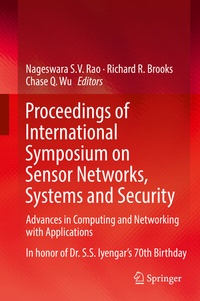
Proceedings of International Symposium on Sensor Networks, Systems and Security
Advances in Computing and Networking with Applications
1st Edition
Published on 23. May 2018
XVI, 309 pages
978-3-319-75683-7 (ISBN)
Description

This book presents current trends that are dominating technology and society, including privacy, high performance computing in the cloud, networking and IoT, and bioinformatics. By providing chapters detailing accessible descriptions of the research frontiers in each of these domains, the reader is provided with a unique understanding of what is currently feasible. Readers are also given a vision of what these technologies can be expected to produce in the near future. The topics are covered comprehensively by experts in respective areas. Each section includes an overview that puts the research topics in perspective and integrates the sections into an overview of how technology is evolving. The book represents the proceedings of the International Symposium on Sensor Networks, Systems and Security, August 31 - September 2, 2017, Lakeland Florida.
More details
Series
Language
English
Place of publication
Cham
Switzerland
Publishing group
Springer International Publishing
Product notice
Reflowable
Illustrations
XVI, 309 p. 103 illus., 84 illus. in color.
File size
9,26 MB
ISBN-13
978-3-319-75683-7 (9783319756837)
DOI
10.1007/978-3-319-75683-7
Schweitzer Classification
Other editions
Additional editions
Nageswara S.V. Rao | Richard R. Brooks | Chase Q. Wu
Proceedings of International Symposium on Sensor Networks, Systems and Security
Advances in Computing and Networking with Applications
Book
05/2018
Springer
€192.59
Shipment within 10-15 days
Persons
Nageswara S. V. Rao is a Corporate Fellow in Computational Science and Engineering Division, Oak Ridge National Laboratory, where he joined in 1993. He was on assignment at Missile Defense Agency as the Technical Director, C2BMC Knowledge Center during 2008-2010. He published more than 400 technical conference and journal papers in the areas of sensor networks, information fusion and high-performance networking. His research projects have been funded by multiple federal agencies including National Science Foundation, Department of Energy, Department of Defense, Domestic Nuclear Detection Office, and Defense Advanced Research Projects Agency. He is a Fellow of IEEE, and received 2005 IEEE Technical Achievement Award and 2014 R&D100 Award.
Dr. Richard R. Brooks got his BA from Johns Hopkins University in Mathematical Sciences and PhD in Computer Science from Louisiana State University. He was head of the Penn State ARL distributed systems department for 7 years and is now a professor of Computer Engineering at Clemson. Dr. Brooks' network security research projects have included funding from NSF (analyzing denial of service), DoE (authentication and authorization), BMW Corporation (penetration testing), NIST (standards definition), AFOSR (timing side-channels) and the US State Department (creating anonymous communications tools). He finds attacks that disable security measures by working at a different level of the protocol stack. His Internet freedom work involves interactions with at risk populations working for freedom of expression.
Chase Q. Wu is currently an Associate Professor in the Department of Computer Science and the Director of the Center for Big Data at New Jersey Institute of Technology (NJIT). He joined NJIT in fall 2015 from the University of Memphis, where he was an Associate Professor in the Department of Computer Science. His research interests include big data, high-performance networking,parallel and distributed computing, sensor networks, scientific visualization, and cyber security. His research in networking develops fast and reliable data transfer solutions to help users in a wide spectrum of scientific domains move big data over long distances for collaborative data analytics. His research in computing develops high-performance workflow solutions to manage the execution of and optimize the performance of large-scale scientific workflows in heterogeneous computing environments. Dr. Wu's work has been supported by various funding agencies, including the National Science Foundation, the U.S. Department of Energy, Department of Homeland Security, Office of Naval Research, and Oak Ridge National Laboratory, where he is a collaborative research staff and works on a number of high-performance networking projects and big-data computational science projects. He has published over 200 research articles in highly reputed conference proceedings, journals, and books, andwon best paper awards at many conferences.
Content
Introduction.- Part I: Privacy and game theory.- A Novel Perfect Privacy PIR scheme for Privacy Critical Applications.- Heterogeneous Sensor Privacy Protection with Stackelberg Privacy Games.- Intelligent Access Control: A Self-Adaptable Trust Based Access Control Framework (SATBAC) using Game Theory Strategy.- Public Key Cryptosystem for Privacy Sensitive Location Based Services.- Stochastic Tools for Network Intrusion Detection.- Part II: High performance computing and the cloud.- Accelerating the Big Data Analytics by GPU based Machine Learning: A Survey.- Multimedia Data Management for Disaster Situation Awareness.- On the Need of Security Standards in Big Data Information Flow.- Using Markov models and statistics to learn, extract, fuse, and detect patterns in raw data.- Dynamic Firewall Policy Management Framework for Private Cloud.- Security threats and solutions for virtualization and migration in virtual machines.- Techniques to certify integrity and proof of existence for a periodical re-encryption based long term archival systems.- Part III: Networking and the Internet of Things (IoT).- A Study of Contact Durations for Vehicle to Vehicle Communications.- Evolution of Sensors leading to Smart Objects and Security Issues in IoT.- Flexible Bandwidth Scheduling for Streaming Data Movement Over Dedicated Networks.- Internet of Things: Current Trends and Emerging Prospects.- Measurements and Analytics of Data Transport Over Dedicated Connections.- Trends and Future Directions of Research for Smart Grid IoT Sensor Networks.- SCADA: Analysis of Attacks on Communication Protocols.- Part IV: Bioinformatics.- TASB-AC: Term Annotated Sliding-window based Boosting Associative Classifier for DNA Repair Gene Categorization.- Temporal analysis of stress classification using QRS complex of ECG signals.- Conclusion.
