

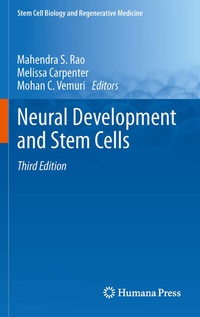
Neural Development and Stem Cells
Description

Reviews / Votes
More details
Other editions
Additional editions
Persons
Mahendra S. Rao, MD, Ph.D
Dr. Rao is internationally renowned for his research involving human embryonic stem cells (hESCs) and other somatic stem cells. He has worked in the stem cell field for more than 20 years, with stints in academia, government and regulatory affairs and industry. He received his M.D. from Bombay University in India and his Ph.D. in developmental neurobiology from the California Institute of Technology, Pasadena. Following postdoctoral training at Case Western Reserve University, Cleveland, he established his research laboratory in neural development at the University of Utah, Salt Lake City. He next joined the National Institute on Aging as chief of the Neurosciences Section, where he studied neural progenitor cells and continued to explore his longstanding interest in their clinical potential. He then spent six years as the vice president of Regenerative Medicine at Life Technologies, Carlsbad, Calif. Most recently, he returned in August 2011 tothe National Institutes of Health (NIH), as Director of the new NIH Center for Regenerative Medicine (NIH CRM). He co-founded Q Therapeutics, a neural stem cell company based in Salt Lake City. He also served internationally on advisory boards for companies involved in stem cell processing and therapy, on committees including the U.S. Food and Drug Administration's Cellular Tissue and Gene Therapies Advisory Committee chair, and as the California Institute of Regenerative Medicine and International Society for Stem Cell Research liaison to the International Society for Cellular Therapy.
Melissa Carpenter, Ph. D.
For the last 17 years, Dr. Carpenter has worked on the development of cell therapies using human adult and embryonic stem cells, in academia and industry, in the United States and Canada. She has been involved with human embryonic stem cell (hESC) research since the field was established. Her work involves discovery research and the translation ofthis research into therapeutics, including developing strategies for preclinical development and navigating the regulatory issues surrounding stem cell therapies. She has held leadership positions at 3 of the major stem cell companies: CytoTherapeutics, Inc (StemCells, Inc), Geron, Corp., and Novocell, Inc (Viacyte, Inc). Currently Dr. Carpenter is President of Carpenter Group Consulting and works with early stage companies, academic groups and investors to translate discovery based research into stem cell therapies. She is credited with numerous publications and patents in the stem cell field.
Mohan C. Vemuri, Ph.D.
Dr. Vemuri is currently the Director, Research and Development of Stem Cells and Regenerative Medicine at Life Technologies. He has been with the company since 2006 in different R&D leadership roles and instrumental in stem cell based product development for human pluripotent (embryonic and iPSC) and adult stem cells in cGMP regulatedconditions for research and cell therapy. Dr. Vemuri has served as faculty and staff at Children's Hospital of Philadelphia (University of Pennsylvania) and worked on enhancing hematopoietic stem cell engraftment and immune reconstitution utilizing gene engineering technology. Dr. Vemuri was also responsible for designing stem cell based assays and lead drug discovery effort for Parkinson's disease in GLP settings at Thomas Jefferson University. Dr. Vemuri is a recipient of National Institutes of Health Fogarty Fellowship award and best investigator award and a citation for deriving hESC from the Association of Reproductive Medicine for the year 2005. Dr. Vemuri has held scientific positions in University of Hyderabad, Thomas Jefferson University, and University College of Sciences in Philadelphia. Dr. Vemuri has authored over 50 publications in peer reviewed journals, and edited three books,1) Stem Cell Assays 2. Regulatory Networks in Stem Cells and 3. , MSC Assays and Applications , by Springer/Humana Press. Dr. Vemuri presently works and collaborates with different investigators towards the successful utilization of stem cells in regenerative cell therapies in a regulatory compliant environment.Content
Defining Neural Stem Cells and Their Role in Normal Development of the Nervous System.- Embryonic Stem Cells and Neurogenesis.- The Cellular and Molecular Properties of Multipotent Neural Stem Cells.- Multipotent Stem Cells in the Embryonic Nervous System.- Neural Crest Formation and Diversification.- Glial Nature of Adult Neural Stem Cells: Neurogenic Competence in Adult Astrocytes.- Neural Stem Cell Death Regulation in Nervous System Development and Disease.- Stem Cells of the Adult Olfactory Epithelium.- Retinal Stem Cells.- Transdifferentiation in the Nervous System.- Neural and Dopaminergic Differentiation of Human Pluripotent Stem Cells.- Mobilization of Neural stem cells in the Adult Central Nervous System.- Stem Cell Pathways in Brain Tumors.
