

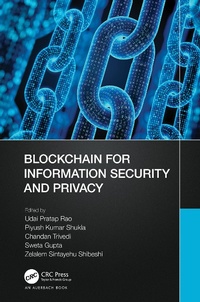
Blockchain for Information Security and Privacy
1st Edition
Published on 30. November 2021
440 pages
978-1-000-48309-3 (ISBN)
Description

Distributed and peer-to-peer (P2P) applications are increasing daily, and cyberattacks are constantly adopting new mechanisms to threaten the security and privacy of users in these Internet of Things (IoT) environments. Blockchain, a decentralized cryptographic-based technology, is a promising element for IoT security in manufacturing, finance, healthcare, supply chain, identity management, e-governance, defence, education, banking, and trading. Blockchain has the potential to secure IoT through repetition, changeless capacity, and encryption.
Blockchain for Information Security and Privacy provides essential knowledge of blockchain usage in the mainstream areas of security, trust, and privacy in decentralized domains. This book is a source of technical information regarding blockchain-oriented software and applications. It provides tools to researchers and developers in both computing and software engineering to develop solutions and automated systems that can promote security, trust, and privacy in cyberspace.
FEATURES
Applying blockchain-based secured data management in confidential cyberdefense applications
Securing online voting systems using blockchain
Safeguarding electronic healthcare record (EHR) management using blockchain
Impacting security and privacy in digital identity management
Using blockchain-based security and privacy for smart contracts
By providing an overview of blockchain technology application domains in IoT (e.g., vehicle web, power web, cloud internet, and edge computing), this book features side-by-side comparisons of modern methods toward secure and privacy-preserving blockchain technology. It also examines safety objectives, efficiency, limitations, computational complexity, and communication overhead of various applications using blockchain. This book also addresses the combination of blockchain and industrial IoT. It explores novel various-levels of information sharing systems.
Blockchain for Information Security and Privacy provides essential knowledge of blockchain usage in the mainstream areas of security, trust, and privacy in decentralized domains. This book is a source of technical information regarding blockchain-oriented software and applications. It provides tools to researchers and developers in both computing and software engineering to develop solutions and automated systems that can promote security, trust, and privacy in cyberspace.
FEATURES
Applying blockchain-based secured data management in confidential cyberdefense applications
Securing online voting systems using blockchain
Safeguarding electronic healthcare record (EHR) management using blockchain
Impacting security and privacy in digital identity management
Using blockchain-based security and privacy for smart contracts
By providing an overview of blockchain technology application domains in IoT (e.g., vehicle web, power web, cloud internet, and edge computing), this book features side-by-side comparisons of modern methods toward secure and privacy-preserving blockchain technology. It also examines safety objectives, efficiency, limitations, computational complexity, and communication overhead of various applications using blockchain. This book also addresses the combination of blockchain and industrial IoT. It explores novel various-levels of information sharing systems.
More details
Edition
1. Auflage
Language
English
Place of publication
London
United Kingdom
Publishing group
Taylor & Francis Ltd
Target group
College/higher education
Professional and scholarly
Illustrations
77 Line drawings, black and white; 77 Illustrations, black and white
ISBN-13
978-1-000-48309-3 (9781000483093)
Copyright in bibliographic data and cover images is held by Nielsen Book Services Limited or by the publishers or by their respective licensors: all rights reserved.
Schweitzer Classification
Other editions
Additional editions

Udai Pratap Rao | Piyush Kumar Shukla | Chandan Trivedi
Blockchain for Information Security and Privacy
Book
10/2024
1st Edition
Auerbach
€72.80
Shipment within 10-20 days
Udai Pratap Rao | Piyush Kumar Shukla | Chandan Trivedi
Blockchain for Information Security and Privacy
Book
12/2021
1st Edition
CRC Press
€157.10
Shipment within 15-20 days
Persons
Udai Pratap Rao received a Ph.D. degree in Computer Engineering from S.V. National Institute of Technology, Surat in 2014. He is currently associated with S.V. National Institute of Technology, Surat as an Assistant Professor in the Department of Computer Engineering. His research interests include information security and privacy, location-based privacy, data mining, Big Data analytics, and distributed computing, and methodologies that promote interdisciplinary education.
Piyush Kumar Shukla is an Associate Professor in the Department of Computer Science & Engineering in University Institute of Technology- Rajiv Gandhi Proudyogiki Vishwavidyalaya (Technological University of Madhya Pradesh), Bhopal, M.P., India. He has around 15 years of experience in teaching and research. He has completed Post Doctorate Fellowship (PDF), "Information Security Education and Awareness Project Phase II.
Chandan Trivedi is working as an Assistant Professor in Computer Science and Engineering Department. Prof Trivedi has more than 4 years of teaching experience. He received his B. Tech. degree in Computer Science Engineering from Rajasthan Technical University, Kota and M.Tech. in Computer Engineering from Sardar Vallabhbhai National Institute of Technology, Surat.
Sweta Gupta is working as an Assistant Professor in the department of Computer Science & Engineering of JLU-School of Engineering & Technology. She has an overall 10+ years of Academic as well as Industrial Experience.
Zelalem Sintayehu Shibeshi holds a PhD from Rhodes University (2016), a BSc in Physics (1989), Associate Degree in Computer Science (1999), and MSc in Information Science (2001), all from Addis Ababa University, Ethiopia.
Piyush Kumar Shukla is an Associate Professor in the Department of Computer Science & Engineering in University Institute of Technology- Rajiv Gandhi Proudyogiki Vishwavidyalaya (Technological University of Madhya Pradesh), Bhopal, M.P., India. He has around 15 years of experience in teaching and research. He has completed Post Doctorate Fellowship (PDF), "Information Security Education and Awareness Project Phase II.
Chandan Trivedi is working as an Assistant Professor in Computer Science and Engineering Department. Prof Trivedi has more than 4 years of teaching experience. He received his B. Tech. degree in Computer Science Engineering from Rajasthan Technical University, Kota and M.Tech. in Computer Engineering from Sardar Vallabhbhai National Institute of Technology, Surat.
Sweta Gupta is working as an Assistant Professor in the department of Computer Science & Engineering of JLU-School of Engineering & Technology. She has an overall 10+ years of Academic as well as Industrial Experience.
Zelalem Sintayehu Shibeshi holds a PhD from Rhodes University (2016), a BSc in Physics (1989), Associate Degree in Computer Science (1999), and MSc in Information Science (2001), all from Addis Ababa University, Ethiopia.
Content
1. Blockchain Impact in Education and Society 2. Apply and Analyse Several Blockchain Techniques in IoT and Big Data Sector 3. Blockchain: Trends, Role and Future Prospects 4. Cybersecurity and Privacy Issues of Blockchain Technology 5. Robust Digital Medical Image Watermarking and Encryption Algorithms Using Blockchain over DWT Edge Coefficient 6. Enhanced Privacy and Security of Voters' Identity in Interplanetary File System Based E-Voting Process 7. Blockchain-Enabled Secure Internet of Vehicles: A Solution Taxonomy, Architecture, and Future Directions 8. Blockchain-Based Federated Cloud Environment: Issues and Challenges 9. Blockchain-Based Secured Data Management in Confidential Cyber Defence Applications 10. Blockchain Technology for Privacy and Security Issues and Challenges in IoT-Based Systems 11. A Secure Online Voting System Using Blockchain 12. Secure Electronic Health Records (EHR) Management Using Blockchain 13. Blockchain Impact of Security and Privacy in Digital Identity Management 14. A New Ecosystem for Digital Identity Verification Using Blockchain 15. Blockchain-Based Security and Privacy for Smart Contracts 16. Blockchain Application in Digital Identity Management in Election 17. Leveraging Blockchain Technology for Decentralized Domain Name Broker Service 18. Using Blockchain for Digital Copyrights Management
